The healthcare network already had an AI pilot. That was the problem. Referrals and prior-authorization forms still arrived as faxes and scans; staff still typed patient and payer details into the electronic health record. According to Entrans’s account, the pilot could neither pass security review nor connect to that record. A machine could read. The organization could not use what it read.
- What you buy: engineering teams that connect AI, data, and existing software.
- Where it earns its keep: document intake, finance operations, customer service, and legacy modernization.
- The lesson to borrow: design the approval and exception queues alongside the automation.
Entrans’s intervention was conspicuously practical. Its engineers worked with clinical operations, security, and compliance inside the client’s cloud. They combined document extraction with payer rules, connected the output through healthcare interfaces, and retained staff approval. Historical documents were tested before a gradual rollout. The interesting change was in the route from document to decision.
That is a useful introduction to Entrans: an engineering company selling the work between an AI demonstration and an ordinary Tuesday.
01 / The invoice is the test
Consider a second client, an enterprise finance team. Invoices arrived as scans, PDFs, and structured records. Employees compared them with purchase orders and goods receipt notes. Three documents, several formats, plenty of opportunities for a price or quantity to disagree. The existing enterprise resource planning system had to stay.
Entrans says its embedded engineers added an extraction layer using AWS Bedrock, then automated the matching. Discrepancies went into a review queue. Staff could concentrate on exceptions rather than inspect every document. The company reports an 80% reduction in manual reconciliation effort and payment clearance twice as fast. Those are results from this particular company-published case, rather than a forecast for the next buyer.
less manual reconciliation effort
The design contains a sensible division of labor. Software reads and compares; people investigate the things that do not agree. For a buyer, the revealing question is how well the system identifies an exception and delivers it to someone who can act.
02 / A services business with product ambitions
Entrans offers product design and development, quality engineering, DevOps, cloud migration, data engineering, AI consulting, and managed operations. Enterprises and software companies can engage it for projects, embedded teams, resource augmentation, or ongoing support. A customer buying this work is buying implementation capacity and expertise, with the commercial arrangement shaped around the engagement.
Its public-facing customer logos include JSW, Ciklum, Spice World, Cars24, and Kofax. Its case library ranges further: banks, healthcare organizations, education platforms, commerce businesses, even a garlic supplier wrestling with AS400, spreadsheets, CSV files, and RPG. Entrans describes moving that supplier toward an Azure-based data platform. A surprisingly earthy example of the infrastructure beneath a digital business.
The product ambition has a name: Thunai. Entrans’s March 2025 account of SaaS Connect says Jegan Selvaraj and Aditya Santhanam discussed its launch alongside their masterclass. Entrans describes Thunai as an agentic orchestration platform it built; Thunai now markets an enterprise AI customer experience platform. A reusable product gives the services story another dimension: the company also builds software of its own.
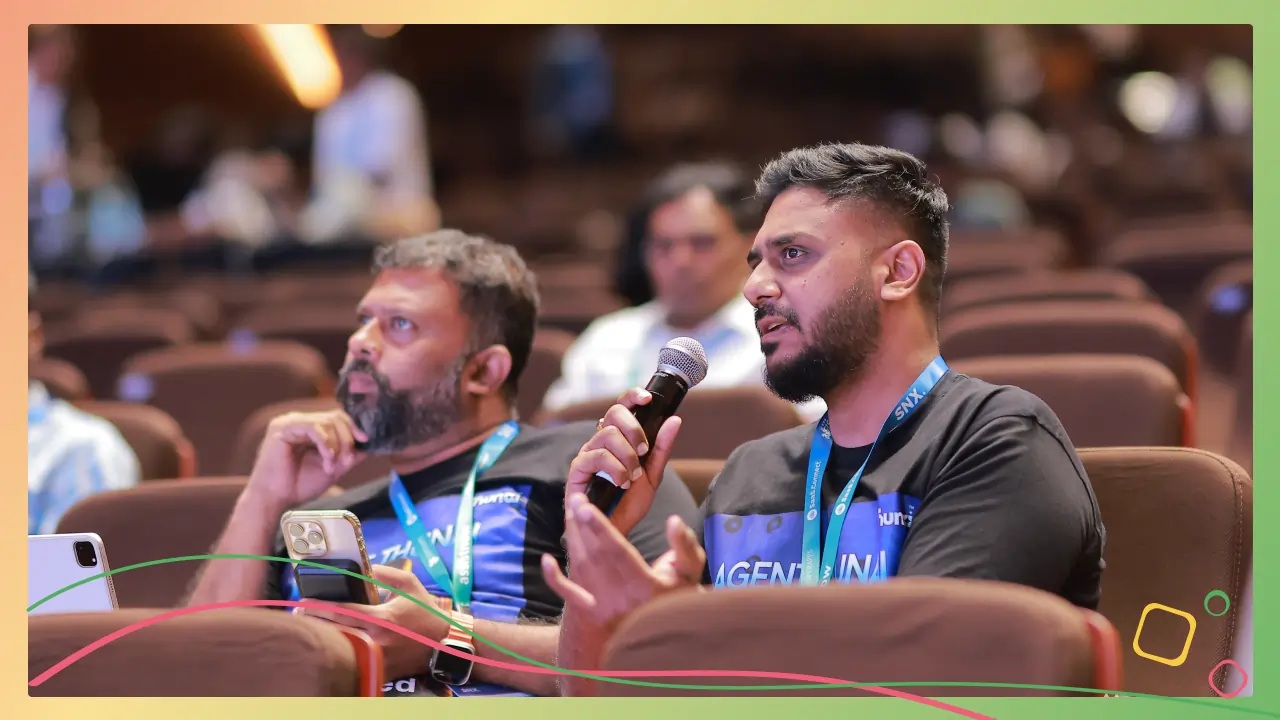
Selvaraj is listed as founder and CEO; Santhanam as founder and chief technology and product officer. The leadership page also names founders responsible for marketing, operations, finance, and a co-founder serving as vice president. Entrans describes a hands-on culture and delivery across the United States, Britain, UAE, and India. Its model combines local alignment with distributed engineering capacity.
03 / The chatbot needs the order book
Another published case concerns a retail brand whose earlier bots could handle scripted questions but lacked live order, returns, and availability data. Product, order, and customer information sat in separate systems. A pleasant conversation could still end with the shopper waiting for a person.
Entrans says its team studied actual conversations, APIs, and data flows before building agents inside the client’s cloud and repositories. The assistant connected to the catalog, order management, and customer relationship systems. It could check an order and start a return request. More complicated cases transferred to a service agent with the conversation attached.
- 01Customer asksProduct, order, or return
- 02Agent connectsCatalog + orders + CRM
- 03Resolve or hand overPolicy checks + context
The rollout began with one workflow, expanding as usage and answer quality supported it. That sequence is worth copying: choose a bounded task, connect the necessary systems, observe real use, then widen the scope. It also explains Entrans’s market position. Its pitch brings product engineering and integration into the same engagement, rather than treating an AI assistant as a self-contained purchase.
04 / Budget for the connections
A practical buying exercise starts with the operational problem. Count the documents being retyped, the systems an employee must open, the cases that need judgment. Then define what success means. Faster clearance and less manual matching are clearer targets than a general instruction to become an AI company.
The budget should reflect that scope: engineering time, integrations, cloud operations, validation, and continuing support. Entrans’s cloud offer includes readiness assessments, total-cost modeling, governance, and spend optimization. Those services belong in the conversation because deployment creates an operating responsibility, not merely a launch date.
“the best technology is invisible”
Entrans’s stated philosophy
For buyers comparing Entrans with an internal team or another engineering consultancy, the useful distinction is delivery responsibility: who connects the systems, validates outputs, handles exceptions, and maintains the result? The approach requires usable access to data, an owner for the workflow, and people willing to approve difficult cases. Without those conditions, another integration project can stall.
The healthcare case supplies the final buying question. Can the people responsible for security, compliance, and daily work actually use the system? Entrans’s most persuasive examples answer that question through the design of the workflow. An approved document reaches the health record. A disputed invoice reaches a reviewer. A shopper’s conversation reaches someone who can help.