Forty-eight hours is a peculiar amount of time to spend checking whether information has arrived intact. Yet that was the manual validation burden described in an OptiSol Business Solutions migration project for a US employee-absence and scheduling organization. Before anyone could celebrate the new system, somebody had to establish that the old system’s records still meant the same thing.
- OptiSol builds software and moves existing systems onto newer foundations.
- Its iBEAM tools tackle specific jobs, including Oracle reports, databases, and application code.
- The buyer’s real test: does the replacement preserve the business rules?
OptiSol says its automation brought that validation step down to 30 minutes. The interesting question is how. The team used schema mapping, transformation scripts, source-to-target comparisons, and discrepancy reports. This is enterprise technology at its least photogenic: field names, data types, conditional rules. It is also where a supposedly simple upgrade can become an expensive misunderstanding.
The check that took two days
The scheduling customer faced inconsistent legacy structures and several environments: staging, mirror staging, and production. A record had to survive transformations across that chain. OptiSol’s account describes five specialized automation tools, including a validator that applies business mapping logic and flags differences. The delay was concentrated in checking the work, so checking became part of the machinery.
Validation time in OptiSol’s scheduling-data case study.
Company-reported result for one engagement. Bars use the same time scale.
That distinction matters. Writing a script quickly is useful; repeatedly knowing whether it produced the right answer is useful in a different way. A failed comparison can stop a bad migration before it becomes a live operational problem. The published case’s timing belongs to that engagement, but the method is portable: define the rules, run the comparisons, and make exceptions visible.
A toolbox with very specific verbs
OptiSol occupies the territory between a software development shop and a specialist modernization provider. Its iBEAM platform brings reusable accelerators into engineering engagements. JCT converts Oracle Reports to JasperReports. O2PIMS addresses Oracle-to-PostgreSQL migration. FormLift targets Oracle Forms. IntDoc generates documentation from legacy code. Each name points to a bounded, recognizable task a technology manager might already have on a troublesome spreadsheet.
The company’s modernization process begins with reverse engineering: finding application flows, dependencies, and business logic. Planning, development, validation, and deployment follow, with human oversight. The sequence suggests a sensible selling point. Reusing a migration tool can reduce repeated work, while engineers handle the peculiarities that made the customer’s system difficult in the first place.
Two adjacent offerings widen the picture. Scanflow uses computer vision for asset identification, visual inspection, and industrial safety, including reading tire markings and serial codes. elsai focuses on governed agentic enterprise workflows. These address different budgets and users, but share an operational concern: converting information into something a business can reliably act upon.
The people still matter
There is a substantial services organization behind the tools. OptiSol describes more than 450 specialists and a presence in India, the United States, Britain, Australia, and the UAE. Its work extends from custom web and mobile applications to cloud engineering and analytics. Customers it names include DHL, Republic Services, and Henkel, alongside smaller organizations commissioning an initial product.
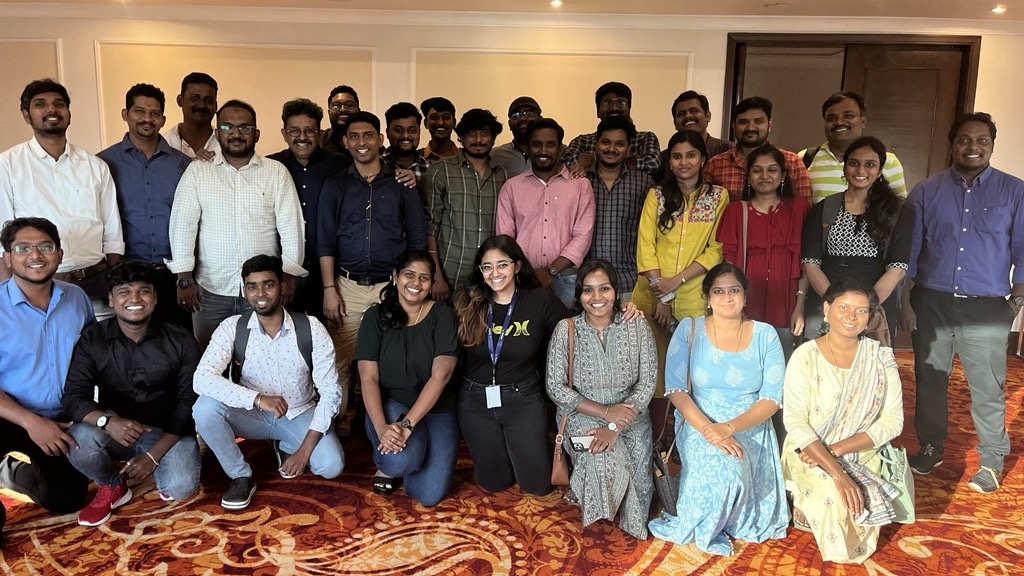
The current leadership page identifies five co-founders, including CEO Karthik Murugian and CTO Karthic Chandran. Its stated values include empathy, empowerment, excitement, and experiment. Great Place to Work lists the Indian company as certified. Those statements acquire more texture in its culture newsletter, which describes the KraftX design team’s work on Lowry Solutions’ asset-management software, from workflow research to a shared design system.
For a buyer, that detail is revealing. Enterprise applications have people at both ends: those explaining how work really happens and those expected to use the replacement. A scalable backend cannot compensate for an approval screen nobody understands. The design work belongs in the same conversation as the migration scripts.
The price of getting it done
Supportal Health offers a smaller, more legible example of buying the service. In an August 2023 verified Clutch review, co-founder Kevin Andrew described an MVP engagement in which OptiSol took over existing code and worked from supplied designs and specifications. The review places the project between $10,000 and $49,999, running from May through August.
“They seemed to work like a well-oiled machine.”Kevin Andrew, Supportal Health · Clutch, 2023
That bracket is a historical project cost, rather than a menu price. OptiSol separately offers monthly engineering capacity, hourly time and materials, and build-operate-transfer arrangements. The latter lets a customer build an offshore capability, have it operated, and eventually take ownership. The commercial choice depends on whether the buyer needs an application delivered, a persistent team, or an organization of its own.
Start with the awkward bit
Its data-foundation offering makes this approach explicit. Discovery, ingestion, modeling, platform selection, and governance remain connected. The promised handover includes contracts, tests, lineage views, and runbooks that a customer’s own platform owners can use. For a company inheriting several databases through acquisitions, those artifacts matter: a future engineer needs to trace where a number came from, understand who owns it, and change a pipeline without accidentally changing its meaning. OptiSol also proposes bounded pilots before wider funding. That gives a buyer a way to inspect the working relationship as well as the technology, before committing the rest of the system.
OptiSol competes for work that can also go to internal developers, specialist migration consultancies, or broader software engineering firms. Its pitch combines reusable tools with delivery teams. That proposition deserves a concrete trial: one report, one data domain, one workflow, with a baseline and an agreed acceptance test.
It also deserves scrutiny. Clutch’s review synthesis includes requests for stronger quality assurance and fewer bugs. Automation does not remove the need to specify correctness. Ambiguous business rules, inaccessible data, or missing domain expertise can undermine a fast conversion. The lesson from the scheduling project is refreshingly practical: find the step consuming two days, understand why, and prove that the shorter version still does the job.