The cleanest way to understand Ilsong Lee’s career is to begin with two kinds of mess. The first lives inside semiconductor fabrication, where gas, plasma, heat, and microscopic tolerances must cooperate without theatrics. The second lives inside research data, where records arrive in incompatible formats, columns refuse to agree, and one apparently simple question can spend days trapped in extraction and cleaning. Lee has built businesses on both sides of that divide. The industries changed. The operator’s problem survived.
Today, Lee is CEO and co-founder of Cipherome, a San Jose company whose COMPASS platform organizes the repetitive work surrounding clinical and genomic analysis. Before that, his public record runs through KLA-Tencor, Integrated Materials, Ferrotec, Synos Technology, and Veeco Instruments. It is a career made from hard tools: first the machines behind electronic manufacturing, later the software around biomedical research.
That crossing can look abrupt on a résumé. Look closer and it resembles a continuation. A machine can be scientifically impressive and commercially useless if it asks too much of the person operating it. So can software. Lee’s recurring assignment has been to stand between technical possibility and ordinary use, then shorten the distance.
The craft beneath the job titles
Lee’s early public career sits squarely in the semiconductor world. He spent roughly a dozen years at KLA-Tencor, with public professional profiles describing a progression to senior director of marketing. KLA sells the inspection and process-control equipment that helps chipmakers find errors before microscopic imperfections become costly ones. Even the marketing department must speak several dialects at once: engineering, yield, manufacturing economics, and customer urgency.
From there, Lee moved through Integrated Materials, which made high-purity silicon structures used in semiconductor processing. He led sales and marketing before Ferrotec acquired the company in 2010, then served as a senior vice president and general manager at Ferrotec. The pattern is useful. He was learning not just how a technical product works, but how it travels: from a specialized team, through an acquisition, into a larger operating system.
Synos Technology raised the stakes. Lee served as president and CEO. A 2012 securities filing names him as both an executive officer and director, and his name appears on patent applications involving a scanning injector assembly and a plasma reactor. The details are gloriously specific - jointed arms, gas paths, substrate shielding. They also complicate the familiar picture of an executive who lives safely above the machinery. Lee’s name is there in the machinery.
Complexity becomes a business only after someone makes it usable.The recurring logic in Lee’s operating career
Veeco agreed to acquire Synos in 2013, and Lee became a senior vice president and general manager there. The transaction closed one chapter: a small technical company found a home inside a public equipment maker. Two years later, he was building in a category where the inputs were less visible and the consequences more human.
A startup built across an ocean
Cipherome began in 2015 around biomedical informatics work associated with Professor Juhan Kim of Seoul National University. Lee joined as CEO and co-founder, giving the business a curious and practical shape. Its scientific roots were in Korea. Its corporate center was in Silicon Valley. Its target market included researchers, hospitals, biobanks, and life-sciences organizations whose work rarely respects national borders.
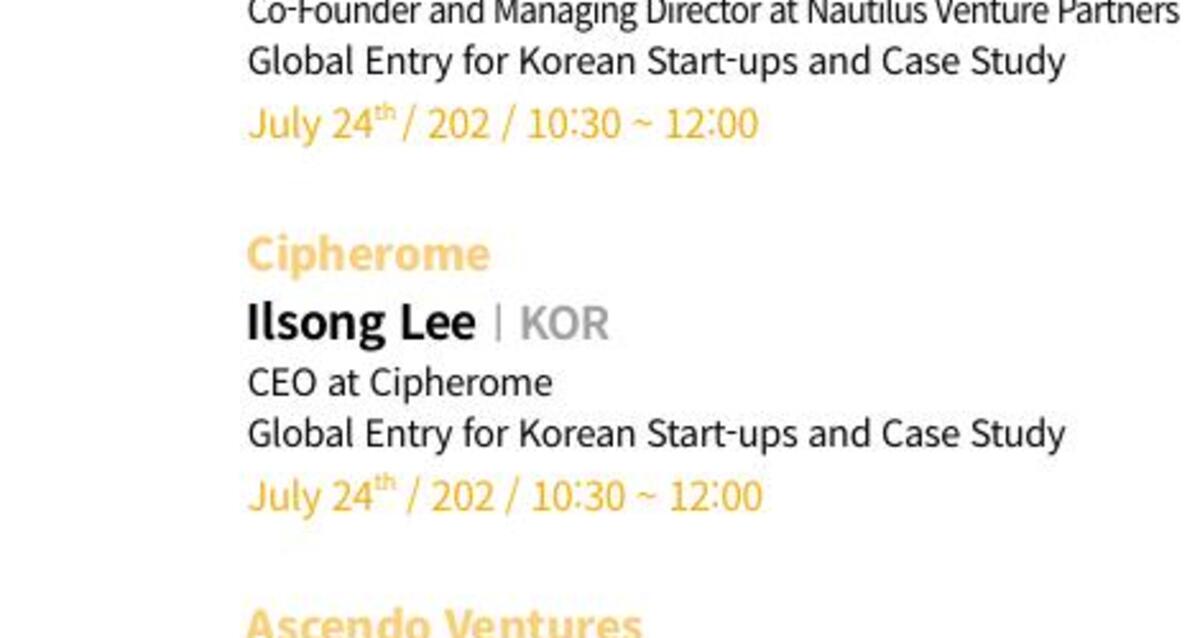
Lee made that bridge visible at NextRise in Seoul in July 2019. The conference program placed him in an investor session with Nautilus Venture Partners, speaking on “Global Entry for Korean Start-ups and Case Study.” It was the sort of title that can disappear into a conference schedule. In context, it reads like a compact description of his job: move knowledge, companies, and trust across markets.
The company initially concentrated on pharmacogenomics, the study of how genetic variation can affect medication response. It launched clinical studies in 2019 and worked with institutions in the United States, Korea, and Europe. A project with DHR Health in South Texas began enrolling participants in late 2020 to study genetic differences related to the metabolism of a commonly prescribed antiplatelet drug. That work put Cipherome close to the friction it later chose to productize.
The product hiding in the workaround
Large research datasets are impressive from a distance. Up close, they behave like an estate sale held in several languages. Useful things are everywhere, but the labels differ and no one agrees which drawer they belong in. Cipherome describes its own experience with biobank data in prosaic terms: extraction, cleaning, organization, and the management of intricate criteria consumed more time than expected.
The team built internal workflows to cope. The tool was once called PGxAI. In 2021, Cipherome released its first public version, and the system evolved into COMPASS. This origin matters because internal tools begin with an unforgiving customer: the person sitting beside you who must use the thing tomorrow morning.
COMPASS now presents that sequence through a graphical interface: transform data, query cohorts, extract records, explore patterns, run statistical tests, and train machine-learning models. Cipherome says it has integrated the UK Biobank and the MIMIC-IV database in a common data model. The platform can also be deployed on premises, an important operating choice for organizations that cannot casually send sensitive research data elsewhere.
No-code is an awkward phrase because serious research never becomes free of judgment. A button cannot decide whether a cohort makes scientific sense. It can, however, save an expert from rewriting a familiar join, repairing the same dependency, or rebuilding a pipeline for the fifth time. The useful promise is narrower and better: reserve human attention for the work that deserves it.
The operator’s contribution
Cipherome’s scientific bench includes specialists in biomedical informatics, pharmacogenomics, medicine, and engineering. Lee’s distinct contribution is legible in the commercial arc. He has spent his working life around products whose buyers must trust what they cannot easily inspect. Semiconductor tools operate at scales the eye cannot see. Genomic analytics operates across data whose meaning depends on careful context. Both ask the seller to be precise about capability and modest about certainty.
In 2022, Cipherome closed a Series B round reported at $16.29 million. By 2023, the company’s own timeline marked COMPASS commercialization. Its recent public activity has widened beyond the original pharmacogenomics focus: clinical research, genomic association studies, education, predictive modeling, and secure collaboration now sit inside the platform’s frame. A 2025 Luxembourg initiative also identified COMPASS as part of a privacy-preserving environment for clinical and molecular analysis.
There is restraint in the shape of this career. Lee does not maintain a sprawling public persona, and the record offers little in the way of founder folklore. The evidence is institutional: job titles, acquisitions, patents, a conference program, company milestones. It describes someone through the systems he has helped move rather than the stories he tells about himself.
That scarcity is oddly fitting. Operators are often most visible in the absence of drama: the machine runs, the acquisition closes, the workflow repeats, the customer reaches the useful part sooner. Their best work removes the obstacle that would otherwise demand attention, time, and another meeting.
A second act with the same plot
The fashionable version of a career pivot celebrates the leap. Lee’s story is more instructive for what it carries across. He brought forward the habits of an industry built on process discipline, difficult sales, and the industrialization of expert knowledge. Cipherome applies those habits to data work that still contains too many artisanal chores.
The company’s ambition is easy to phrase and difficult to execute: researchers bring the study design; the platform handles more of the mechanical path to analysis. If it works, the achievement will not be that software had an idea. It will be that a person with an idea reached the evidence with fewer preventable detours.
Lee once helped commercialize equipment that made invisible processes controllable. Now he is trying to do something similar for the unruly middle of research. The materials are different. The patience required is familiar. And in both worlds, progress begins when complexity stops showing off and starts doing its job.