The alluring phrase in Ilana Matro's announcement that she had joined Cursor was not “AI,” “scaling,” or even the name of one of software's most closely watched young companies. It was four quieter words: “no established playbook.” Most people like a playbook. It turns judgment into a checklist and uncertainty into a meeting with numbered slides. Matro has arranged her career around the moments before that comfort arrives, when the forecast no longer describes the business, the departments speak adjacent dialects, and somebody must decide what the new nouns mean.
In July 2026, she moved onto Cursor's Sales Strategy & Operations team. She described the attraction as a rare chance to build an operating backbone around a product that builders genuinely love. The problems were hard. The expectations were high. The company was moving quickly. Her enthusiasm read less like the usual new-job confetti and more like a person recognizing her preferred weather.
The move followed six years at MongoDB, where Matro worked across marketing, sales, and customer success. That breadth is the point. A revenue organization may be drawn as boxes connected by tidy arrows; customers experience the seams. Matro's work kept taking her to those seams: from customer strategy and planning to sales strategy, then sales transformation, and eventually chief-of-staff work for the chief marketing officer. She became fluent in the passage between an executive idea and Tuesday morning's behavior.
A communications graduate in the machinery room
Matro did not arrive through the standard caricature of operations, clutching a finance degree and a beloved spreadsheet. She studied communication at the University of Maryland College Park from 2009 to 2013. Her early background also touched media and political consulting. Politics, after all, is an education in constituencies, incentives, disputed definitions, and the delicate art of moving a group that did not ask to be moved. These skills travel rather well.
After university, she joined AIG as a senior business operations analyst, working with the Global Claims and Operations Technology group from 2013 into 2016. Then came QBE North America, where she became a sales operations lead and worked on strategic initiatives for distribution. Insurance supplied scale, complexity, and a healthy suspicion of hand-waving. By May 2020, she had moved to MongoDB.
What followed was less a climb up one ladder than a tour of the building. Matro's MongoDB roles put her near the systems and processes of selling, then near customer strategy, transformation, and the CMO's office. A colleague, Daniel Barrett, later wrote that she had led the systems, process, and policy components of a move toward a workload-centered business. He praised her ownership, appetite for detail, and high standards, and noted a Partner of the Year award. The recommendation is unusually useful because it names the work rather than merely applauding the worker.
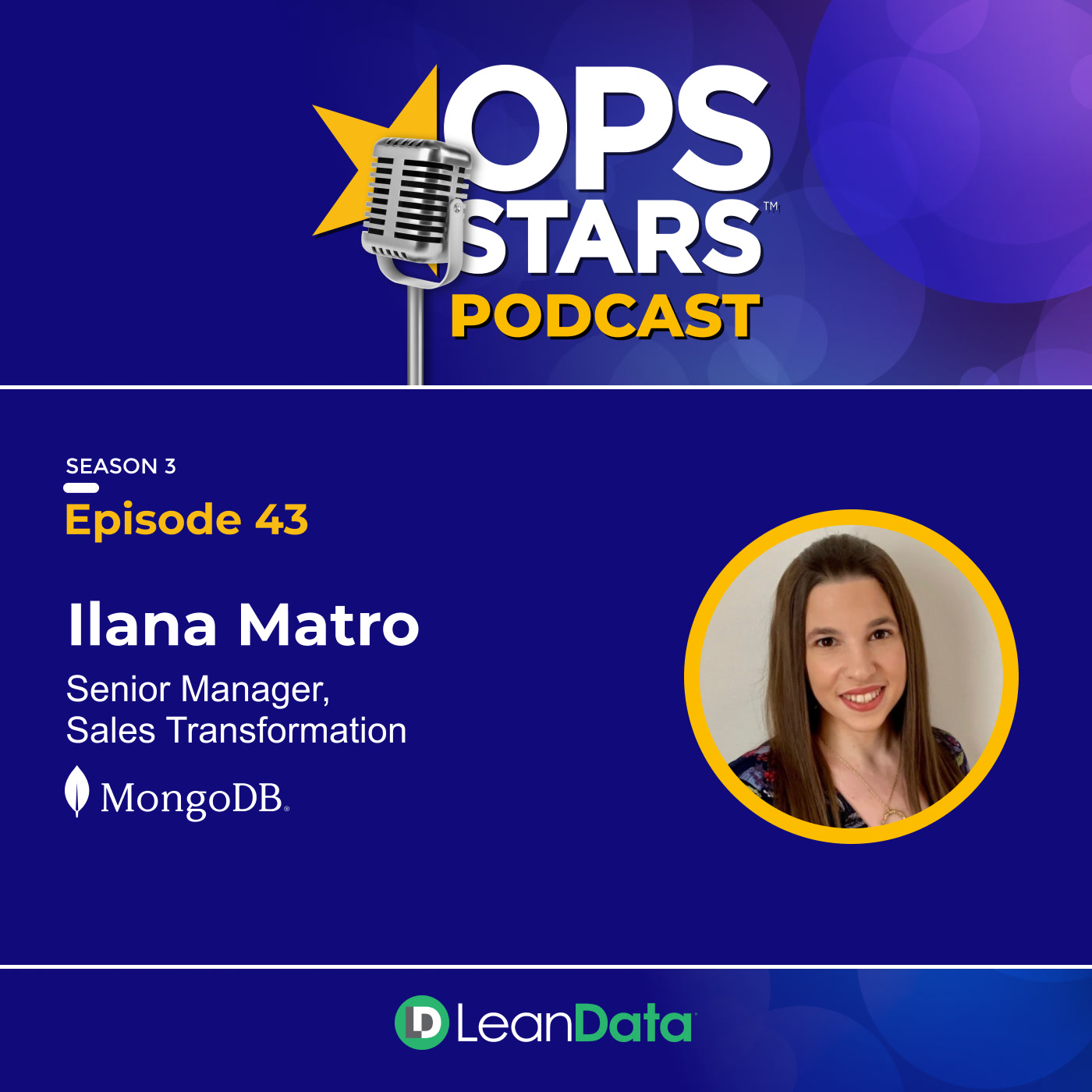
“The difference makers in revenue operations are strategists at heart. We are the internal face of Go to market.”Ilana Matro, OpsStars podcast
When the price changes, the company changes
In a 2024 podcast conversation, Matro unpacked MongoDB's shift from a license-based commercial model toward consumption. The deceptively simple difference is the unit. Selling a seat gives the operator a familiar object to count. Consumption asks how customers will actually use a product over time. The forecast stops being a census and starts behaving more like a weather model.
That change travels. Forecasting needs different signals. Salespeople need to understand customer workloads rather than merely secure a commitment. Customer success moves closer to the economic center because adoption and usage now shape revenue. The handoff between seller and customer-success manager cannot be a ceremonial passing of the folder. It becomes part of the growth model. Hiring profiles change. The technology stack must capture what the business now cares about. A pricing decision quietly rearranges the furniture in every room.
The bars above are a map of reach, not a claim of measured impact. They show why transformation work resists being filed under a single function. Each consequence belongs to a different team; the outcome belongs to all of them. Matro's description of revenue operations as the internal face of go-to-market makes sense here. The operator must represent the logic of the new model inside the company, repeatedly, until process and behavior agree.
There is a comic precision in the term “workload.” Inside a database company it can sound perfectly concrete. Around a conference table it can become a small philosophical crisis. When Matro left MongoDB, a colleague affectionately revived the recurring question, “What is a workload though?” The joke catches the difficulty of transformation: a business can build an entire model around a word before everyone shares its definition.
The apprenticeship inside the six-year run
Matro's farewell to MongoDB named four people who had shaped her: Meghan Gill, Daniel Barrett, Hang Zhang, and May Petry. She thanked them for taking bets on her, pulling her into difficult problems, and offering honest feedback. There is a revealing sequence there. Opportunity came first, difficulty second, candor third. Comfort does not appear.
Her public tribute to Petry, written while Petry was being recognized on a B2B marketing list, was even more specific. Matro admired clarity of thought, bias to action, and a refusal to hedge. Petry led with the point and expected her team to do likewise. Matro ended with a concise theory of mentorship: the best mentors change how you think.
Lead with the point. Go into the detail. Take ownership across the seam. Seek honest feedback. Treat a difficult assignment as a vote of confidence.
These are portable standards. A chief of staff learns the executive cadence: what deserves attention, what needs a decision, what can survive another week. A transformation lead learns organizational physics: where resistance gathers, which incentives are real, and how quickly a slogan wilts without a system beneath it. Sales operations teaches the discipline of numbers. Customer strategy keeps the numbers attached to human behavior. Matro carried all four perspectives into a company whose clock is set by AI.
An operator meets the agentic workplace
Three weeks after adopting Grok Bot at Cursor, Matro posted that it had changed both her workflow and how she approached problems. She called it her AI “aha moment,” singling out the feeling that the product had been designed for a knowledge worker rather than treating one as an afterthought. It was, she added, the first time she could remember publicly declaring herself so bullish on a piece of technology.
That reaction matters less as a product endorsement than as a clue to how Matro evaluates tools. An operator is interested in the distance between a demonstration and a habit. Clever software earns its keep when it fits into work, changes the approach to a problem, and returns something useful. The same practical instinct runs through her account of consumption pricing. A model is meaningful only when forecasts, roles, handoffs, and systems begin to behave differently.
Cursor presents a fresh version of her old problem. The product is used by builders. The market is moving with indecent speed. The operating backbone must support growth without calcifying it. Too little structure and the company pays a chaos tax. Too much, too early, and the structure becomes ceremonial luggage. Sales Strategy & Operations sits exactly on that tension.
“The problems are hard, the expectations are high, and there is no established playbook.”Ilana Matro, announcing her move to Cursor
There is no public grand theory under Matro's name, and perhaps that suits the craft. Her body of work is closer to a set of operating verbs: translate, align, forecast, hand off, earn, change. The glamour arrives later, usually in somebody else's slide about growth. The operator's reward is a business that makes more sense on Friday than it did on Monday.
Her career also offers a useful correction to the mythology of the lone strategic genius. The record is crowded with colleagues, mentors, customers, sellers, marketers, and customer-success managers. Credibility is earned among them. Transformation is negotiated through them. Even her move to Cursor came with thanks to Amy Q Lin for the connection and to Jonathan Krangel, Adam Stanco, and Lawrence Wang for the invitation. Networks do not replace ability; they are where ability becomes visible.
So the through-line from an insurance operations desk to Cursor is not a database, a job title, or a fashionable acronym. It is a taste for the unresolved middle. Matro goes where a strategy must become a forecast, where a customer promise must become a handoff, and where a fast company must decide which habits deserve to become infrastructure. The playbook is still blank. For her, that seems to be the welcome sign.