In June 2018, Tim Furey announced a new chief analytics officer at MarketBridge with a confession. After years of running a company and sitting on a public company board, he was still discovering the extent of his own ignorance. “I learn every day how little I know.” It was an unusual way to introduce a senior hire. Most corporate announcements arrive wearing a freshly pressed suit of certainty.
Furey was welcoming Andy Hasselwander to the role. The problem he wanted solved was the growing distance between executives making decisions and employees who understood the data underneath them. A chief executive could approve the budget without understanding the machinery. Someone had to connect the two. His admission gave that appointment a purpose more useful than another title on a business card.
That moment offers a way into Furey’s career. The founder and former CEO of the original MarketBridge business has spent decades examining the awkward space between a company’s intentions and a customer’s behavior. The interesting things happen there: a sales channel stops working, a product goes unbought, a buyer takes an unexpected route. A tidy strategy meets a person with other plans.
The route was part of the product
Furey’s professional foundations were in economics and consulting. He earned an economics degree, cum laude, at Harvard University and an MBA at Harvard Business School. His earlier employers included Boston Consulting Group, Strategic Planning Associates, Kaiser Associates and the Marketing Science Institute. The work placed him among organizations that made a business of studying other businesses.
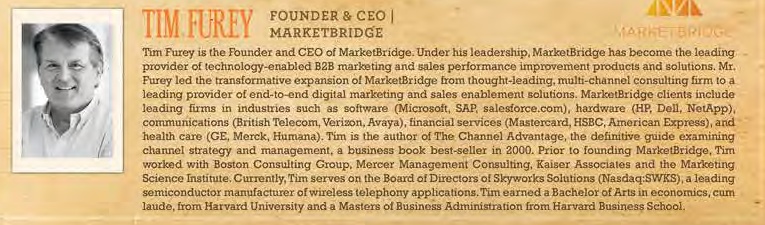
By the end of the 1990s, he was chairman, CEO and co-founder of Bethesda-based Oxford Associates, established in 1991. Its specialties included sales strategy and integrating electronic commerce with other ways of selling. In 1999, he and Lawrence Friedman published The Channel Advantage. The book examined the mix of direct salespeople, distributors, partners, telephone selling and the internet.
The practical question was how those routes should work together. An organization might have an excellent product and still make it expensive, inconvenient or confusing to buy. Adding a website did not automatically settle what the sales force should do next. Selling had become an exercise in coordination, with rather more moving parts than a purchase button suggested.
A consulting idea acquires machinery
At MarketBridge, Furey’s work expanded into digital marketing, sales enablement and customer analytics. By 2016, the company’s client roster included Microsoft, SAP, Salesforce, HP, Dell, British Telecom, Mastercard and American Express. Those names cover different markets, but share an operational complication: reaching a customer often requires several people, systems and intermediaries to cooperate.
The expansion had a geographical expression, too. In July 2014, MarketBridge announced a New York office for its retail and consumer finance work. Furey said that client base had doubled since 2012. His explanation emphasized the proximity of retail brands, creative talent and payment partners. The office followed the work of connecting online activity with purchases and relationships in physical stores.
It was a revealing choice of emphasis. Digital commerce could sound wonderfully weightless in a presentation. Here it had a city, an office and neighboring businesses. Furey’s account of the opportunity involved the practical company that a firm could keep, as well as the technology it could deploy.
What should the salesperson do on Monday?
In September 2017, MarketBridge expanded three cloud-based offerings. BuyingSignals collected and analyzed customer and market information. PlayCaller helped turn information into actions, including identifying prospective buyers, matching products and choosing relevant messages. DigitalAccess organized material that marketers, salespeople and partners could use with a prospect.
Taken together, the products addressed an ordinary workplace difficulty. Knowing something about a market is useful; getting that knowledge to the person handling a customer is another job. A report can be accurate and still spend its working life unopened. These offerings attempted to carry information further into the everyday choices of marketing and sales teams.
There was precedent for that concern. In 2008, Furey had urged financial services firms to reconsider how they acquired and retained customers. Discussing digital marketing, he pointed to customers influencing other customers and the value of advocates within an existing customer base. The sale had social surroundings. A company could buy attention without controlling what people said afterward.
The product worked. The customers hesitated.
In 2019, Furey hosted The Last Mile Podcast, giving colleagues and other executives room to explain how business problems actually unfolded. One guest was Hasselwander. Their episode concerned a product expected to sell strongly that was struggling with both adoption and repeat business. It performed its intended function. That made the disappointing results more puzzling.
Hasselwander’s investigation involved observing users and prospective users at 60 companies, split into two groups of 30. Researchers watched people work and asked them to attempt purchases or renewals. They found obstacles in ordering, difficulties finding the right website, and an overlooked role for IT managers in buying decisions.
They also found something a process diagram might miss. Automation had removed interactions that office managers had enjoyed. A change designed to make work easier had altered its social texture. The episode’s interest lies in those competing realities: the product could function properly while the buying experience and workplace response undermined it. Furey let the explanation become a detective story, with the clues in everyday behavior.
Before the last mile, do the arithmetic
Another guest, Mark Pilipczuk, then vice president of marketing analytics and operations at Pandora, brought the conversation back to the beginning. Who was the audience? What was the objective? How much could the business afford to spend acquiring a customer? These were the first-mile questions that could determine the outcome of all the activity afterward.
Pilipczuk distinguished the economics of a single transaction from the economics of a continuing customer relationship. A business expecting repeat revenue has different acquisition options from one expecting a solitary purchase. That difference should shape the campaign before the campaign acquires a budget, a calendar and a roomful of opinions.
In his own account of the interview, Pilipczuk described conversations with product and marketing leaders who struggled to answer such opening questions. His concern was practical: understanding costs and objectives before running a test. Furey’s podcast gave that unglamorous preparation airtime. It also put a useful complication into the title. Sometimes the difficulty in the last mile has been waiting at the starting line all along.
The golf-club test for software promises
Furey could make his skepticism more playful. Writing about digital sales transformation in October 2019, he compared productivity promises from software vendors with promises from golf equipment makers. Successive generations of drivers supposedly add distance. The golfer, somehow, remains familiar with the same patch of fairway.
The joke supported a detailed argument about work. His framework covered buying behavior, sales resources, coverage and compensation, workflow automation, and data. A new tool entered an existing arrangement of jobs and incentives. If those arrangements made little sense, purchasing additional licenses offered an expensive way to preserve the confusion.
He also emphasized the expertise buyers expected from salespeople who finally secured their attention. Customers could arrive having researched products and consulted other people already. The representative needed to contribute something beyond the information available before the meeting. Across his writing, the buyer kept acquiring alternatives. The company’s response required thought about roles, skills and judgment as well as software.
“Channels don’t choose customers; customers choose channels.”
Tim Furey, recalling his advisory practice in 2026
The view from the boardroom, and the building
Furey’s career also included a long board association with semiconductor company Skyworks Solutions. Its corporate biography recorded his directorship beginning in 1998 and described his experience with enterprise clients as relevant to understanding business operations and growth. He had spent time looking at companies from both the operator’s chair and the director’s seat.
By 2021, his work had extended into commercial buildings. Skyworks described him as CEO of Integrated Smart Solutions, a role he had held since 2020, alongside chairmanship of MarketBridge and a managing partner role at Decision Technology Group. Integrated Smart Solutions worked with cloud-based building data, analytics and energy management for commercial property investors and managers.
That move took him into a different setting for a familiar practical question: what can an organization do with the information its operations produce? A building and a sales organization have different jobs. Both can generate data that needs to reach somebody able to act on it. The connection is an interpretation of his career, but a useful one.
- 1999The Channel AdvantageHow companies combine routes to market
- 2018The analytics appointmentHow information reaches decision-makers
- 2019The Last MileHow customers actually experience buying
- 2026AI discoverabilityHow companies appear in buyer research
The buyer finds another entrance
In 2026, Furey returned explicitly to the subject of his book. In a public post, he recalled his advisory practice’s emphasis on customers choosing their own channels. He connected that idea to buyers using AI systems to research suppliers and compare options before speaking to a vendor.
His essay The One AI Mandate Every C-Suite Leader Must Enforce, published by No Fluff in July 2026, argued that executives should ensure AI systems can accurately identify and explain their companies. He treated discoverability as a leadership concern spanning several departments. The aim was appropriate inclusion when buyers asked for options, with a clear account of what the business did and whom it served.
There is continuity in that concern, rather than a claim that every new channel behaves alike. The internet, specialist sales teams and AI recommendations present different problems. Furey’s recurring interest is where the customer goes, and what a company has to understand when the route changes. His 2018 admission remains useful here. A business can spend years learning how to sell. The customer retains the pleasure of making the next lesson necessary.