Davis Potter wanted some people to talk to. He was building account-based marketing at Scale AI and looking for peers who understood the job. A professional community appeared to offer the right company. Then came the quote: five figures, even with a discount. It was a considerable cover charge for the privilege of asking a colleague a question.
He could not see himself taking that request to his boss while still making the case for the program’s own budget. The experience helped shape a decision at ForgeX, the research and advisory firm he co-founded in 2023: access to its practitioner community would be free. The company could charge for professional services without putting every useful conversation behind an invoice.
A conversation with a cover charge
That origin gives Potter’s business a practical starting point. He had been the person responsible for making an account-based program work inside a company. He wanted somewhere to compare notes, test an idea and hear how another team had handled a similar problem. A sales presentation would have been an unfortunate substitute.
ForgeX’s community has rules to protect that purpose. Applications are reviewed. Pitching is prohibited under a zero-strike policy. In a public account of its growth, Potter put membership at more than 1,000 people and reiterated that access would remain free. The welcome is broad enough to encourage discussion and selective enough to keep the room useful.
“There is NO reason to gatekeep access to your peers.”
Davis Potter
The tension is interesting for a marketer whose work concerns choosing audiences. His own community also depends on deciding who belongs in the room and what they came to do. Free admission still requires care. Otherwise, the people seeking advice become an audience for people selling it.
Before the frameworks, the wrong webinar
Potter grew up in New Hampshire and studied marketing at the University of New Hampshire. His working life took him into account-based marketing at Pegasystems, Google Cloud and Scale AI. Those employers gave him experience across established software businesses and a company constructing its program with a different set of constraints.
There was also a much less flattering lesson. Early in his career at Pegasystems, he owned a webinar project for the financial-services ABM team. Preparation included a thought leader, a recording session, subject experts and an effort from sales to bring in registrations. When the audience arrived, the wrong prerecorded webinar played.
He later estimated the investment at roughly $30,000 to $40,000 and described believing that his career might end there. It did not. The anecdote has the virtue of being recognizably work: a plan can survive every meeting and still fail at the moment someone presses play. Years later, he was willing to tell the story in public.
It also offers a useful counterweight to the diagrams that now accompany his work. Before a marketer develops a framework for an industry, there is the smaller obligation to get the correct file in front of the correct audience. The practical end of the business has a way of keeping everyone acquainted with humility.
Learning to begin small
At Scale AI, Potter’s early approach concentrated on individual strategic accounts. Existing customers held meaningful potential for expansion, so the program began by considering their business priorities and where Scale’s use cases could matter. The relevant unit could be a particular business division, with its own people, needs and decisions.
That choice required close work between functions. Marketing could research an account and build material for it, but sales and other teams had to help turn the understanding into a relationship. The work involved paying attention to interactions over time. An account could not be understood merely by inserting its name into a campaign.
In his startup advice, Potter described a three-stage launch: pilot, standardize and scale. A central collection of templates, lessons and ways of working could help a small team avoid repeatedly solving the same problem. He also urged practitioners to change direction when an account or tactic stopped making sense.
- 01PilotTest the approach.
- 02StandardizeMake learning reusable.
- 03ScaleExpand the program.
“Do not be afraid to pivot and switch accounts,” he advised. The sequence makes that permission useful. A pilot is allowed to teach the team something that changes the plan; standardization captures the lesson before expansion multiplies the workload. Even in a growth business, a little patience can save a great deal of repetition.
The account list has a budget attached
Account-based marketing, or ABM, focuses a company’s effort on selected business customers. The apparently simple idea opens several difficult questions. Which customers? How much effort? What can the team realistically deliver? Potter’s work at ForgeX concerns the connection between those choices and the organization expected to carry them out.
In a 2024 industry discussion, he distinguished Enterprise ABM from Growth ABM. Enterprise approaches allow close attention to individual accounts or small clusters. Growth approaches organize wider coverage into tiers, with different resources and tactics assigned to each. The categories help practitioners describe the work they have the capacity to perform.
The distinction brings a useful discipline to an attractive promise. A company may want hundreds of customers to receive highly individual attention, but a practitioner’s working week has limits. Segmentation becomes meaningful when the team can explain how its treatment of one tier differs from another. A spreadsheet with three colors is only the beginning.
Potter’s broader discussion of account portfolios connects those choices across revenue teams. The aim is a shared view of where the company intends to invest. That makes an account list a management decision with consequences for people, time and money. It also gives colleagues something concrete to argue about before the campaign starts.
A logo cannot attend the meeting
Potter’s September 2025 Revenue Xchange session on buying groups moved inside the account. A business contains units; those units contain groups involved in purchases; those groups contain individual people. Different decisions can be happening under the same corporate name. The organizational map matters when the team tries to interpret engagement.
His emphasis was practical: identify the people, associate them with the relevant opportunity and share responsibility for maintaining that information. Marketing can surface engaged contacts. Sales can add stakeholders discovered in conversations. The result depends on colleagues keeping the record useful as their knowledge changes.
Potter’s teaching follows the decision down to the individuals involved. This is a relationship map, not a performance chart.
It is easy to understand the appeal of a single account score. It is harder to ask whether the people who matter to this particular purchase are participating. Potter’s teaching keeps bringing the discussion back to that smaller, more demanding question. A recognizable company name supplies a label; the people inside supply the decision.
The practitioner becomes the teacher
At ForgeX, Potter has taken on the work of making these ideas teachable. Demandbase’s certification program incorporates ForgeX research into courses on account-based GTM, measurement and reporting, and AI in ABM. The material moves from a research firm into a curriculum that working practitioners can use to structure their own programs.
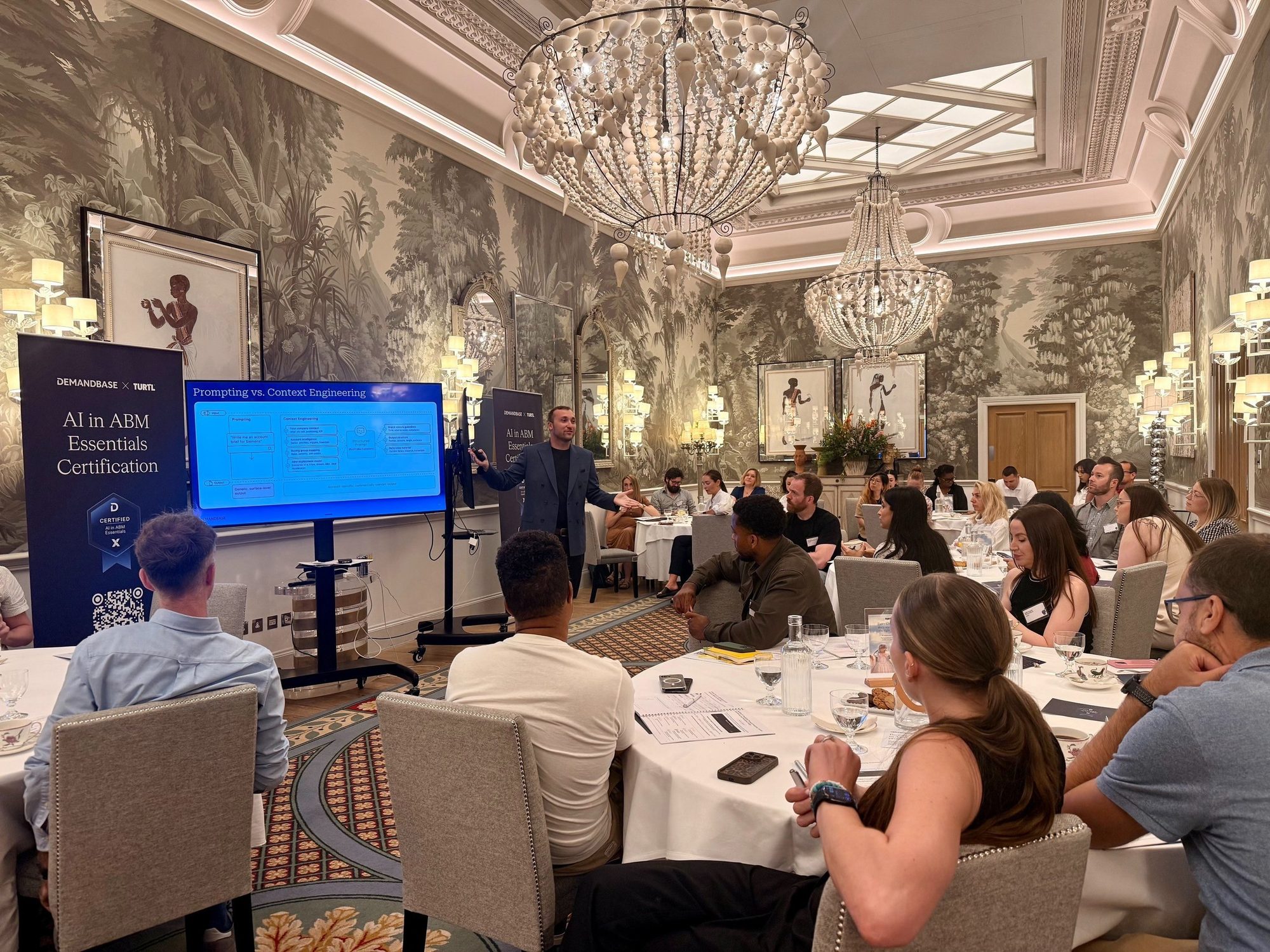
Teaching also brings him into conversation with people who have to apply the material. In London, he has delivered AI in ABM certification instruction alongside Demandbase’s Stephanie McArthur. Attendees bring their own data problems, operating constraints and questions. A framework earns its usefulness when someone can connect it to the work waiting at their desk.
His podcast, Revenue Xchange, extends that exchange through guest conversations and interactive sessions. The format gives him room to explain a model and hear where it becomes difficult. Alongside the classroom and community, it makes conversation part of how his professional work travels.
One theme is the relationship between marketing disciplines. Speaking about account-based strategy, he has emphasized product marketing’s understanding of the customer. In practice, that asks people to contribute different kinds of knowledge to the same plan. Research can inform the choice; colleagues still have to work together to carry it out.
Fewer tabs, harder questions
By August 2026, Potter’s writing was examining another change in the practitioner’s working day: marketing platforms becoming accessible through external AI environments. His essay on software going “headless” considered a future in which teams coordinate more tasks from tools such as Claude, using connections to the systems that hold their data and execution capabilities.
He presented that direction as a forecast. The appeal is straightforward: less movement between applications, more coordination from a common working environment. Yet it also makes the earlier questions in his career more consequential. Faster execution gives a team more reason to be clear about the customers, people and outcomes it wants to pursue.
ForgeX’s 2026 AI in ABM Benchmark Report lists Potter among its contributors, with Eric Wittlake as author. His role now spans the collection of evidence, the explanation of ideas and the work of helping practitioners apply them. The transition from operating programs to running an advisory firm has enlarged the audience for the same practical concerns.
There is a pleasing continuity between that work and the conversation he once wanted at Scale AI. He needed access to people who knew the job. Today, he helps run the room. The question that began with an unwelcome membership quote remains a useful one for the business he is building: what would make this exchange worth someone’s time?