The first fence was supposed to be the last. When Rachel Truair entered the ring at the 2022 Pin Oak Charity Horse Show, she was an adult amateur riding a horse quite capable of doing the course without much assistance. Her bargain with herself was modest: clear fence one, then leave. The jump felt good. She kept going.
The moment contains a compact version of Truair's life. She has repeatedly reached an edge, discovered new information on the other side, and continued. The route runs from an Austin stable to PetRelocation, from night classes to an MBA, through Magento's acquisition and Confluent's public listing, and now to Demandbase. Straight lines are handsome on résumés. They are less common in nature.
Before the boardroom, the barn
Truair met horses at five during a local summer camp. She fell off and cried. The instructor told her that nobody counted as a real horseman until they had fallen ten times. Young Rachel considered the logic, found it sound and climbed back on. She later called herself a “wimpy kid,” but the difficulty appealed to her. Weekly lessons at Switch Willo Stables became the organizing fact of adolescence.
Once she had a driver's license, she drove to the barn and offered labor for more saddle time. She expected to paint jumps. Instead, she became a working student. She nannied for a client's young daughter, worked alongside professional Kelly Lorek and graduated from high school early. College could wait; the barn could not. At 20, Truair was running Madrone Ranch Stables, a 40-stall community operation outside Austin, while living in a small apartment beneath the hay barn.
It was the dream completed with suspicious efficiency. It was also lonely. Her friends were away at college, and achievement did not feel as triumphant from underneath the hay. Truair eventually accepted that a goal can be honestly won and still be wrong for the winner. An executive career coach asked her to look beyond the one world she knew and apply for the first job that sounded interesting.
A startup with fur in the supply chain
The interesting job belonged to PetRelocation, then a young Austin company that moved animals across borders. Truair described it as wedding planning for traveling pets: paperwork, safe flights, customs and the final journey home, all coordinated for clients whose anxiety was understandable and whose passengers could not explain what had gone wrong.
She joined early - Marketing Week calls her employee number two - and stayed for nine years. Her responsibilities moved through public relations, digital work, operations, marketing and chief-of-staff territory. The small company taught a lesson that survived every later expansion of budget and headcount. A charming photograph of a puppy is pleasant; it is not a content strategy. Owners needed clear answers to frighteningly specific questions.
“We really had to get beneath the surface of what our potential customers' questions and needs might be,” she later said. PetRelocation turned the practical knowledge already moving through sales calls, customer emails and internal manuals into helpful public content. Marketing automation supplied reach. The stories of reunions supplied emotion. One without the other was a machine humming in an empty room.
The course, as ridden
Learning after hours
Truair began college in her twenties and completed her bachelor's degree in organizational communication at St. Edward's University while working. Then came the University of Texas at Austin's McCombs School of Business, where she earned an MBA between 2014 and 2016 and met her future husband, another student who had taken a circuitous route to higher education.
She encountered organizations before studying them formally. Operations was an animal waiting at customs; customer empathy was a worried family on the phone. Business school added models to pressures she had already felt. In 2014, she and two teammates reached the top 15 of the National University of Singapore's Cerebration business case competition with a five-year proposal for Daimler Financial Services.
At the same time, she occupied another consequential Austin room. In 2013, Truair served on the city's inaugural Independent Citizens Redistricting Commission, the citizen body charged with drawing Austin's first ten City Council districts. She worked on its marketing plan and website. The final map was adopted 14-0. It is an easily missed line in a technology résumé, and perhaps the one that most plainly reveals her appetite for complicated systems with human consequences.
The category-change years
After PetRelocation came a quick passage through 3M and then Oracle. In 2017 Truair joined Magento, where commerce software sat at the center of an expanding argument about how businesses would sell online. Adobe acquired Magento for $1.68 billion in 2018. Truair moved into a global role at Adobe, directing enterprise campaigns across content and commerce and managing a portfolio budget tied to a $250 million revenue target across three products.
At Confluent she entered another category still teaching the market its own vocabulary: data in motion. She led revenue marketing, then campaigns, digital and partner marketing, as the company traveled toward its 2021 IPO. Her next roles placed the full marketing brief on her desk - first at ecommerce company Cart.com in 2022, then at field-service software business Simpro in 2023.
Across those companies, the products changed more often than the task. Translate something technically complex into a business reason to care. Align brand, demand and sales around the same outcome. Measure without worshipping the measurement. In an interview while at Cart.com, Truair argued that attribution without action is meaningless. A model can be exquisitely current and still useless if the executive team does not understand it or the company does not change its choices.
Read the water, do not fight it
For all the software in her working life, Truair's most persuasive marketing metaphor comes from fly fishing. An angler notices where trout are feeding, studies which insects are hatching and lands the right imitation at the right moment. The cast improves through rhythm and feel, not force. “It's not about strength,” she has said. “It's not about muscling it into something.”
Her version of the lesson is refreshingly unsentimental. Go where success is probable. Know that the audience is really there. Test and iterate inside those waters. The marketer is not the hero of this picture; the marketer is the person paying sufficient attention. Customers do not gather around a channel merely because a campaign calendar says they should.
The metaphor restores craft to a profession fond of shortcuts. Casting looks effortless only after repetition. At Simpro, Truair connected global marketing to predictable revenue for a company serving the trades. Her public emphasis remained on the less glamorous verbs: align, test, learn, act.
The old dream, revised
Horses returned first through a screen. Truair watched equitation finals and hunter derbies, then made equestrian TikToks. “Big Eq starter pack” and “What your saddle says about you” traveled widely. The B2B executive had rediscovered the old community by being fluent in its particulars and willing to have fun.
In 2021 she bought an investment horse called Diaronimo. Then came Winchester, an imported horse at an Arabian barn in Georgia who was looking for a second career of his own. At the trial, onlookers kept calling him Larry. Truair learned that this was not his name; they simply thought he looked like a Larry. She agreed. The horse went to Texas with the new name.
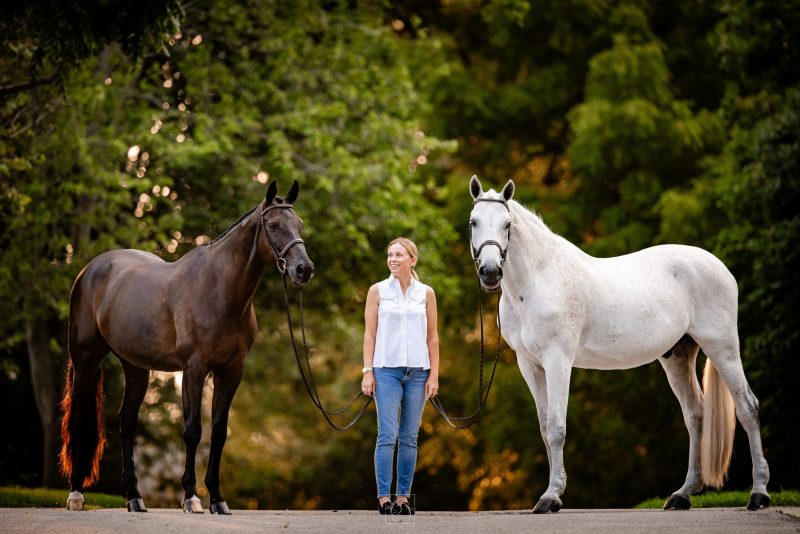
Larry became her “heart horse,” a large, good-natured gelding who takes particular offense at white flowers. Truair made a portable stash for the warm-up ring. She later returned to places imagined as a child: Wellington and Kentucky Horse Park, where she had attended BreyerFest at 12 carrying model horses on the plane in tiny shipping wraps.
The adult dream has more logistics and a better sense of humor. Her husband and children join her for parts of the season. Her daughter likes sweeping stalls; her son prefers the machinery. A miniature pony named Sugar Snap has family appeal. Truair hopes to return to the three-foot Adult Hunter and equitation divisions, but no longer treats one arrangement as proof of seriousness. “Adult life requires constant reevaluation,” she has said. The sport should bring joy.
Making AI answer for itself
In January 2026, Demandbase appointed Truair CMO. Her brief covers global brand and go-to-market strategy at a company that helped make account-based marketing a standard B2B discipline and now calls its territory “pipeline AI.” The assignment suits someone who has repeatedly worked where categories are being named, acquired or taken public.
Truair's declared aim is blunt: make Demandbase the leader across go-to-market AI categories. Her more interesting public instinct is to drag AI out of the theater and into the work. After attempting to install an agent for a repeatable process, she described getting caught in a command-line spiral, colliding with permissions and watching credits disappear. Her eventual question was not whether the experiment looked futuristic. It was whether the thing drove pipeline, improved customer connection or produced a business outcome.
That skepticism is not resistance. It is the operator's demand for a receipt. Truair has argued that access to an AI account is not the same as adoption, and that leaders who want the truth should ask their teams to show what they have built. Open the project. Examine the workflow. Learn where unofficial tools have filled a need and where training has failed to arrive. “Show me” is less comfortable than a survey and considerably more useful.
Questions before the playbook
That phrase now animates The Prompt, the Demandbase podcast Truair began hosting in 2026. It starts with unresolved questions: whether persuasion is becoming a lost art, whether automation made selling easier while making buying worse, and how far individual AI use has outrun organizational understanding.
The premise fits a woman who once wanted to be a journalist as much as she wanted to ride professionally. She ended up doing both kinds of work sideways. Marketing gave her the audience problem. Horses gave her rhythm. Operations gave her consequences. The podcast gives her permission to keep a question open long enough for an honest answer to appear.
A clean career story would turn the barn into a charming prologue and the C-suite into the inevitable destination. Truair's is more useful without that polish. The barn was a real ambition. Leaving it was a real revision. Returning was another. Between those decisions sit companies, classrooms, a civic commission, two children, a river and a horse annoyed by white flowers.
The first fence was supposed to be the last. Then she cleared it, noticed how the landing felt and made a better plan in motion. Reinvention rarely arrives with the dignity of a strategic offsite. Sometimes it is simply the courage to stay in the ring for fence two.