There is a peculiar occupational hazard in marketing the future: if you do the job well, the strange thing soon looks ordinary. Digital photographs become photographs. Cloud software becomes software. Weather data becomes a decision made before a crew, crop or cargo meets trouble. David Rich has spent more than three decades near precisely these vanishing points, giving new systems a commercial language while the rest of us were still learning their nouns.
His current desk is at DTN, where he is chief marketing officer. The company sells operational intelligence across agriculture, energy and weather-sensitive industries. It is a world of meteorological models, fuel markets, field-level insights and alerts that arrive because waiting would be expensive. Rich's assignment is less about making data sound exciting than making its consequence unmistakable. A forecast is interesting. A forecast that changes when a utility dispatches a crew is useful.
This is marketing with muddy boots and a Bloomberg terminal. One customer may be watching pavement temperature before sending salt trucks onto a highway; another may be following refined-fuel demand; another may be deciding whether an outdoor event can proceed safely. The common product is judgment under conditions that refuse to sit still. For a marketer, that removes a familiar luxury. There is little room for ornamental cleverness when the buyer's next decision has machinery, money or people attached to it. The message has to cross the distance from a model to a Monday morning operation.
That distinction follows him. Rich's resume includes Pepsi, Disney, Bigstep.com, Yahoo, Kodak, Adobe, Litmus, Paddle and Amplience. Read quickly, it looks like a shelf of corporate logos. Read chronologically, it becomes a compact history of how products escaped their old containers. The photograph left the album. Software left the box. Commerce left the storefront. Now buyer research is beginning to leave the browser and enlist an AI assistant.
When a photograph stopped being paper
In the early internet years, Rich served as vice president of marketing at Bigstep.com and then as a director at Yahoo. By 2003, he was at Eastman Kodak, eventually working as vice president of marketing for Ofoto, the online photo service renamed Kodak EasyShare Gallery. The old photography giant was attempting something delicate: preserving the emotional habit of pictures while rebuilding nearly everything around it.
Rich described a system in which customers could upload images from phones, digital cameras and film, keep and organize them online, then print them at home or in a store. In 2005, he said the gallery held more than a billion images and expected that count to double during the following year. A billion is a technical statistic until one remembers what each file contains: a birthday, a holiday, somebody's new haircut, a dog refusing dignity. Kodak was not merely moving inventory. It was moving memory.
“We were looking for one set of metrics and one view into the data.”David Rich, on rebuilding the commercial funnel at Amplience
The Kodak chapter also gives the first clean glimpse of Rich's recurring role. He arrives not simply when a product needs promotion, but when a category needs explanation. The new service had to feel connected to the familiar Kodak promise while behaving like an ecommerce platform. His education looks almost suspiciously suited to that work: undergraduate degrees in economics and art at Duke, followed by an MBA from Duke's Fuqua School of Business. Measurement on one side, meaning on the other.
The consumer internet: Bigstep.com, Yahoo and Kodak's online photo business.
The subscription turn: Adobe Creative Cloud for Teams as creative software moved online.
The SaaS operator: CMO roles at Litmus, Paddle and Amplience.
Decision-grade data: global marketing at DTN across weather, agriculture and energy.
The box disappears; the team remains
After a senior marketing turn at video-production marketplace TurnHere, Rich joined Adobe in 2010. He ultimately became worldwide director for Creative Cloud for Teams. The product sat inside another profound change in packaging. Creative professionals who once bought software in boxes were being asked to subscribe to a cloud service, receive continuous updates and let an account administrator manage access. The product was familiar. The commercial relationship was new.
Rich called the teams offering a shift in creative expression and a place for workgroups to reach Adobe's tools and services. Beneath the launch language was a tougher marketing problem: a subscription asks the customer to keep choosing. That makes adoption, retention and customer value part of the story from the beginning. The sale is no longer a finish line with a receipt attached.
His next three chief marketing officer roles made that logic explicit. At Litmus, an email creation and testing platform, Rich argued that unusually high email returns could reflect underinvestment rather than triumph. He moved to Paddle in 2020, working in payments infrastructure for software companies, then joined commerce-experience company Amplience in late 2021. Three products, all sold to businesses, all complicated enough to punish a fuzzy explanation.
A dashboard can settle an argument
At Amplience, Rich found marketing and sales looking at fragments of the same customer journey. Salesforce held multiple reports, but there was no unified funnel for the early interactions that occur before an opportunity is qualified. The company built an account-based program with common stages, common data and common accountability. This sounds like plumbing because it is. Buildings are mostly plumbing once the architect leaves.
The reported results were a 36 percent increase in first-year annual contract value, 50 percent more pre-booked meetings around events and a 250 percent increase in event opportunity value. The figures have the crispness beloved by a slide deck. More revealing is the method: make departments look at the same reality. Rich later joined Amplience's shared leadership team with its chief technology officer and chief revenue officer during the founders' transition out of full-time executive roles in 2023.
This is where the label “marketer” becomes slightly misleading. Rich's public description of himself is someone who builds commercial growth engines for private-equity-backed and high-growth B2B technology companies. The engine metaphor matters. Campaigns are visible pistons; the work also includes fuel lines, timing and an agreement about which direction the vehicle is meant to travel.
The weather changes. So does the buyer.
DTN brings Rich's career themes into a business where abstraction has a deadline. Its customers feed, fuel and protect people. Weather and market intelligence inform choices across farms, transport networks, utilities and energy trading. Product, sales, marketing and customer success have to connect an enormous technical estate to a simple human question: what should I do next?
Rich has also been watching AI alter the other side of that exchange. He says some prospects now arrive after using AI agents to research vendors. They have done more homework, understand the field and ask sharper questions about differences and fit. This behavior is not yet every conversation, he cautions, but he expects more of it.
“These are generally more qualified prospects because they've done their homework.”David Rich, on AI-assisted buyers
The implication is wonderfully inconvenient for marketing. A page may be read by a human, a machine acting for a human or both. Empty adjectives become easier to compare and easier to discard. Evidence, specificity and coherent product information gain value. Rich's advice is practical: understand how customers research now and adapt before the new behavior becomes routine. He has already lived through enough category changes to know that routine arrives quietly, then all at once.
A second kind of current
Rich serves on the advisory board of the World Open Water Swimming Association. He is also listed as a limited partner at Stage 2 Capital. The combination adds two useful footnotes to the CMO biography: endurance outside a lane, and an operator's interest in the companies coming behind him.
Credit travels in a crowd
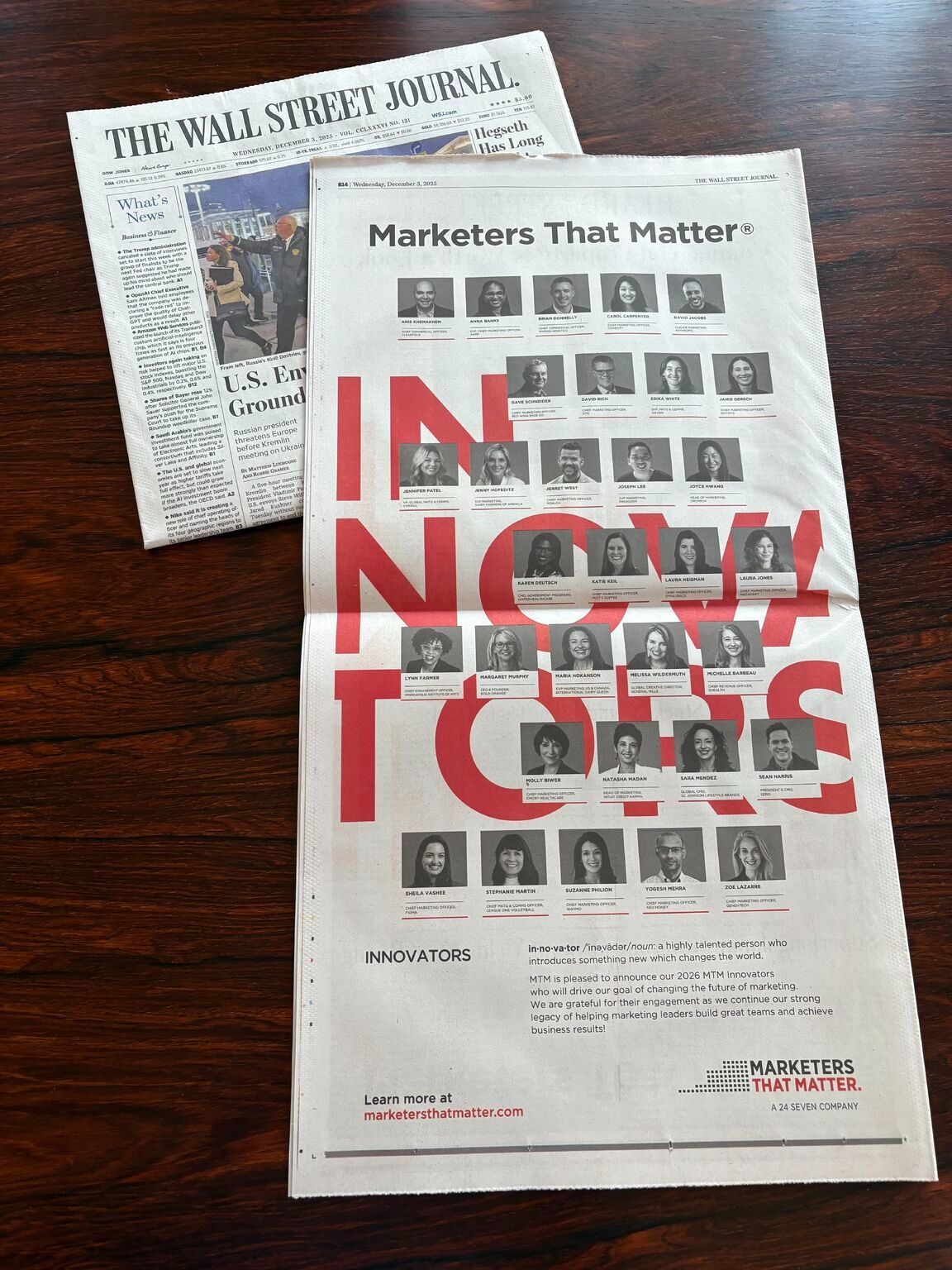
When Rich was named a 2026 Marketers That Matter Innovator, his response was striking for the number of other names in it. He thanked CMO peers, DTN's executive group and members of the marketing team, writing that innovation thrives in community. On another post he sharpened the ambition: build a marketing team where innovation is expected, shared and developed, so more people shape what comes next.
This is consistent with the work he does away from quarterly targets. Rich mentors MBA students through Fuqua's alumni network and previously served on the school's Alumni Board. From 2018 through 2022, he was a mentor and corporate sponsor for Duke's DTech program, which supports undergraduate women studying computer science, engineering, mathematics and statistics through technical internships and a peer community.
Mentoring is an apt coda for a career spent at transitions. New technology creates a temporary imbalance: nobody has quite enough experience because the experience does not exist yet. A mentor cannot hand over a map. He can offer better questions, a memory of earlier upheavals and the reassurance that confusion is not the same thing as failure.
Rich's career does not resolve into a grand theory, and that is part of its charm. It offers a durable practice instead. Learn the new system. Find the customer consequence. Give sales and marketing one view of reality. Keep the creative promise honest by measuring whether it works. Then, when the strange thing becomes ordinary, move close enough to the next change to hear customers searching for words.