The email writes itself now. The budget meeting remains stubbornly human. For B2B marketers, that is an awkward place to be: artificial intelligence can produce more campaign material, while the people approving the spend still want to know which customers it will win. ForgeX has built its research and advisory business around that uncomfortable conversation.
Account-based marketing, usually shortened to ABM, concentrates effort on selected businesses and the people who make decisions inside them. ForgeX helps teams decide where that effort belongs, how sales and marketing should coordinate it, and what counts as a worthwhile return. Its proposition is particularly timely when adding another AI tool is easier than agreeing on the problem it should solve.
A five-figure reason to open the door
The company’s origin contains a nicely specific irritation. While building an ABM program at Scale AI, Davis Potter wanted access to other practitioners. In an interview with Influ2’s People are People, he described receiving a discounted, five-figure quote to join another community. He wanted colleagues to bounce ideas off. He could not imagine taking that budget request to his boss.
ForgeX opened its own community in 2023. Membership was free, and the company says it will stay that way. The rule attached to the invitation is unusually firm for a gathering of marketers: no pitching, with a zero-strike policy. “We don’t like self promotion,” Potter said in the interview. The intended transaction is an exchange of experience.
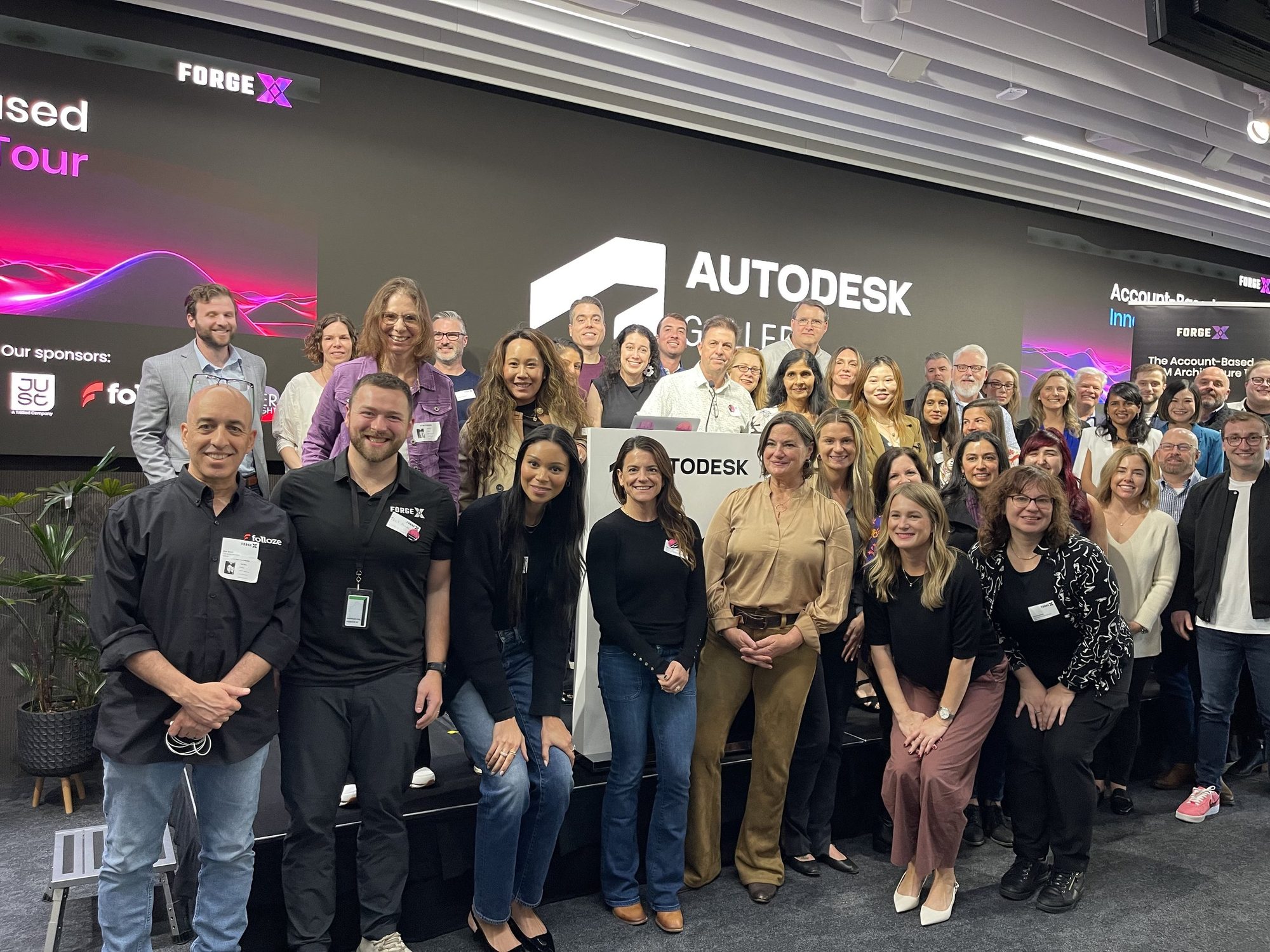
That decision supplies a useful explanation for the business that followed. A community gives a research firm regular contact with the problems people are trying to fix. Research gives those conversations something more substantial than anecdotes. Advisory turns the shared material into work on a particular company’s problem. Each activity has a reason to sit beside the others.
The community also acquired a physical meeting place. ForgeX’s September 2024 Austin roadshow used Miro’s office, with research sessions, structured roundtables and an exercise on participants’ successes and hurdles. Its executive council asks members for monthly conversations and quarterly analyst discussions. Those commitments make the peer network more than a mailing list. They also impose a cost that free admission does not remove: experienced people have to show up and contribute something worth hearing.
The account list is a spending decision
Potter came to ForgeX with experience at Pegasystems, Google Cloud and Scale AI. His career crossed large enterprise programs and a younger company building its approach from scratch. The distinction matters in this corner of marketing: a program aimed at a handful of valuable customers asks different things of a team than one serving a much larger account pool.

ForgeX organizes those choices through Enterprise ABM, Growth ABM and Deal Acceleration. Its broader Account-Based GTM Architecture connects the strategy across revenue functions. The Account-Based Arrow provides a measurement framework and common data model. The names are proprietary; the managerial challenge underneath is familiar. A company needs to decide which opportunities deserve scarce time, money and attention.
In a June 2026 episode of Revenue Xchange, Potter treated ABM as an account investment strategy. High-potential enterprise accounts continue to need human judgment, even as AI removes work. More scalable programs can use automation to coordinate research, prioritization and campaigns. The interesting choice is how to reinvest the capacity that technology releases.
For a reader, the transferable idea is simple enough to try in a planning meeting. Put the target accounts, expected opportunity, available people and intended investment on the same page. Ask whether the allocation makes sense before debating the next campaign. That is an editorial application of ForgeX’s argument, rather than a promise of a particular financial result.
The software arrived. Readiness lagged.
The firm’s 2025 research with Demandbase put numbers around a familiar AI dilemma. Among surveyed B2B marketers, 91 percent said their companies used AI to support ABM in some form. Only 52 percent were satisfied with progress, and 19 percent had a formal AI roadmap. Training, expertise and integration were among the barriers identified.
Adoption had a head start.
That evidence explains why ForgeX sells more than instruction in writing prompts. Its AI service begins by assessing maturity, then moves into strategy, role-specific training and implementation. The company describes an engineer working inside the client team to build workflows, agents and integrations. The service is aimed at B2B marketing leaders, with its AI page specifying businesses between $50 million and $5 billion in revenue.
“Higher AI token spend does not magically equate to higher revenue.”
ForgeX, AI advisory and training
The early failure documented here is the gap between access and execution. Teams could acquire tools before establishing the skills and connections needed to use them well. Buying the next license does little to settle who owns a workflow or whether the underlying account data is usable. Those are precisely the questions an advisory engagement can put on the agenda.
A benchmark with an important distinction
ForgeX’s 2026 AI in ABM Benchmark Report surveyed 189 practitioners running active programs. Eric Wittlake authored the report, with contributions from Matt Steffen, Chandler Martin and Potter. Propensity and Folloze supported the research. Its question had become more specific: where was AI affecting the business, rather than simply making production faster?
A June analysis reported average AI use across 3.7 channels among its high-performing group, compared with 2.4 among other respondents. But the classification deserves attention. The first group consisted of people who agreed that AI had significantly improved their ABM program’s performance. That is a self-reported assessment, not a ranking based on audited customer revenue.
The findings are useful as prompts for investigation. They cannot establish that adding another channel causes success. Nor should the 2025 and 2026 studies be read as tracking the same companies over time. The practical distinction is to measure hours saved separately from changes in engagement, conversion and pipeline. A faster process may be valuable even when the revenue case still needs work.
Free conversation, paid working time
ForgeX packages paid access in a recognizably analyst-firm format. An annual advisory seat covers a leader, with bundled seats available for teams. It includes research, benchmark data, analyst inquiry time, frameworks and community access. Workshops and consulting are scoped at a flat rate, using half-day or full-day sessions delivered virtually or on-site.
The work around the workshop matters. ForgeX includes planning and stakeholder interviews beforehand, uses the client’s accounts and data during the engagement, and follows with an action plan and debrief. Its benchmark assessment separately describes a sequence of diagnosis, peer comparison and recommendations. A buyer is purchasing structured attention to a problem, with research available to inform the decision.
- 01DiagnoseSurveys, interviews, internal data
- 02CompareBenchmarks and relevant peers
- 03ActAudit report and analyst workshop
The commercial arrangement requires scoping: seat count and the workshop’s objective determine the engagement. Community admission costs $0. For the company buying advice, the budget conversation should also account for staff preparation and follow-through. A half-day session occupies a calendar; implementing its decisions asks for a continuing commitment from the team.
Demandbase puts the research to work
A partnership announced in April 2025 gave ForgeX another route to practitioners. Demandbase and ForgeX launched the AI report together and set out plans for certification and community collaboration. Demandbase customers were to receive access to ForgeX paid research during that engagement. The relationship connected an ABM software company’s audience with an advisory firm’s teaching material.
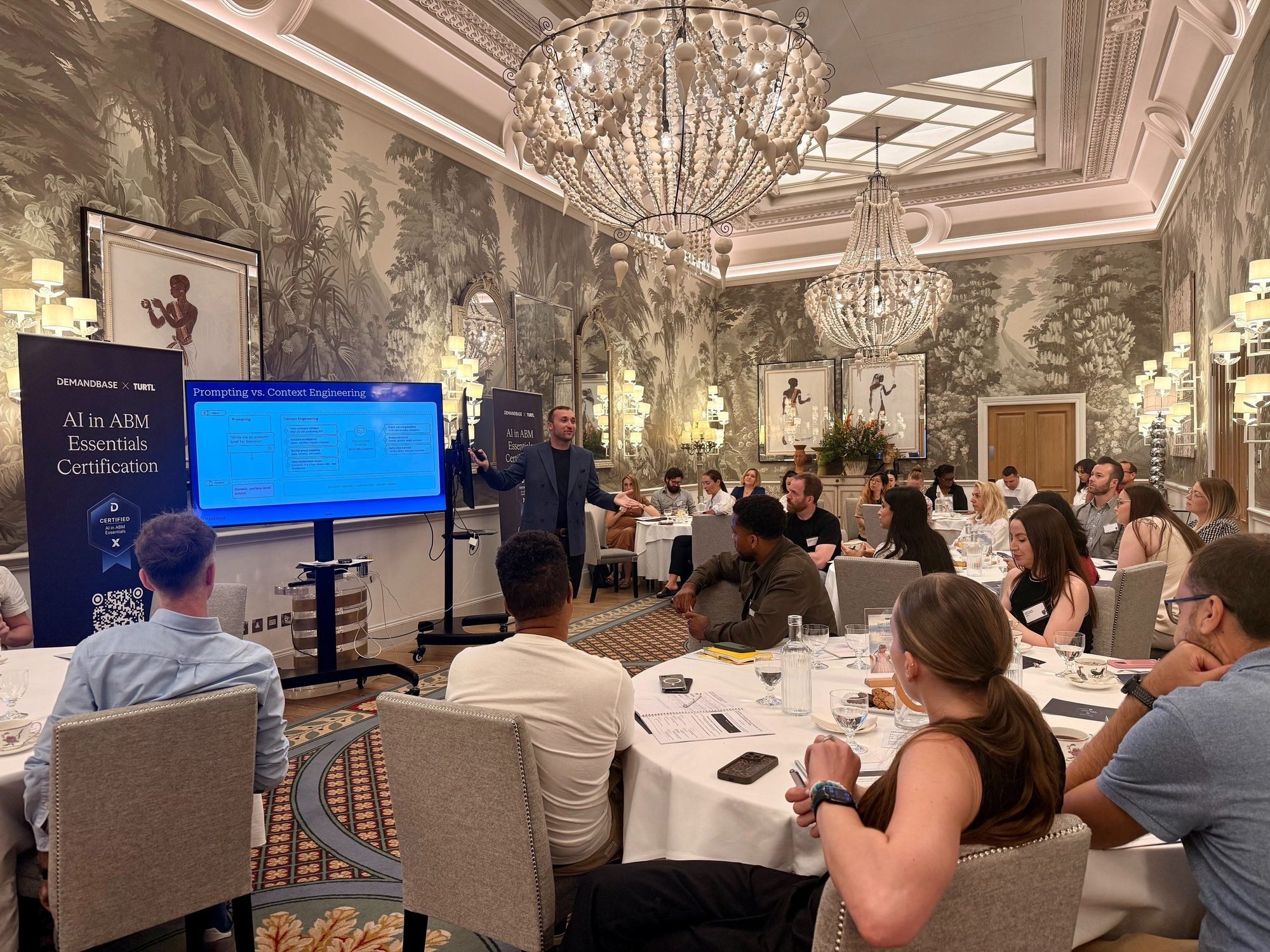
Demandbase licenses ForgeX research and frameworks for certifications, including AI in ABM Essentials. A further session is scheduled for September 23, 2026, in Dallas. That relationship is concrete evidence of distribution. It also helps locate ForgeX in the market: the firm can teach people who use an ABM platform while advising them on decisions that extend beyond it.
Its competition for a buyer’s attention includes broad analyst services, specialist consultants, vendor education and the company’s own internal experts. ForgeX’s case rests on a narrower subject focus and proximity to practitioners. The logos of employers represented in a community establish the reach of that network; they do not, by themselves, identify a roster of paying advisory clients.
The work starts between departments
One of the more revealing examples comes from Potter’s discussion of buying groups. A large target account may contain several business units, each with its own decision-makers. Looking at company-wide engagement can obscure the people relevant to a particular deal. ForgeX’s approach calls for associating those people with opportunities and examining their engagement with sales colleagues.
That creates a clear condition for useful advice: someone must maintain the data and act on it. If sales and marketing cannot agree on account priorities, or nobody takes ownership of updating buying-group information, a framework has little operational force. The discipline suits complex B2B selling where coordinated attention to selected accounts can justify the work involved.
ForgeX’s August 2026 writing looks further ahead, arguing that marketers will increasingly access platform data and actions through AI interfaces. The prediction may change the software people use, but the allocation question survives. Which account merits the next hour? Who needs to hear from the company? What happened afterward? Those are useful questions to carry into a budget meeting, however quickly the email was written.