The first version was plain enough to make a good origin story and awkward enough to make an honest one. Basic HTML templates. A small team. Many revisions. Harsh Trivedi remembers that modest beginning because he was there for the part startup histories tend to edit out: the stretch when the future is a folder of files, the product keeps changing shape, and every confident noun in the pitch deck is still a verb on somebody’s task list.
Trivedi joined Mercor in January 2022 as a software developer intern. His assignment was practical rather than prophetic: build an Electron.js tool that used Amazon Web Services to upload static websites. Four months later he became a software engineer. The remit expanded into a hiring dashboard built across backend and frontend, internal CRM tools, database structure and AWS operations. By May 2023, he was principal engineer, leading a development team while managing deployments, database infrastructure, pipelines and code architecture. In April 2024, his title changed again - founding engineer, with infrastructure and security in view.
The ladder took a little over two years to climb. It also resembles a cross-section of the company. As Mercor moved from simple pages toward automated interviews and vetting, Trivedi moved from uploading static sites to tending the systems beneath a live AI product. The titles tell only half the tale. The widening surface area tells the rest.
The Mercor ladder / 27 months
The apprenticeship in useful things
There is no single moment when Trivedi suddenly becomes a full-stack engineer. There is a pile of small projects instead. At Marwadi University, where he studied computer applications and computer science from 2020 to 2023, his work wandered productively: an employee-management application with Spring and Angular, a Spring JPA boilerplate, a Java program for news and weather, a WhatsApp bot, and Blendmon, an all-in-one downloader. In 2020 he published walkthroughs for TryHackMe exercises on Nmap, web scanning, Tmux, Blue and Volatility. The portfolio reads like a young engineer opening every door in the workshop to see what is kept inside.
Before Mercor, he spent six months at Real IT Solutions Pune. There, the abstractions met invoices. He worked on a billing application with a Spring Boot backend and Angular frontend, built a deployable scheduler and an OAuth2 API consumer for microservices, and made smaller projects using JWT and OAuth2. The vocabulary was broad because the job was broad. A billing screen could lead to an authentication problem, which could become a deployment problem before lunch.
That habit of crossing layers became useful at Mercor. A hiring dashboard is not merely a dashboard when it has to structure candidate data, support internal decisions and survive company growth. An AI interviewer is not merely a talking model when it needs video, context, evaluation logic and reliable handoffs. Trivedi’s public record names WebRTC, Firebase, cloud platforms, microservices and databases. More revealing than any tool is the pattern: the work follows the product wherever its next weakness appears.
His education outside the classroom had the same practical tilt. Certifications in JavaScript, Core Java, HTML5 and Oracle Database SQL fundamentals were modest markers of a larger habit: take a tool apart, learn its rules, then make something with it. In May 2022, near the end of his internship and while finishing university, he placed in the top 20 at Hack4Bengal, a national hackathon at Sister Nivedita University. Hackathons reward a peculiar mixture of speed, compromise and nerve. Production engineering asks for the same ingredients, then adds patience.
The timing matters. Trivedi was studying, working for Real IT Solutions and beginning at Mercor across overlapping months. The tidy career ladder was, in real life, several ladders leaning against the same wall. College projects supplied breadth. Client software supplied constraints. Mercor supplied a system that kept growing faster than any fixed job description. When one colleague later recalled Trivedi helping him write his first lines of professional code, the detail suggested that his scope was expanding socially as well as technically. He was learning to build while helping somebody else begin.
“We’ve shipped numerous applications ... including a cutting-edge Coding Platform, an AI-powered Interview System, and a comprehensive Vetting Dashboard.”Harsh Trivedi, reflecting on Mercor’s early build
A robot called John
Software acquires personality as soon as people must live with it. Mercor’s AI interviewer was given the splendidly ordinary name John Sharma. In late 2023, chief executive Brendan Foody praised John’s work ethic: the synthetic colleague could conduct thousands of interviews at once. Trivedi replied with the engineer’s natural measure of character: “Nobody can match John’s uptime.”
It is a throwaway joke, but a revealing one. Candidates encounter John as a conversation. Engineers encounter a stack. The model must respond to a person’s background, keep a real-time exchange coherent, collect useful evidence and feed a larger vetting process. Meanwhile, the video must connect, the data must land in the right place and the surrounding application must behave. A tireless interviewer still depends on very human vigilance.
Trivedi has described the team’s goal in sober terms: automate the vetting pipeline with quality and reliable tools. Reliability is not the word that receives applause in an AI demo. It is the word people remember when the demo becomes their workday. The distance from one clever interaction to thousands of dependable ones is where infrastructure earns its keep.
From demos to consequences
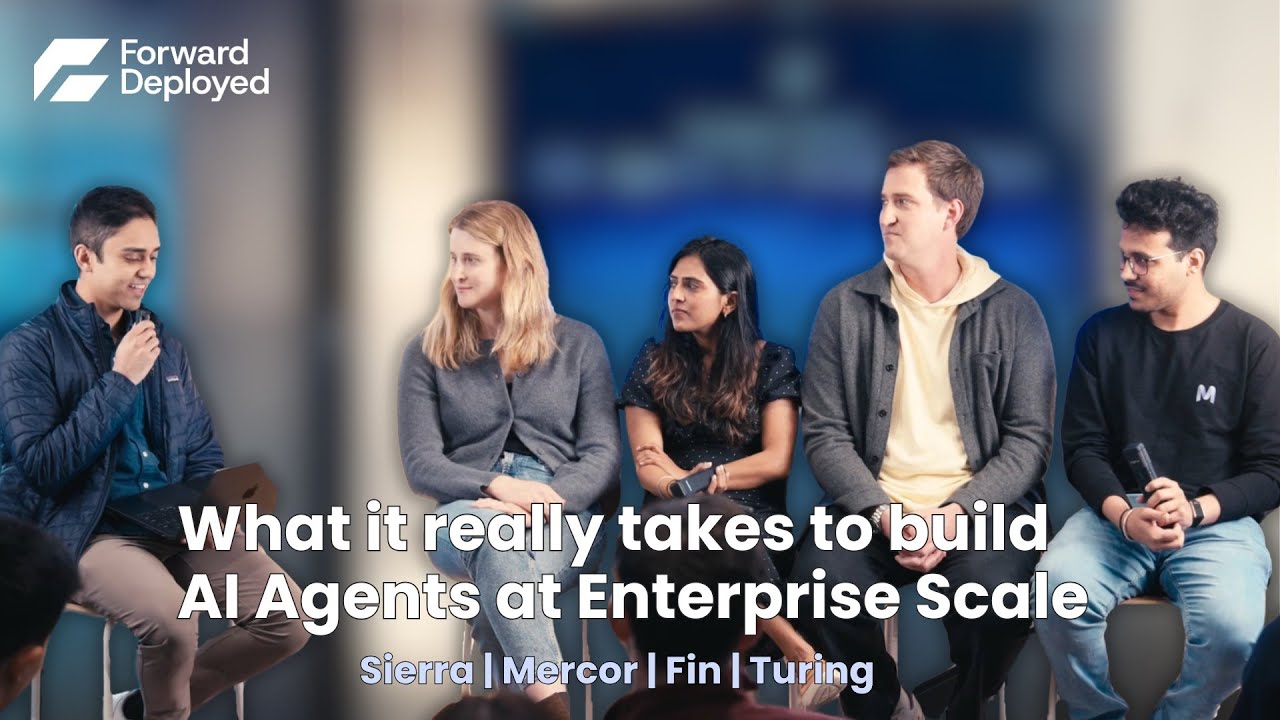
By June 2026, the question had grown larger than recruiting. Trivedi joined Natalie Meurer of Sierra, Juhi Parekh of Turing and a representative from Fin for a Forward Deployed panel on what it takes to build AI agents in the enterprise. The discussion ranged across model choice, voice systems, orchestration, inference economics and the gap between benchmarks and production behavior. The fashionable subject was agents. The underlying subject was consequence.
This is familiar territory for someone whose public career moved steadily downward through the stack even as his title moved upward. New models arrive with better benchmark charts, but an enterprise system has other loyalties: to the user waiting on the other side, to the process it must complete, and to the business that cannot afford improvisation in the wrong moment. The work is less about selecting one magnificent brain than arranging several imperfect components so the whole can be trusted.
Mercor itself has also widened its vocabulary. The company now describes its purpose as organizing human intelligence for the AI economy. Its public platform spans expert work, human data, evaluations, benchmarks, reinforcement-learning environments and enterprise AI. The early hiring dashboard has become one room in a much larger house. Trivedi’s own progression makes sense against that expansion: first the application, then the systems, then the conditions under which those systems remain secure and useful.
“I am deeply committed to creating products that enhance usability and access, making high-quality tools available to the greatest number of users.”Harsh Trivedi
The ambition hidden in access
Trivedi describes his aspiration in the language of access. He wants to develop scalable, cross-platform products and make high-quality tools available to more people. It sounds almost gentle beside the industrial nouns of his job. Yet access is a demanding engineering brief. A product cannot reach widely if it breaks at the edges, assumes one kind of device, confuses its users or treats security as decoration.
His story also contains a small but useful counterweight to the mythology of solitary builders. When Trivedi reflected on Mercor’s earliest templates and later products, he thanked the team. A former colleague, Yatharth Sameer, remembered writing his first lines of software-engineering code with Trivedi’s help. Foody’s public recommendation credits Trivedi with initiative and speed, then adds the rarer observation: he creates a culture that invites other people to match his work ethic and shows management potential.
There is a tendency to treat “founding engineer” as a romantic title, all midnight breakthroughs and privileged proximity to founders. Trivedi’s record is more useful than that. It contains a static-site uploader, a billing application, CRM plumbing, database structure, deployments and security. These are not supporting details to the real adventure. They are the adventure, if the aim is to make an idea survive contact with thousands of people.
In his 2024 reflection, Trivedi ended with a cheerful line: “Let’s write some billion dollar code.” The money makes the quip sparkle, but the preceding history gives it weight. Billion-dollar code is still code. It begins as a template. It is revised, replaced and occasionally rescued. It gains a database, a pipeline and obligations. Then one day it interviews a stranger while its engineer sits somewhere offstage, worrying about uptime.