There is a moment in the life of a new product when it is still too small to require a press release. It has no polished name, no launch video, no confident paragraph about the future. It is a repository with almost nothing in it. A blank file. Two engineers deciding what should exist first. Handshake AI, which now connects academic experts with laboratories developing frontier models, once occupied that modest territory. Markus Dücker, an engineering colleague, later described its beginning in a single revealing sentence: he and Igor Arkhipov wrote the first lines of code.
The phrase is wonderfully free of fireworks. Arkhipov's title now carries the ceremonial weight of Founding Engineer at Handshake AI, but his public record is the record of a working programmer: coursework, commits, web applications, certificates, side projects, and a habit of returning to difficult questions until they become systems. The title arrived after the work had already started.
“What started with Igor Arkhipov and me writing the first lines of code - now has become Handshake's bold new chapter.”Markus Dücker, Handshake colleague
A machine tries to read the room
Six years before Handshake introduced its AI service, Arkhipov submitted a bachelor's thesis at Hamburg University of Applied Sciences. Its English title was dry and exact: Retrieval and Sentiment Analysis of Tweets Including Specific Keywords. The project asked a problem that still bothers software: given a brief human utterance, can a machine tell how it feels?
This was 2018, when public conversation about machine learning was less crowded with oracles and existential dread. Arkhipov's subject was practical. Tweets are short. Their language is unruly. People misspell, abbreviate, joke, quote one another, and use the same word with opposite intent. He compared supervised-learning approaches, explored feature selection, tested classifier quality, and built a web application around the result. The implementation retrieved posts through Twitter's API and assigned positive, negative, or neutral sentiment. Uncertain answers were placed in the neutral category rather than dressed up as confidence.
The recurring problem: turning expression into signal
It would be too neat to claim that a student thesis foretold an entire career. Careers do not respect foreshadowing that obediently. But the continuity is hard to miss. Arkhipov was already working at the boundary between expression and classification, asking how much trust a machine's judgment deserved. Handshake AI would later operate on the other side of that boundary: qualified people evaluating what machines produce.
Hamburg, with coffee
An older personal page preserves a more informal Arkhipov. It introduces him as a web developer, photographer, and barista in Hamburg, then adds four compact identifiers: “IT specialist, traveler, photographer, coffee enthusiast.” It lists Gpredictive GmbH as his workplace and Hamburg University of Applied Sciences and Nayanova University in Samara as his schools.
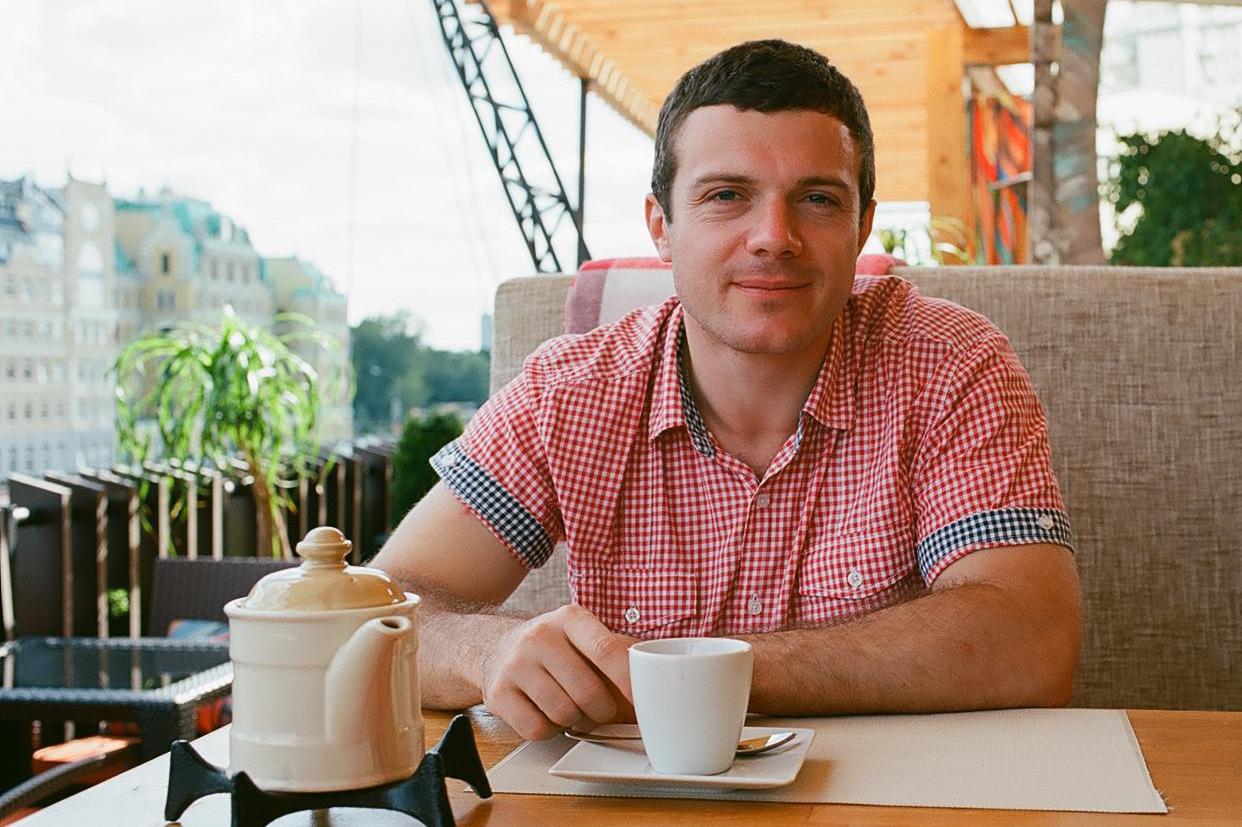
The list is not a personality test, but it tells us what he chose to put in public when a professional profile could still be playful. Photography is an art of selection. Coffee is an accumulation of small variables. Software engineering, on a difficult day, is both. Decide what belongs inside the frame. Adjust one thing. Observe. Try again.
His degree ran from 2014 to 2018. The thesis shows the apparatus of an applied education: not merely a survey of sentiment-analysis literature, but code, architecture, tests, a Twitter wrapper, and an interface. The machine-learning work had to become an application somebody could use. That bias toward a finished system would matter later.
The European chapter
By 2023, Handshake was naming Arkhipov among a group of software engineers brought in for its European expansion. The company had begun as a network connecting university students, career offices, and employers. Europe added different institutions, languages, and expectations to a product already built on coordination. Arkhipov joined as a software engineer, one of several technical hires tasked with making the expansion real.
The available milestones are spare, but they draw a clean route: applied computer science in Hamburg; web development at Gpredictive; engineering for Handshake Europe; then the AI division. A recommendation Arkhipov wrote for a colleague refers to both the European team and, later, the AI group. The work moved, and eventually so did he. His current public profiles place him in San Francisco.
Completes an applied-computer-science thesis on tweet retrieval and sentiment classification.
Works in web development at Gpredictive and keeps a public identity shaped by travel, photography, and coffee.
Joins the engineering group supporting Handshake's expansion in Europe.
Handshake AI becomes public; Dücker credits Arkhipov with its earliest code.
Works in San Francisco as a founding engineer and represents Handshake in Datadog's Spotlight Program.
When the side project is a workbench
Arkhipov's GitHub account, created in April 2014, provides the most concrete view of what interests him when no corporate announcement is required. Earlier repositories track exercises in Ruby on Rails, database design, application optimization, mapping, geosearch, and internationalization. His LinkedIn profile records a concentrated run of coursework in 2023: PostgreSQL database design, code design for Rails applications, Hotwire, and Rails optimization, alongside React training.
The later projects widen the bench. There is a TypeScript starter for an AI-driven development workshop and an MCP server for booking a San Francisco tennis court. There is unpin, a Rust tool for discovering and safely changing AI-agent configuration. There is fff, a file-search SDK intended for agents and several programming environments. Other repositories venture into custom keyboard firmware and a Rust application called Entropy for configuring compatible keyboards and trackballs.
The collection does not pretend to be a single grand project. Its charm is practical promiscuity. Search faster. Configure the agent. Book the court. Tune the keyboard. Learn another part of the stack. Founding work often rewards this range because young products are impolite about job descriptions. They ask for whatever is missing.
The title is recent. The habit of building in public is more than a decade old.
Human judgment becomes the product
Handshake formally described its AI service as a way to connect highly educated experts with AI labs that need model validation and specialized human feedback. At launch, the company said its wider network included 1,500 university partners in the United States and Europe, 18 million students and alumni, and three million graduate-level scholars. Its proposed advantage was not simply a crowd. It was verified expertise across nearly 200 specialties.
The engineering challenge behind that description is substantial. An expert must be found, verified, matched to the right domain, trained for a task, paid, and given an interface through which careful judgment can become useful data. Quality must survive the trip. Handshake said it would manage the process in-house and produce the data on its own annotation platform. Arkhipov's precise responsibilities inside those systems are not publicly itemized, so his contribution should not be inflated into the whole. The documented fact is important enough: he was there at the code's beginning.
That beginning gives his earlier thesis an echo. In 2018, the goal was to make human sentiment legible to software. At Handshake AI, the surrounding business makes expert human judgment legible to the teams building software. The direction of travel has reversed, but the bridge is the same.
The engineer steps into the light
In September 2026, Arkhipov shared a small departure from his ordinarily quiet public presence. He had participated in Datadog's Spotlight Program at the company's San Francisco Summit, an initiative celebrating customers using the monitoring platform inside their organizations. “Proud to represent Handshake and the incredible work our team is doing,” he wrote. The post promised a behind-the-scenes look. For an engineer whose most interesting credential may be work completed before the curtain rose, the phrase suited him.
Public profiles have a way of converting people into nouns: engineer, founder, photographer, barista. Arkhipov's record is more interesting as a sequence of verbs. Classify. Build. Photograph. Learn. Move. Configure. Begin. The products have grown larger, and the city on the profile has changed from Hamburg to San Francisco. The working method visible from outside remains pleasantly untheatrical.
Even the photographs supply a modest clue. His Flickr archive and older portrait belong to the era when a personal homepage could simply invite a visitor to “view my photos.” There is no effort to make the hobbies sound strategic. They sit beside the technical work because people contain several rooms, and a useful profile should leave the doors open. The engineer can care about a classifier's confidence threshold and still notice the light at a cafe table. He can work on infrastructure for AI agents and then make software for a keyboard. The variety keeps this from becoming a tidy tale about destiny. It is a story about attention, applied repeatedly.
A launch tells us when a company is ready to be seen. The first line of code tells us when somebody decided an idea could be made real. Igor Arkhipov's story lives in the distance between those two moments, where a machine is still uncertain, the repository is still quiet, and judgment belongs to the person at the keyboard.