The glamorous part of an AI agent is the moment it appears to think. The expensive part begins one second later, when it needs to open Salesforce, touch a calendar, respect a permission, refresh a token, survive a retry, and leave behind a record clear enough for security to sleep. Karim "Wen" Rahme has built a company in that second. At Metorial, the Austrian engineer and founder is working on the connective tissue between models and the systems where actual work lives.
His timing looks neat only in retrospect. Rahme graduated from New York University Abu Dhabi in May 2025. He and his long-time collaborator Tobias Herber joined Y Combinator's Fall 2025 batch a few months later. By December, Rahme said their open-source project had crossed 3,600 GitHub stars and was approaching 1,000 weekly active users five weeks after launch. The seed round, he said, closed in about five days.
But Metorial did not spring from a whiteboard exercise about agentic infrastructure. Its roots run through an Austrian classroom, a quantum computing hackathon, an Abu Dhabi ticketing business, and a first attempt at building the wrong product. This is a story about a founder learning that the supposedly secondary work is often the work customers will pay to stop doing.
The friendship before the company
Rahme and Herber met at 14 as seatmates at a technical high school in Austria. Computer science was not an extracurricular flourish there; it was part of their formal education. They spent five school years making projects together, then carried the partnership into adulthood. A decade later, the shared context shows. Rahme handles the CEO role, Herber the CTO role, but both have described themselves as technical founders who write code.
Rahme moved to Abu Dhabi for university, pairing computer science with mathematics at NYU Abu Dhabi. In 2022, he joined a team called qVerified at the university's International Hackathon for Social Good. The group built an automated way to check whether a quantum application had compiled correctly, using IBM's Qiskit and the open-source MQT QCEC tool. They finished second.
The project is an early clue. Compilation verification is a backstage problem: few users ask to admire it, but everyone wants to trust the result. Rahme's later work would keep returning to this category of invisible assurance.
Two million chances to be wrong
While studying, Rahme spent roughly three and a half years running Valicit, an event-ticketing startup in Abu Dhabi. Herber joined him to co-lead its technical development. The platform handled ticketing for concerts by Travis Scott, 50 Cent, and G-Eazy. Rahme says it sold more than 2 million tickets and sometimes faced about 50,000 buyers trying to purchase at once.
A concert onsale is a blunt systems test. Traffic arrives in a wall. Inventory must stay accurate. Payment cannot become an improv exercise. A tiny defect can acquire thousands of witnesses before an engineer finishes opening the dashboard. Valicit's original pitch also tried to improve the secondary market, giving event vendors controls for resale prices, restrictions, and royalties without requiring customers to understand the blockchain machinery underneath.
The concert business gave Rahme a practical education in reliability. It also supplied a durable partnership. Tickets would eventually give way to AI, but the operating question stayed familiar: what happens when a piece of software leaves the demo and meets a crowd?
The product hiding beneath the product
Metorial began elsewhere. Rahme and Herber first built a no-code AI workflow product. The model could do useful things, but every attempt to connect it to the outside world produced the same unpleasant list: authentication, session handling, retries, security, monitoring, scaling. One integration was manageable. A catalog of them became an infrastructure company wearing the costume of a feature.
When the Model Context Protocol arrived, the founders recognized the value of a common language for connecting models to tools. They also found that a standard did not make production operations disappear. Local experiments worked. Multi-tenant systems still needed isolated credentials, OAuth flows, observability, and permission boundaries. Metorial pivoted toward that gap.
The company now describes itself as one place for employees, agents, and AI clients to connect tools and skills, with governance and tracing included. Its open-source stack supports TypeScript and Python, multiple model providers, a managed service, and self-hosting. The specific catalog count has climbed as the product has changed. The more important proposition is consistent: developers should not rebuild the same credential and access machinery for every agent.
A rejection, then a slope
Rahme and Herber applied to Y Combinator for the S25 batch and reached an interview. They were rejected. The response praised the team and the open-source growth but questioned how the product would defend itself among a wave of MCP projects. The founders could have polished the same pitch. Instead, they made the company easier to distinguish.
By the F25 application, both founders were full-time. Their open-source projects had grown from 700 to 2,600 stars. Roughly 350 developers were waiting for access. An enterprise buyer had begun a pilot, and the first paying customer arrived while the application was still editable. Metorial had expanded beyond a one-line convenience into a platform with deployment, SDKs, monitoring, and security.
Rahme later published both applications, typos included. His explanation is more useful than a victory lap: a first application gives investors a point; a second gives them another point, allowing them to calculate a slope. The improved prose mattered, he wrote, but months of changed facts mattered more. YC accepted Metorial on the second attempt.
The live-demo temperament
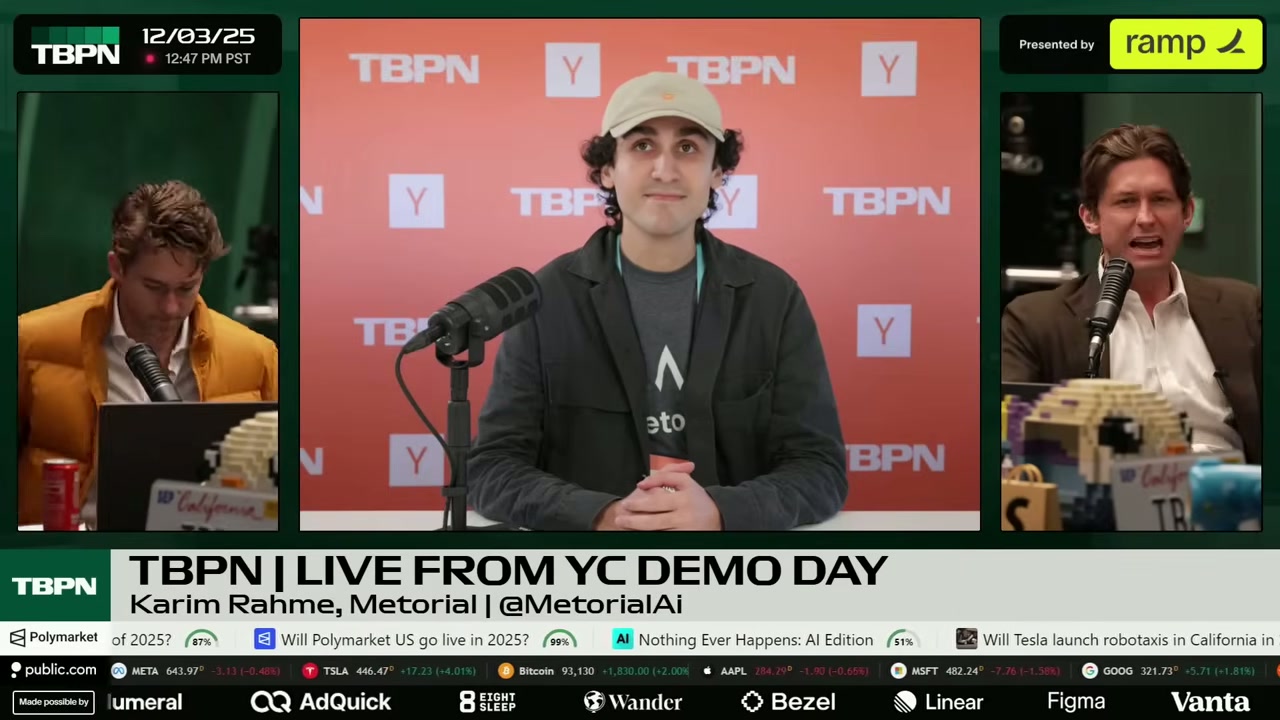
At YC's Fall 2025 product showcase, Metorial placed third overall and first among the software companies, by Rahme's account. The founders had not built a special presentation. They showed the live product. Rahme then joked that the hardware winners, including projects operating in the stratosphere, had benefited from "altitude bias."
That combination appears often in his public voice: strict about infrastructure, loose enough to make fun of the ceremony around it. An announcement about Metorial's European region counted 47 internal reviews, 12 security questionnaires, three mildly concerned legal calls, and one "emotionally significant" data-residency discussion. The punchline served the product argument. Enterprise plumbing can be comic because anyone who has endured it recognizes the numbers.
In a December 2025 interview, Rahme described himself and Herber as "OG software engineers," pointing to more than 11 years of formal computer science education and a preference for first-principles engineering. He was equally direct about the longer ambition: Metorial should become the substrate for integrations and access control, then add workflow builders and agent hosting above it.
Watch: Metorial's production MCP demoPLAY ↗Bet on the need, not the acronym
Rahme's view of MCP is notably unsentimental for someone building an MCP company. Metorial uses the protocol, contributes to its ecosystem, and sells infrastructure around it. Yet he has said the long-term bet is not that one standard survives forever. If another protocol wins, the middleware can change. Companies will still need to decide which model may touch which application, whose credentials it uses, and what record remains afterward.
That distinction gives the business a cleaner spine. Models change. Protocols change. The dull obligations of production remain stubborn: permissions, audit trails, rate limits, session state, and failure recovery. Rahme has compared the desired role to Oracle's place beneath enterprise databases. It is an aspiration, not an accomplished outcome, but it reveals the scale at which he is choosing to think.
His June 2026 essay, "AI infrastructure accumulates," turns the thesis into an office comedy. A team ships one useful agent. Then Salesforce arrives, followed by Jira, a security review, an audit log, team-level permissions, and a growing file everyone fears. Nobody voted to build an internal platform. Each reasonable decision simply added another pipe. Rahme's answer is to stop owning the glue.
A founder who keeps the awkward draft
Publishing both YC applications exposed more than the eventual acceptance. The first included a market-size calculation Rahme now calls precise in arithmetic and weak in assumptions. Another answer said the company had no revenue even after the founders added a note about their first paying customer. He left the contradiction in the public version. It makes the lesson legible: founders are rarely handed a clean narrative while living it.
In August 2026, Rahme added another scene to the record. He wrote that, 30 minutes before the YC acceptance call, he had been removed from ETH Zurich. Twenty minutes later, he was unplugging the speakers at a Starbucks so he could hear the call. He framed the larger story around how success changes the adjectives applied to earlier choices. The same move animates his account of the rejected application. An outcome can make a messy route look strategic. The route was still messy.
The through-line is neither AI nor tickets. It is Rahme's attraction to systems that become important after the attractive demo ends. At 14, he learned the machinery. In Abu Dhabi, he learned the crowd. At NYU, he learned to verify. At Metorial, he is assembling those lessons into a layer most users should never have to think about.
There is a certain founder vanity in wanting to build the substrate of an industry. There is also discipline in choosing a substrate whose success looks like absence: no expired credential, no mystery action, no integration held together by Dani returning from vacation. Rahme's bet is that the future of agents will be won partly by intelligence and partly by very good plumbing. The second part may be less fun to demo. It is much harder to live without.