Company Profile · AI Infrastructure
The Company Betting That AI Still Needs a Human in the Loop
Label Studio put data labeling in the hands of a million AI practitioners. Now HumanSignal is wagering that the harder generative-AI models get, the more they need human judgment behind them.
Every impressive AI model has an unglamorous secret behind it: somewhere, a human sat down and told it what things are. This is a cat. This answer is better than that one. This transcript is wrong. That work of labeling, ranking, and correcting is the quiet engine of machine learning, and it is exactly the part most companies would rather not think about. HumanSignal built a business by thinking about almost nothing else.
The San Francisco company is the maker of Label Studio, an open-source tool for labeling and annotating data. If you have trained a model in the last few years, there is a reasonable chance you or a teammate has used it. Label Studio has passed a million practitioners and gathered more than 28,000 stars on GitHub - the kind of adoption most developer tools never see. HumanSignal is the company that builds it, supports it, and sells the enterprise version to teams that need more than the free download offers.
01 / WHAT IT DOESTurning raw data into training data
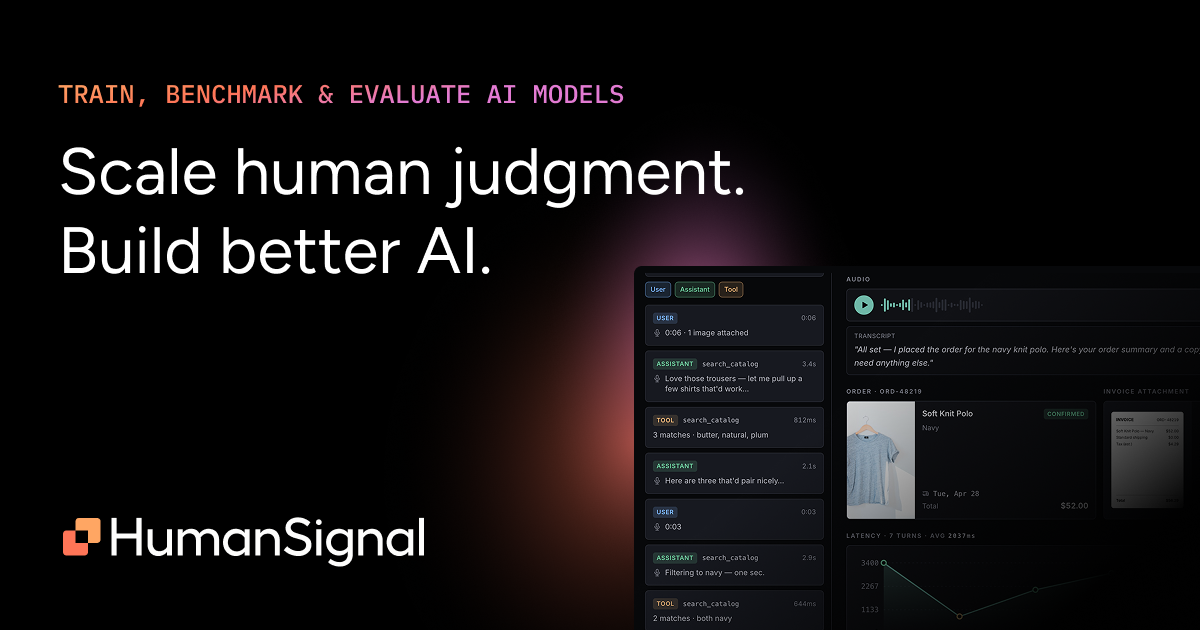
The company's tagline reads like a thesis statement: Scale human judgment. Build better AI. Behind it is a straightforward observation. Foundation models are trained on the open internet, which makes them broadly capable and generically similar. What makes a model useful for a specific company - a bank's risk language, a hospital's imaging, a game studio's assets - is the specialized, human-labeled data layered on top. HumanSignal builds the place where that layering happens.
Label Studio handles what most labeling tools do not: nearly every data type in one interface. Text, images, audio, video, time series, PDFs, and 3D data all live under the same roof, with customizable labeling interfaces and a standardized output format that plugs into a training pipeline. Teams can connect a model to pre-label data, then have humans correct it - a loop that gets faster the more it runs.
In practice, the tool bends to whatever a team is trying to teach a model. A radiology group can draw bounding boxes on scans; a support team can tag intents in thousands of chat logs; a speech team can transcribe and time-align audio; a search team can rank which of two answers is better. The labeling interface is defined in a simple configuration, which means the same install can be reshaped for a new task without new software. That flexibility is a large part of why a single open-source project ended up spanning so many industries.
One tool, many data types
02 / THE ORIGINFrom 20,000 feet to a labeling tool
HumanSignal started life in 2019 as a company called Heartex, founded by Michael Malyuk, Nikolai Liubimov, and Max Tkachenko. The founders trace the spark to an unlikely place: a hard climb in the Himalayas, thinking about how much signal gets lost in the trip from raw data to usable insight. The tool they built to close that gap became Label Studio, and they gave the core away as open source - a decision that turned a small team into a large community.
That community became the company's distribution. Instead of a sales team knocking on doors, Heartex had a million people already using its product, filing issues, and telling their employers about it. In 2022 the strategy attracted Redpoint Ventures, which led a $25M Series A that brought total funding to roughly $30M, alongside earlier backers Unusual Ventures, Bow Capital, and Swift Ventures.
03 / THE REBRANDWhy Heartex became HumanSignal
In June 2023, as generative AI reset the entire field, Heartex renamed itself HumanSignal. The new name was a bet as much as a brand. When every company can call the same handful of foundation models, differentiation moves to the data - and specifically to human feedback: the preferences, corrections, and judgments that fine-tune a model and keep it honest. HumanSignal wagered that this human layer would become more valuable as the models got more powerful, not less.
That reframing pulled the product toward the newest problems in AI. Reinforcement learning from human feedback (RLHF), LLM evaluation with customizable rubrics, preference collection, red teaming, and labeling the traces that AI agents leave behind - all of it runs on the same core idea of structured human input, and all of it now lives inside the platform.
04 / WHO USES ITFrom open-source download to Bayer
The user base splits cleanly in two. On one side are the individual practitioners - students, researchers, and ML engineers who pip-install the open-source edition and label a dataset over a weekend. On the other are AI platform teams at large companies who need governance, security, and support. HumanSignal names customers including Bayer, Electronic Arts, Epic Games, Lufthansa Technik, Verily, Zendesk, Canva, and Outreach.
What can a team actually do with it? Build a training set for a computer-vision model, evaluate whether one LLM answer beats another, collect the preference data that RLHF needs, transcribe and label audio, or red-team a model to find where it breaks. The same tool that helps a solo researcher clean a dataset also runs the human-feedback pipeline for a company shipping AI to millions of users. The problem it solves is the same at both ends: raw data is cheap and abundant, but data a model can learn from is scarce and expensive to make.
For those teams, Label Studio Enterprise adds the machinery that regulated and security-conscious organizations require: role-based access control, single sign-on, audit logging, reviewer workflows, uptime SLAs, and SOC 2 and HIPAA attestations. It can be bought directly through the AWS Marketplace, and for teams that would rather not label everything themselves, HumanSignal Data Services supplies expert annotators, with native speakers across 91 countries.
05 / THE BUSINESSGive away the tool, sell the platform
HumanSignal runs a classic open-core model. The free tool builds an enormous top of funnel and keeps the product honest against real-world use. Revenue comes from the enterprise platform - sold as subscription software and self-managed licenses - and from higher-touch data services. Public estimates put annual revenue around $3M against a team of roughly 130 people, a shape typical of an infrastructure company converting broad adoption into enterprise contracts.
The expertise the company has accumulated is less about any single feature than about the workflow around data quality. Good labeled data is not just labeled; it is reviewed, disagreements are resolved, edge cases are surfaced, and the whole thing is measured. HumanSignal's platform is built around that reality - reviewer queues, agreement metrics, and quality checks sit alongside the labeling itself. For a company shipping a model into production, that machinery is often the difference between a dataset it can trust and one it cannot.
- 2019 — Heartex founded; Label Studio released as open source.
- 2021 — Seed funding; adoption climbs across the ML community.
- 2022 — $25M Series A led by Redpoint Ventures; ~$30M total raised.
- 2023 — Rebrands to HumanSignal, repositioning around human feedback.
- 2024 — Expands into LLM evals, RLHF, and agent-trace labeling.
06 / THE FIELDHow it stands apart
Data labeling is a crowded, well-funded corner of AI. Scale AI is the best-known name, and Labelbox, SuperAnnotate, Snorkel, V7, Encord, and Surge AI all compete for the same buyers. HumanSignal's differentiators are consistent: an open-source core that lets teams start for free and inspect the code, unusually wide support across data types, and the option to self-host for full data sovereignty - a real concern for a hospital or a bank that cannot ship sensitive data to a third party.
Whether the wager pays off depends on a question no one has fully answered yet: as models automate more of the labeling itself, does the human layer shrink or move up the stack? HumanSignal's answer is that it moves up - from labeling cats to judging whether an agent behaved well - and that judgment stays human for a long time. The company has spent seven years building the tool that would prove it right.