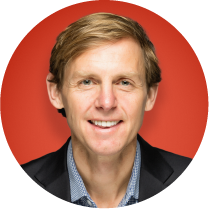
The reviews you skim before buying software? He built the place they live.
Open a tab, type in the name of some unglamorous piece of business software - a help desk tool, a CRM, an e-signature app - and somewhere in the results sits a wall of star ratings and verified peer reviews. That wall is G2. And the person who decided the world needed it is Godard Abel, who co-founded the company in 2012 and still runs it as CEO from Chicago, with a foot in Boulder, Colorado.
The pitch was almost insultingly simple: bring the logic of Yelp to the way companies buy software. For decades, buying enterprise tools meant paying analysts for thick reports. Abel bet that a buyer would trust a hundred people who actually used the thing over one expert who was paid to grade it. He was right. G2 became the marketplace where that trust gets priced.
In early 2026 he made the bet louder. G2 announced it would acquire Capterra, Software Advice, and GetApp from Gartner - the very analyst giant whose model G2 set out to replace. The deal was announced January 29 and closed a week later, on February 5. In one move, Abel folded the biggest neighboring review properties into his own and called it "a transformational moment" for the industry.
Now, in 2025 with generative AI, we are seeing the biggest wave in tech since the advent of the commercial internet 30 years ago.Godard Abel
Meet Monty, the agent that shops for you
G2 sits on millions of verified reviews. The obvious next question in an AI world: what if a buyer could just ask the pile of data a question and get an answer? So in 2025 Abel shipped Monty, an AI assistant that walks buyers toward the right tool, and Monty for Sales, an agent that works the other side of the table - educating, prequalifying, and converting buyers on behalf of software vendors.
Abel talks openly about where this leads: "agent-to-agent buying likely coming soon." One bot representing the buyer, another representing the seller, negotiating over a dataset of human opinions. It is a strange future, and he is building the marketplace for it rather than waiting to be disrupted by it.
Monty
The buyer's assistant. Layers AI over G2's review corpus to hand each buyer personalized software recommendations.
Monty for Sales
A dedicated AI sales rep for vendors, built to educate and convert buyers at scale, day and night.
Three generations, one instinct: build the thing
The entrepreneurial streak did not start with Godard. It started in the rubble of postwar Germany, where his grandfather founded a pump company, Abel Pumps. His father took the business over and moved the family from Monchengladbach - where Godard was born - to the United States to launch the American arm. Godard grew up around Pittsburgh, at the dinner table where the day's talk was business.
He collected the credentials of someone who could have done anything: a bachelor's and master's in mechanical engineering from MIT, an MBA from Stanford, a stint at McKinsey sharpening strategy. Then he did the least safe thing available and started a company.
Ride these waves to accelerate the inevitable, but don't set your vision too broad. Focus on a narrow problem you uniquely care about.Godard Abel / on how to scale
He sold to Oracle. Then he sold to Salesforce. Then he started over.
In 1999 Abel co-founded BigMachines with two MIT friends, Christopher Shutts and Eugene Chiu. It was pricing-and-configuration software - CPQ, in the trade - and for years it struggled. A co-founder talked him into relocating the company to the Chicago suburb of Deerfield in 2004, and the move changed everything. By the time Abel stepped down as CEO in 2011, BigMachines had more than 300 employees. In 2013, Oracle bought it for a reported $400 million-plus.
Most people would have coasted. Abel started SteelBrick in 2014 - and, improbably, ran it at the same time as the young G2, which then had only about $2.3M in funding and little traction. Salesforce acquired SteelBrick in 2016; Abel joined as an SVP and general manager, running what is now Salesforce Revenue Cloud, until he left in 2017 to pour himself back into G2 full time.
Two enterprise software companies, two of the biggest acquirers in the industry. He could have retired into board seats and angel checks. Instead he went back to the harder, weirder company he had started on the side.
Bars scaled for comparison. Figures from public reporting and company disclosures.
The near-bankruptcy that taught him to ignore advice
The BigMachines story has a chapter founders rarely brag about. Early investors pushed Abel to take the company public within a year. He listened. The company scaled before it was ready and came close to going under. He survived it, and he now cites it as the lesson that shaped him: not all advice, even from smart people writing checks, deserves to be followed.
Out of that came a management philosophy he borrows from leadership coach Jim Dethmer - the idea that at any given moment a leader is operating from either fear or love. Abel tries to lead from the second. He also talks about leading "from the front," which for him means doing the actual work of winning customers and building product, not delegating from behind a desk.
How a book about Maslow became a company's operating system
At a Stanford alumni event, Abel picked up Chip Conley's book PEAK: How Great Companies Get Their Mojo from Maslow. He turned the title into a mnemonic and then into G2's values: Performance, Entrepreneurship, Authenticity, Kindness. He signs his own posts "PEAK." It is the kind of earnest founder move that can read as corporate, except that Abel keeps returning to the word to describe his own ambition, too - his "next PEAK" is to take G2 public.
I want to build a public company at G2 that truly is the trusted place where the world's knowledge workers go for trusted software and AI insights.Godard Abel / on the next PEAK
What he wants that has nothing to do with software
Ask Abel about aspirations and the answer wanders past the balance sheet. He has spoken about wanting every child to have access to quality education and safe environments starting in pre-K, on the belief that early learning shapes what a person can become. It is a long way from CPQ software - and maybe not, if you think of both as bets on giving people a better starting position.
Things that don't fit on a LinkedIn profile
Third-generation entrepreneur - grandfather, father, then Godard.
Degrees from two brutally selective schools: two from MIT, one from Stanford.
Ran G2 and SteelBrick at the same time in the mid-2010s.
Born in Monchengladbach, Germany; raised near Pittsburgh.