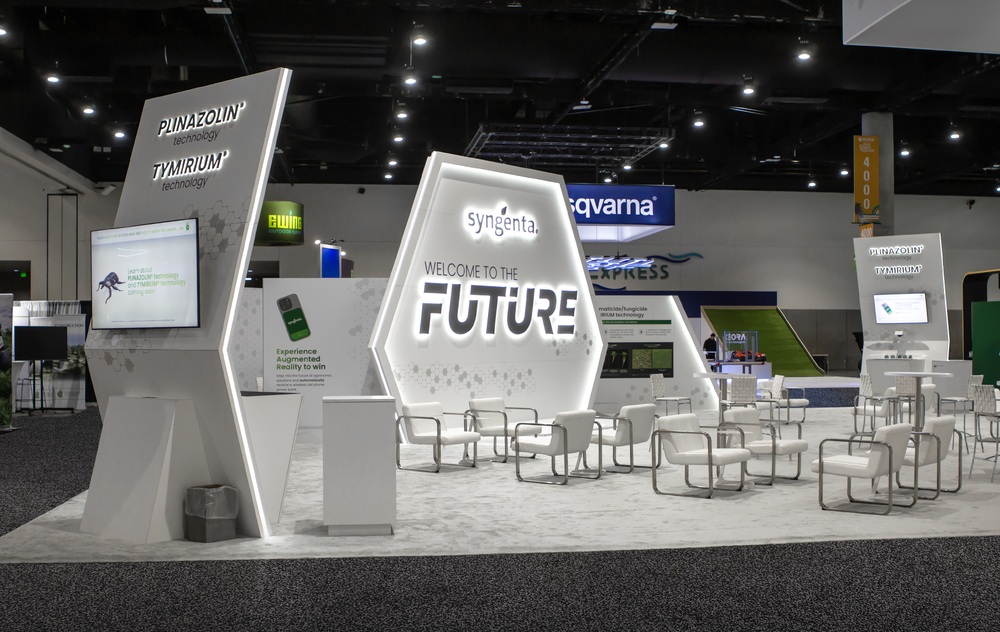
At the 2025 golf-course industry trade show, Syngenta had a peculiar problem. It wanted to explain new turf technologies in a room where everyone already knew what grass looked like. G&S Business Communications helped give the company a white, museum-like booth and an augmented-reality experience featuring enlarged pests. Suddenly, something small enough to overlook became something visitors could inspect.
The quick read
- G&S translates specialized businesses for the people making decisions about them.
- Its work connects research, brand strategy, creative production, public relations and paid media.
- Clients span crop science, manufacturing, healthcare and professional services.
The booth is a useful introduction to the agency. G&S works where a product’s explanation can become an obstacle to its adoption. The assignment often begins with a practical question: what does someone need to understand before they can do something useful?
A small pest, a different conversation
For Syngenta, the experience extended beyond the exhibition floor. G&S built a microsite and coordinated advertising, email and social content before the show. The agency reports pre-show video views exceeding nine times forecast and landing-page visits approaching five times the previous year’s level. Those figures measure attention against different benchmarks; they do not establish product sales.
“In a sea of green booths featuring grass, our clean, white, museum-like space immediately stood out.”
Mark LaFleur · Syngenta communications lead
The revealing detail is the client’s reaction. Syngenta’s communications lead described the approach as a departure from tradition and said elements would be reused. An unfamiliar presentation had made familiar subject matter easier to discuss. That is a more useful ambition for a trade-show booth than merely occupying more square feet.
The initials came before the integration
Dick Gibbs and Richard Soell left Burson-Marsteller in 1971 to establish their own firm. Their bet, as the agency’s fiftieth-anniversary account describes it, was on client service and deep knowledge of selected industries. That choice still explains the business better than a long menu of marketing disciplines.
Today, G&S specializes in B2B and B2B2C communications. Those labels cover a complicated social arrangement: a company may need to persuade a distributor, an adviser and an end user about the same product. Its sectors include agribusiness, advanced manufacturing, healthcare, home and outdoor living, and professional services. Buyers, regulations and routes to market matter as much as the headline.
The firm also changed through acquisition. CooperKatz joined in 2018, bringing Anne Green, who became G&S CEO in January 2024. The MorganMyers acquisition in 2024 expanded food-and-agriculture expertise within a parent platform, G&S Integrated Marketing Communications Group. G&S Business Communications and MorganMyers operate as separate agency brands within that group.
When the specification sheet gets in the way
Consider DuPont Water Solutions. Its earlier case studies were, in G&S’s account, technical and transactional. The technology had value; the presentation made that value harder for broader audiences to grasp. The agency changed the starting point to the customer’s experience.
It filmed at operating water-treatment facilities, developed written narratives and testimonials, and distributed material through social channels and trade media. Ten customer stories were activated in a year. The useful mechanism was reuse: one real operating example could support a substantial film, a shorter clip and a written account for different readers.
At Lallemand Animal Nutrition, the confusion lived inside the portfolio. Multiple legacy brands and inconsistent names made products harder to navigate. G&S used customer research to inform a unified architecture and the MAGNIVA brand, rolled out across more than 20 countries within 14 months. Sometimes the most valuable communication is a name that makes choosing easier.
How G&S organizes the work
An agency service model, rather than a measured conversion funnel.
Attention needs somewhere to go
Insightec’s assignment makes the next step explicit. Its “Get a Grip on ET” campaign addressed essential tremor through educational content, testimonials, videos and an interactive symptom checker. Paid and organic social distribution directed people toward resources. G&S reports more than 60,000 website sessions and 439 new-patient leads. A lead is an inquiry, not evidence that someone received treatment.
A different kind of urgency shaped Miravis Neo, Syngenta’s fungicide. In early 2025, a competitor cut pricing shortly before purchasing decisions. G&S’s eight-week Neo Surge campaign connected events, advertising, retailer communications and sales materials around performance and value. The agency reports 276 qualified leads at Commodity Classic. The work illustrates why an agricultural buying decision needs more than a message aimed only at growers.
The business behind the explanation
G&S sells professional services: research, positioning, campaigns, content, media activity and measurement. Its current capabilities also include crisis preparation, spokesperson training, sales enablement and generative engine optimization, which addresses how brands appear in AI-mediated discovery. A buyer is hiring an agency team to coordinate an assignment, with scope and distribution determining the practical work involved.

The positioning sits between a specialist communications boutique and a broader integrated agency. Its case rests on combining sector familiarity with execution across channels. For a prospective client, the sensible test is whether the team understands the actual buying process, can explain the technical evidence and can name an outcome beyond impressions.
That coordination has an internal counterpart. The parent group describes a FlexConnect hybrid model, an inclusion advisory structure and on-demand learning. These are the organization’s stated practices; they show how it says it supports the teams doing the work.
Borrow the question before the campaign
The copyable idea is to begin with a decision. Identify who makes it, who influences it and what uncertainty prevents it. Build the explanation around that uncertainty. Then give the audience a practical next step and measure whether people take it.
For a simple offer with a short buying cycle, an elaborate integrated assignment may add more coordination than value. Technical storytelling also depends on evidence worth explaining. G&S’s most instructive work starts with something concrete: a facility, a product, a customer problem. Even the giant pest had a job to do.
Follow the work
Explore G&S, its client work, perspectives and The Topline.