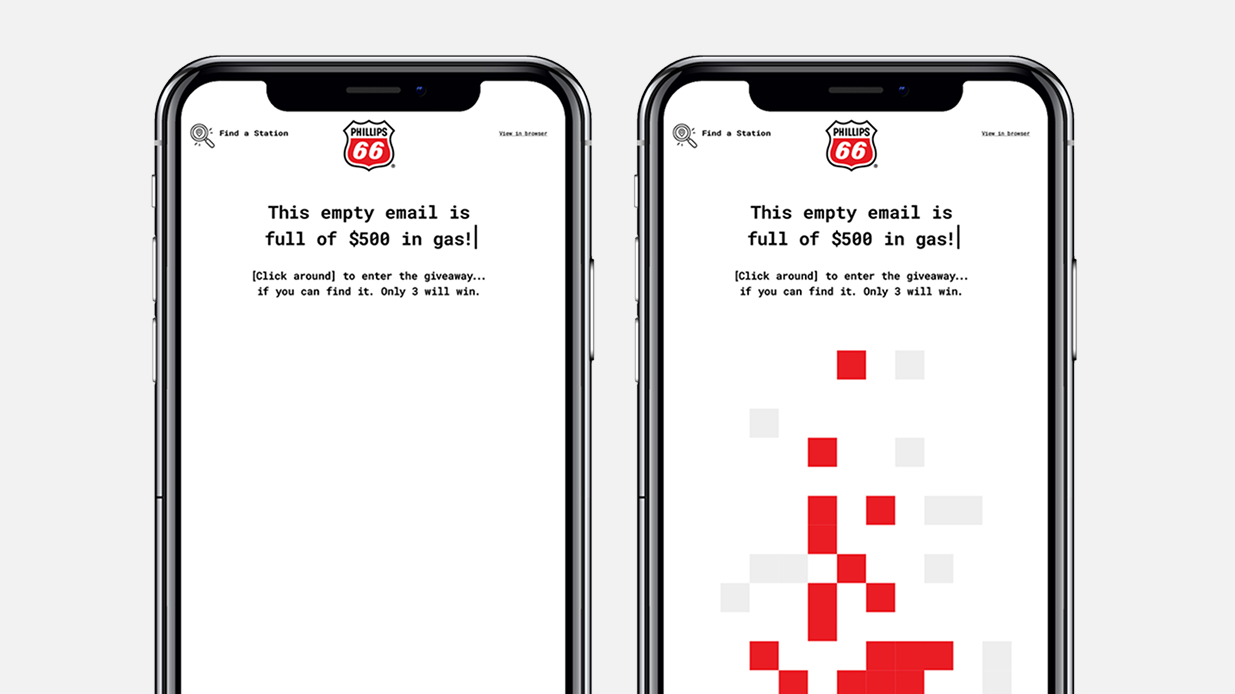
A blank email is an odd thing to send on purpose. For Phillips 66, Love Advertising made the emptiness the attraction. Click around the apparently vacant message and you could uncover a chance to win free gas. The inbox, that crowded little corridor of demands, briefly became a game.
- The offer: strategy, creative, media, digital and PR from one independent Houston agency.
- The evidence: playful fuel-brand campaigns, a community-minded YMCA repositioning and a 2026 pizza account win.
- The useful idea: give people something to do with an advertisement.
There is a practical question hiding inside that stunt: what happens when the people who invent an advertisement also understand where it must live? Love’s answer runs through its portfolio. An email can become a game. A dirty windshield can become a canvas. A gym membership can become an invitation to belong.
The inbox had room for a game
Hidden Gas Hunt borrowed from Minesweeper and Battleship. Its brief was to encourage app downloads and fuel purchases, while giving subscribers something worth sharing. Associate creative director Brett Reiland’s portfolio reports 2,618 entrants across Phillips 66, 76 and Conoco, with $1,500 in giveaways.
That dollar figure describes prizes, not the total campaign budget. Keeping the distinction matters: an inexpensive reward can sit inside a substantial production and distribution effort. The lesson available to another marketer is narrower, and more useful, than “cheap advertising works.” A familiar channel can reward participation instead of merely requesting attention.
Brenda Love’s long game
Brenda Love founded the agency in 1979. A biography published by the Peace of Mind Foundation puts her starting capital at $500. The detail gives the company’s name a pleasing double duty: a surname on the door, and a remarkably small sum behind it.
Her agency biography emphasizes integrity and honesty, alongside client relationships lasting more than 25 years. Those are the company’s own claims, but they explain its chosen identity. Love presents itself as an independent shop built around continuing relationships. Its current about page describes a team of more than 70.

That puts Love in an interesting part of the market: large enough to maintain several disciplines, still identified with its founder and city. Houston’s Adcetera offers a comparable breadth of integrated services. Love’s distinction rests in its particular combination of client continuity, fuel-brand experience and work spanning physical events, broadcast and the inbox.
One address, several kinds of thinking
The agency says strategy, brand planning, PR, media buying and creative production happen at its Houston Heights address. For a client, the promise is straightforward: fewer organizational handoffs between deciding what to say, making it and placing it. Whether that produces better work depends on how those people collaborate.
- 01Strategy +
brand planning - 02Creative +
production - 03Media +
public relations
Its careers page offers a small clue to the intended culture. Internships cross departmental boundaries: creatives learn from media, and account-service staff might work on a layout. That approach treats an agency as a collection of connected decisions. A beautiful layout still needs somewhere sensible to run.
The work makes the breadth tangible. For Conoco, Love used a Denver Broncos sponsorship to feature Hall of Famers in dirty-windshield art at the stadium. For 76, Dream Car paired children’s imagined vehicles with a professional car designer. Both projects start with something people already recognize, then make it slightly strange.
A gym becomes a reason to show up
The YMCA work asks for a different kind of attention. In “Not a Place. A Purpose.” Love frames the organization around community and loneliness after the pandemic. The change is in the reason to visit: exercise remains available, but connection becomes the invitation.
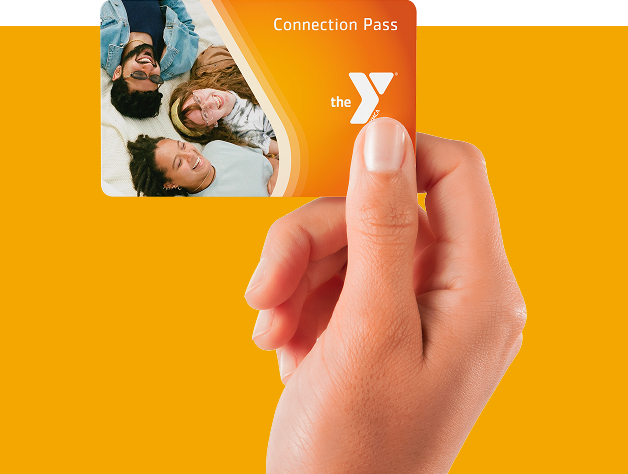
A Connection Pass and campaign posters carry that proposition into tangible materials. This is useful brand strategy because it changes what the audience is being asked to value. Comparing exercise equipment invites one conversation. Thinking about a place to meet people invites another. The agency’s portfolio makes that strategic choice visible.
The same organization also produces casino campaigns and waterpark advertising. Naskila Casino’s “Lucky Signs” plays with unexpected luck; Pyek Group’s “Passport to Summer” turns waterparks into a seasonal destination. Love’s expertise crosses categories while repeatedly looking for a recognizable human situation to organize the message.
Recognition has followed several kinds of work. Love’s awards archive records a 2024 Houston ADDY Best of Show for Hidden Gas Hunt and a 2023 broadcast Best of Show for the YMCA’s “Young Mom.” In June 2025, the Radio Advertising Bureau named Love among the Radio Mercury winners for Naskila Casino. The variety is revealing: the agency is still making a case for craft in established channels while experimenting inside newer ones. For a prospective client, these awards help identify work to inspect; the relevant question remains whether the idea serves the business.
The pizza chain wanted the whole kitchen
In January 2026, Vocelli Pizza named Love its marketing agency of record after reviewing more than eight agencies. The chain specifically cited in-house creative, strategy and integrated services. Its announcement described more than 80 locations and a remit covering brand development, reputation management, SEO, PR, social campaigns, website support and media.
“Love brings a wealth of experience in the QSR sector and, more importantly, the pizza category.”Toni Bianco, CEO, Vocelli Pizza
The business model is professional services: clients hire people and expertise to plan and execute marketing. One public SFA agreement illustrates the mechanics, with approved scopes, estimates and budgets. Its amended ceiling is $350,000 annually and $1.75 million across a possible five-year term. Those are contract limits, not proof of spending or Love’s revenue.
For a marketer considering Love, the portfolio supplies a sensible starting point: decide whether the job needs several disciplines working together, then examine work resembling the actual problem. A tightly bounded assignment may need only a specialist. Interactive ideas also depend on the audience’s devices and willingness to participate. The blank email works as an invitation only when someone wants to click.
The next conversation should be specific. Bring the audience, the desired action and the constraints into the brief. Ask how the proposed creative would behave in its actual channel, who will make it and how results will be judged. Love’s range makes that conversation possible across several services; a clear business objective gives those services something useful to work toward.