The smallest drama in Figma is a colored cursor arriving uninvited. It skitters across the canvas, selects the button you were polishing, then pauses. Someone else is here. They can see the same pixels, the same component, the same half-finished thought. In older design software, that person would have waited for an export, opened an attachment or left a comment on a screenshot already going stale. Figma made their presence immediate. The cursor looks trivial. It is the business.
Figma began in 2012 with a technical wager by co-founders Dylan Field and Evan Wallace: professional creative software could live in a web browser. The harder and more valuable wager was social. A design did not have to be a precious local file passed from expert to expert. It could be a shared URL where designers, product managers, engineers, researchers, writers and clients worked around the same object. The product launched publicly in 2016 after years spent making browser graphics behave like a desktop application.
That choice changed the unit of work. Instead of asking, "Which version do you have?" a team could ask, "Are you in the file?" Comments stayed attached to decisions. Components could be reused. Prototypes sat beside source frames. A design system became a live dependency rather than a PDF of commandments. Figma did not remove disagreement from product work. It gave disagreement an address.
“The cleverest thing Figma designed was not a button. It was a shared place to disagree.”The multiplayer advantage
The file became a room
The clearest measure of Figma's expansion is who shows up. In the final three months of 2025, the company said roughly two-thirds of its monthly active users were not designers. This is not a side effect. It is how a specialist tool became company infrastructure. A product manager can sketch a flow in FigJam, a designer can turn it into an interface in Figma Design, an engineer can inspect variables and components in Dev Mode, and a marketer can pull approved material into Buzz. Nobody needs the same level of craft, but everybody can stay near the work.
The customer list ranges from solo founders to Microsoft, Netflix, Airbnb, GitHub, Slack, Atlassian, Stripe and The New York Times. Those names are useful, but the adoption pattern matters more. Someone begins free, invites colleagues, borrows a community file, installs a plugin, and slowly creates shared dependencies. When the work becomes important, the company buys seats, permissions, security, libraries and governance. Figma's distribution is hiding inside its collaboration mechanics.
A suite built around the handoff
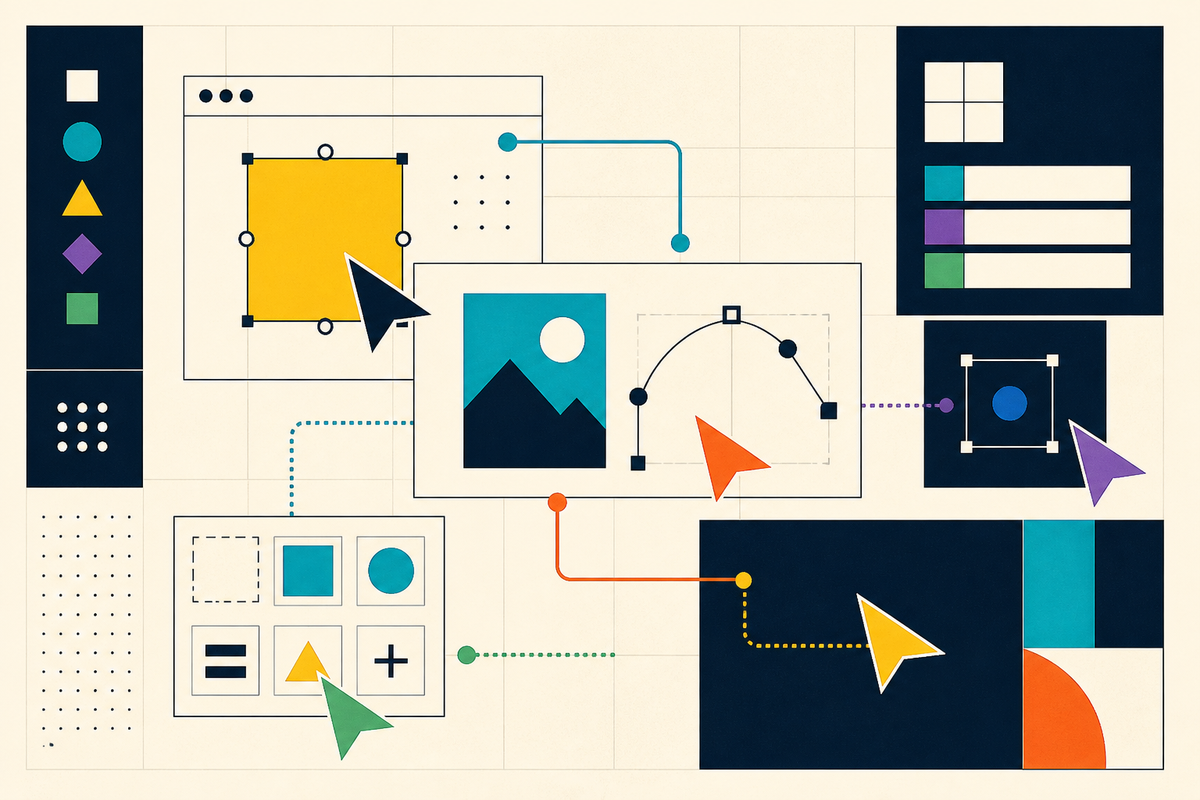
The original Figma Design combines vector editing, interface layout, prototyping, animation, reusable components and feedback. FigJam, launched in 2021, catches the messier upstream work: meetings, diagrams, research, sticky notes and plans. Dev Mode arrived in 2023 to make specifications, assets and code-linked components easier for engineers to use. Slides followed in 2024, bringing live designs and prototypes into presentations.
Then the surface area widened quickly. At Config 2025, Figma introduced Sites for visual website publishing, Buzz for scaled brand content, Draw for richer illustration, and Make for turning prompts and designs into interactive, code-backed prototypes. Weavy, acquired and renamed Figma Weave, added AI-assisted image and video workflows. In 2026, Figma previewed code layers, expanded its agent, and added Motion, shader effects and generative plugins. A local-code beta for Make even lets selected users visually edit a production codebase and create a pull request without leaving Figma.
One connected product loop
FigJam
Canvas
Make
Dev Mode
Sites / code
This is where Figma differs from tools that win one step. Sketch and Adobe remain alternatives for design. Miro and Lucid compete for the whiteboard. Canva dominates fast visual communication. Framer and Webflow publish websites. AI builders such as Lovable, Replit and v0 can jump from prompt to application. Figma's defense is the connective tissue: a component, comment, prototype, variable, design-system rule and code reference can retain context while the work crosses roles.
Every handoff translates intent. Translation creates delay, missing detail and duplicate work. Figma's platform tries to make the object itself carry more of the context.
The economics of one more cursor
Figma is a freemium software business. Individuals and small teams can begin without paying, while Professional, Organization and Enterprise customers buy monthly or annual seats. Larger plans add centralized administration, security, libraries, analytics and controls. A direct sales team helps complex organizations deploy the platform. In March 2026, Figma also began enforcing AI-credit limits and selling more usage, adding a consumption meter to a business built mainly around seats.
The model benefits when one discipline invites another. By March 31, 2026, Figma reported about 690,000 paid customers, up 54 percent from a year earlier. Of those, 15,218 generated at least $10,000 in annual recurring revenue and 1,525 generated at least $100,000. Net dollar retention reached 139 percent, meaning the larger customer cohort spent substantially more after expansion and churn were counted. First-quarter revenue was $333.4 million, up 46 percent year over year, after full-year 2025 revenue crossed $1.05 billion.
AI makes the economics less tidy. Model inference costs money, usage can be spiky, and generated interfaces may compete with the careful seat-by-seat workflow that made Figma valuable. It also makes more people capable of producing software. Figma's answer is context. A blank prompt can make a plausible screen, but a team needs its own components, data, constraints, history and taste. Make kits and attachments bring those ingredients into generation. The MCP server gives coding agents access to design context. The company is betting that cheap creation increases the value of a shared place to decide what should survive.
The $20 billion plot twist
Figma's corporate history briefly threatened to swallow its product story. Adobe agreed to acquire the company for $20 billion in 2022. Regulators in the United Kingdom and Europe challenged the combination, and the companies ended the deal in December 2023. Adobe paid Figma a $1 billion termination fee. The episode left Figma independent, well funded and facing an obvious question: could it grow into the number that had been printed on it?
The company answered in public. Figma listed on the New York Stock Exchange under the ticker FIG on July 31, 2025, raising about $1.2 billion at $33 a share. Its first-day market value was dramatic, then moved with the volatility familiar to new public companies. The durable achievement was simpler: a product that began as an improbable browser experiment had become a billion-dollar revenue business with 1,886 employees at the end of 2025.
Inside, Figma calls those employees Figmates. Its stated values include building community, running with initiative, loving craft, growing through feedback and playing. Maker Week gives the company time for odd experiments. That playful vocabulary can sound cute until it is placed beside the product. Figma sells a serious organizational idea: people do better work when they can see one another working, try something before asking permission, and respond to the thing itself.
Where design ends
The risk in widening the canvas is clutter. A focused design tool can become a busy suite. Designers may resent automation that flattens craft; developers may reject generated code that ignores a real architecture; marketers already have dedicated systems; enterprises can tire of seat definitions and credit meters. Competitors do not need to replace all of Figma. They can peel away a valuable moment and make the return trip unnecessary.
Yet Figma has one advantage that is difficult to demonstrate in a feature checklist. Its users already gather there. The interface mockup is beside the component library. The comment is beside the decision. The engineer can see what changed. The product manager can move a sticky note without scheduling a ceremony. AI agents can increasingly enter the same context. This is less romantic than a machine that invents an app from one sentence. It is also closer to how products are actually made: in revisions, compromises, jokes, objections and the occasional cursor hovering over your rectangle.
“As creation gets cheaper, shared context becomes more expensive - and more useful.”Figma's next market
Figma's mission is to make design accessible to everyone. Its more practical accomplishment has been making design observable by everyone. The company now has to prove that the room can stretch from brainstorm to production without losing the precision that brought people inside. If it can, Figma will be more than the place a screen is drawn. It will be where a digital product remembers how it became itself.