A fish can be caught in the right sea, by the right person, and still end up on the wrong side of an economic arrangement. Getting it out of the water is one job. Finding a dependable buyer, preserving its quality and getting paid fairly are several more. Farid Naufal Aslam built his career in the distance between those jobs. The distance turns out to be considerable, even when everyone involved owns a telephone.
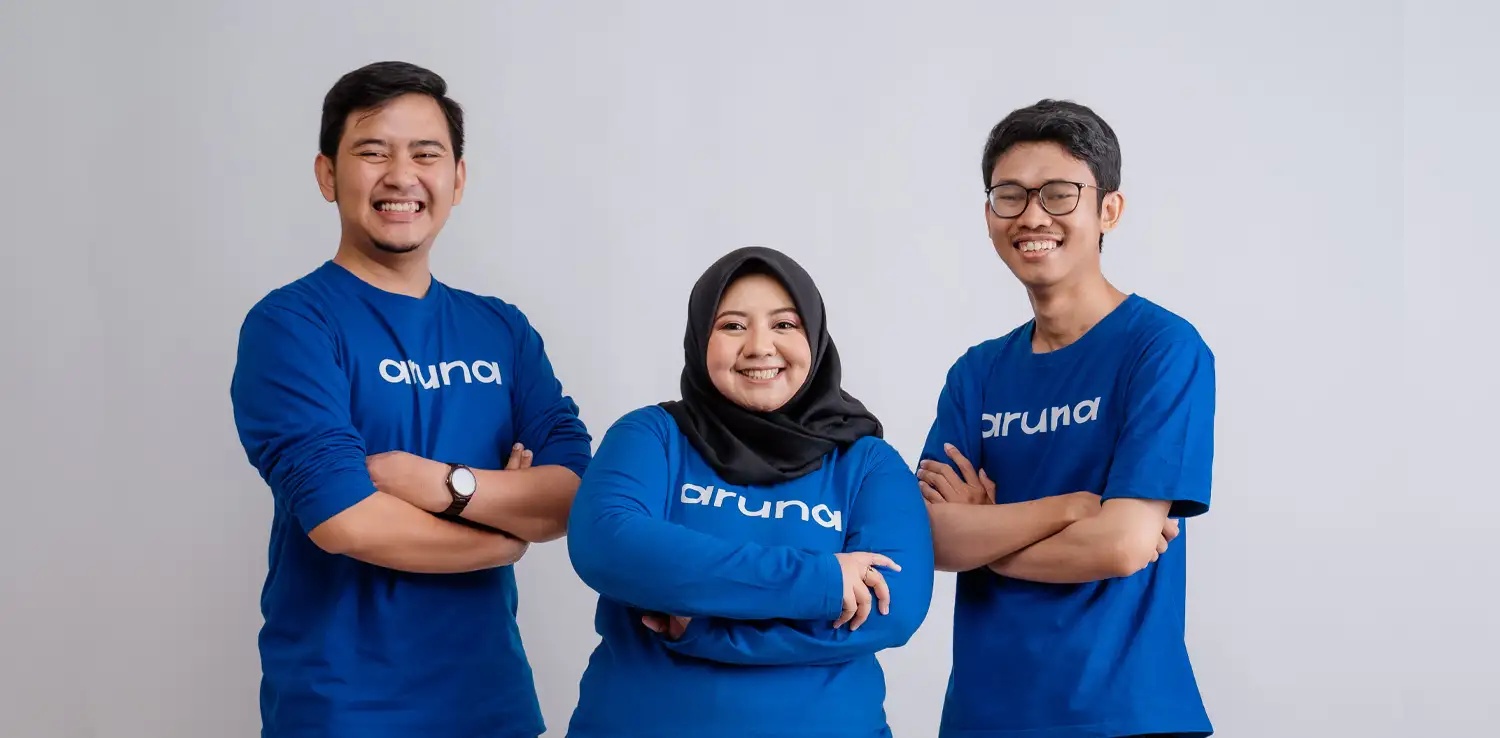
He is the co-founder and CEO of Aruna, the Indonesian fisheries commerce company he started with Utari Octavianty and Indraka Fadhlillah in 2016. Their proposition sounds straightforward: connect small-scale fishers with a wider market. Following that proposition into a coastal village makes it considerably more interesting. There are boats, habits, relationships and products with an unforgiving clock. A marketplace can arrange an introduction. Dinner still has to arrive.
A small world, a very large coast
Before building a trading network, Farid studied networks of another sort. His undergraduate work at Telkom University examined relationships between investors and ICT startups in Indonesia and Singapore. With Andry Alamsyah, he co-authored a paper on the small-world phenomenon: the way a seemingly complicated web of connections can contain surprisingly short paths between people and organizations. The conference reference dates to 2016; the paper appeared on arXiv in 2021.
That academic interest gives his later career an appealing symmetry. An investor trying to reach a startup and a fisher trying to reach a customer face different circumstances, but both depend on connections. The resemblance is an editorial one, rather than a claim that a research paper supplied Aruna’s business plan. What is clear is that Farid was thinking seriously about networks before running a company built around them.
At Telkom, he studied ICT business management from 2011 to 2016. His professional profile records a full scholarship and interests in social computing, big data and network theory. In 2019, he added executive programs in data-driven decision-making at UC Berkeley and artificial intelligence at MIT. These were short executive programs. The useful detail is the subject matter: he kept returning to how information could improve a business decision.
Three classmates, two kinds of knowledge
Farid’s interest in technology met a more intimate understanding of the coast through his classmates. Utari and Indraka had coastal backgrounds; Utari grew up around the fishing trade in Balikpapan. In her account of their beginnings, Farid supplied the particular enthusiasm for technology. Their partnership joined people who understood the market’s machinery with people who had lived close to the people it served.
The idea also had an everyday irritation behind it. While studying in Bandung, the coast-raised students struggled to find the fresh seafood they were used to. The problem looked different from inland: fish could be abundant at its origin and expensive by the time it reached a plate. Distribution was already editing the menu.
Their early product, Pasarlaut, concentrated on smaller local sales. Infrastructure constraints complicated that approach, and Aruna developed around access to export buyers. The first fisher collective formed near Utari’s home in Balikpapan. Farid’s career as an entrepreneur therefore began with two linked tasks: finding customers and helping organize a supply that could actually serve them. Neither task politely waited for the other to finish.
By 2017, Aruna was already connecting fishers with bulk customers such as restaurants, hotels and supermarkets. Farid’s early ambition to enter e-commerce had acquired a particular set of responsibilities. The product could spoil, supply came from many small operators, and the people at its origin needed a reason to trust a different arrangement.
The person between the phone and the boat
The founders had competed in business-plan contests as students. Their team won at ISEA INDFEST in 2015, before Aruna’s formal start the following March. Competitions could test whether an idea persuaded a panel. A fishing community offered another examination altogether. Established ways of buying, selling and borrowing came with histories that a new platform could hardly erase by arriving with a presentation.
Aruna’s response included local people known as Local Heroes. They helped fishers work with the platform and acted as the company’s connection to their communities. The job required explaining unfamiliar systems and understanding local relationships. In a business commonly described through technology, a significant part of the interface could hold a conversation.
That arrangement matters to understanding Farid’s role. His technological background was one part of the founding combination. Aruna’s day-to-day usefulness depended on people translating the system into a village’s working life. Utari has described early difficulties winning acceptance and adapting technology to fishers’ circumstances. The company had to earn participation through repeated contact, rather than assume that access to an app produced confidence in its operator.
- 01The catchSmall-scale fishers
- 02The connectionLocal teams + data
- 03The handlingHubs + processing
- 04The customerDomestic + export
A simplified view of the work between landing a catch and reaching a buyer.
A fish has a deadline
Software can record what is available. Seafood also needs handling, processing and a route to the customer that preserves quality. Aruna developed hubs and data systems alongside its commercial relationships. The resulting business looks less weightless than the word “platform” might suggest. Fish have never shown much interest in the convenience of a founder’s preferred business model.
The work inside the supply chain extended beyond the people going out in boats. Women in coastal communities took on seafood-processing jobs. Local teams helped with digital adoption; training covered financial literacy and business skills. A catch could create income at several points before reaching its buyer. That wider household economy helps explain why the founders talked about coastal livelihoods rather than simply the price of an individual fish.
There is a useful qualification in Utari’s account of market access. A fisher might sometimes obtain a better price locally; a buyer might sometimes find a cheaper offer elsewhere. Aruna’s proposition also involved more consistent demand and confidence about product standards. A good transaction today matters. Having a customer tomorrow changes what someone can plan. That distinction makes the business more interesting than a claim to win every price comparison.
By April 2023, Aruna’s university described a network of 40,000 fishers, 177 hubs and exports reaching eight countries. It also recorded a 15-ton shipment of blue swimming crab to mainland China under the BOON brand. These are dated milestones, not a live scoreboard. They show the kinds of practical obligations accumulating around an idea that began among students.
The prize and the plumbing
In April 2019, Aruna won the inaugural Alipay-NUS Enterprise Social Innovation Challenge, emerging from 350 submissions and a final field of nine teams. The award brought S$50,000, on top of the S$10,000 awarded to each finalist. It was an international stage for a business whose work remained rooted in individual fishing communities.
“We will next work on further growing our team and help more fishermen out of poverty.”
Farid Naufal Aslam, following the 2019 Alipay-NUS Enterprise win
His response to the win was practical: more people on the team, more people reached by the business. Recognition continued. Farid and his fellow founders entered Forbes 30 Under 30 Asia in 2020. Endeavor selected him in May 2021. Tatler included him among Indonesia’s Gen.T Leaders of Tomorrow in 2023. The sequence charts a widening audience for work that had started with classmates and a seafood problem.
Capital followed, too. Aruna raised $35 million in Series A financing in 2021 and another $30 million in 2022. Money could support expansion, but the operating requirements stayed stubbornly physical. More customers meant coordinating supply, processing and delivery. Each additional connection brought an obligation to make it work. A funding announcement is brief; the fish keep coming.
Figures reported by Aruna. The company said women filled 90% of those coastal jobs.
Even the shells have work to do
One revealing detail in Farid’s account concerns what happens after the useful meat has been removed. At Aruna’s Bangkalan hub, discarded blue swimming crab shells were turned into fish feed. The example puts a concrete object inside a conversation that can otherwise drift toward large ambitions. A shell remains a shell until someone finds a process and a use for it.
Farid has emphasized community participation and environmental preservation together. That pairing fits a business in which coastal women and young people can participate in processing and waste management. It also leaves something tangible to inspect: materials handled, jobs done and products sold. In this part of his story, the leftovers are part of the enterprise.
The arithmetic gets harder
Growth did not spare Aruna difficult choices. On March 1, 2025, Farid signed a statement announcing workforce adjustments as part of a strategic restructuring. He described tighter access to capital across the sector and said the company was concentrating on productivity, stronger operations and long-term business continuity. For a founder whose stated purpose includes creating livelihoods, reducing the workforce is a consequential part of the record.
Later that March, Aruna reported partnerships with 55,000 fishers and more than 7,000 coastal jobs. The two announcements belong together: a large network of people depending on the business, and a company making changes to keep operating. Scale describes the reach of a promise. It also describes the number of relationships that management must continue to support.
In December 2025, Metro TV recognized Farid in its People of the Year awards, in the category celebrating figures who advance economic independence. The recognition returned the story to the same question that had animated Aruna’s beginnings: who gets a fair opportunity to participate in the trade? Farid’s contribution has been to help build the connections around that question. The test arrives with each new catch.