The first useful artifact in Roberto Milk’s story is not a pitch deck. It is a Volkswagen van. During long summers, his teacher parents packed Roberto, his younger brother Andy, their childhood friend Charles Hachtmann, assorted cousins and both grandmothers into a navy-blue VW and pointed it toward Mexico. Other trips took the family through Peru and Europe. They wandered markets, met craftspeople and returned with objects that made childhood collecting feel like fieldwork: ceramics, alpaca figures, carved coconut pirates, mariachi frogs and whatever else the van could bear.
The passengers supplied a portable philosophy. His mother, Rosa, was Peruvian; his American father had served in the Peace Corps and met her while both were teaching in Peru. One grandmother was an artisan. The other had been a missionary. One represented the hand that makes; the other, the impulse to serve. Milk would later describe himself as a fusion of those influences, a tidy line for a childhood that appears to have been charmingly untidy.
Years later, the souvenirs became evidence. Talented makers could produce beautiful work and still struggle to reach a customer. The object traveled. The name of its maker often did not. Milk’s career would become an attempt to correct that vanishing act.
A party, then Portuguese
In 1995, Milk was a senior at Stanford studying international relations. At a campus party where he was spinning music as a DJ, he met Mina Olivera, a Brazilian student who would become his wife and a NOVICA co-founder. The next day, he enrolled in Portuguese for Spanish Speakers. Romance, in this instance, had an unusually efficient registration process.
In that class, professor Karin van den Dool discussed Brazilian artisans who could no longer make a living through traditional craft. Their work risked disappearing with their livelihoods. The subject connected Milk’s academic interests with the markets of his childhood. He could see a new commercial route: use the internet to connect remote artisans directly with people who valued what they made.
My brother and I learned to not just observe poverty, but consider ways we could be of service.Roberto Milk
This was not a solitary light-bulb story. Milk’s future mother-in-law, Armenia Nercessian de Oliveira, was a United Nations human-rights officer. When she heard the idea, she said she would consider leaving the UN to help build it. His brother Andy, childhood friend Charles, Stanford roommate José Cervantes and Mina joined the founding group. The company would emerge from an uncommon mixture of dormitory friendship and family diplomacy.
Four years of useful delay
Milk did not leap from classroom epiphany to checkout page. He graduated with honors, worked in investment banking at Prudential Securities in New York and became a Chartered Financial Analyst. He has said he chose the work deliberately, to learn about venture capital and private equity while the idea incubated. The mission acquired spreadsheets, and that may have saved it from remaining merely noble.
NOVICA launched in 1999, four years after the initial idea. Its business model attacked a familiar problem in craft commerce: layers of intermediaries could conceal the maker, pressure the price and capture much of the margin. NOVICA offered artisans a free route to its marketplace. Makers chose what to sell and what to charge. The company’s regional teams handled the stubborn machinery around the object: interviews, photography, quality checks, customs, shipping and delivery.
makes + prices
records + ships
buys + learns
Stanford’s alumni magazine captured the inversion in one exchange. Rather than bargain artisans down, the team sometimes urged them to set a higher price. It also asked them to sign their work. The signature was a small operational detail with a large moral shadow. Traditional retail often treated origin as decorative copy and the craftsperson as an anonymous supplier. NOVICA made identity part of the product.
Bring commerce to the craft
The regional hub became the crucial unit. NOVICA began in places the founders knew well - Peru, Mexico and Brazil - then established operations in other craft-rich regions. Local teams could find makers beyond the obvious urban circuits and maintain relationships in person. The guiding principle was to bring commerce to artisans, not force artisans to relocate toward commerce.
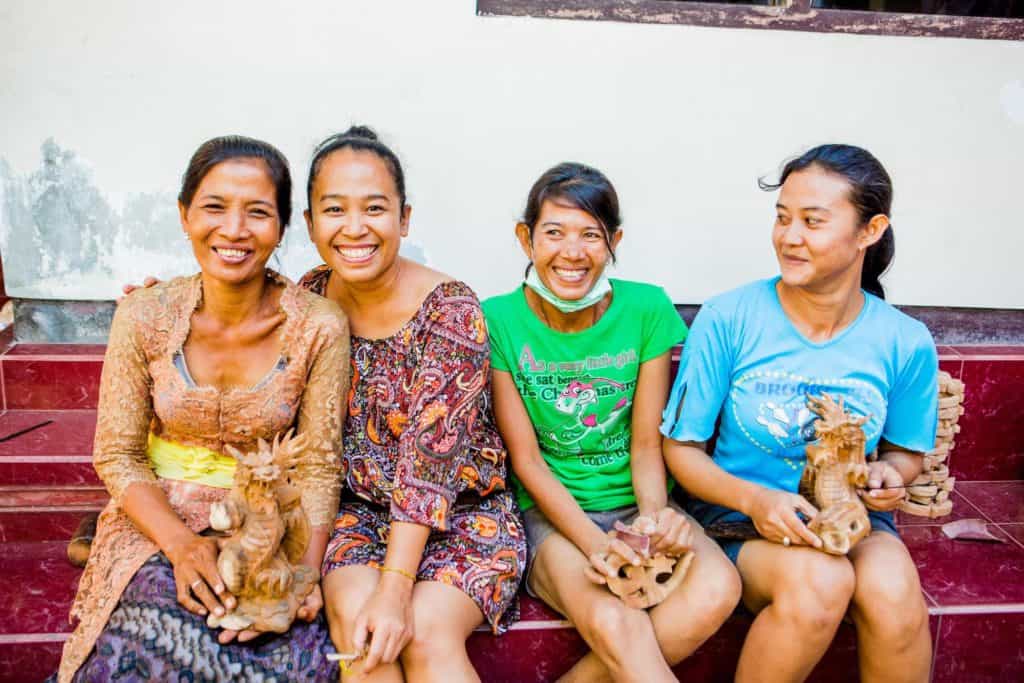
That design recognized a practical truth: access to a website is not the same thing as access to a market. A maker in a remote community may need product photography, translation, export knowledge, packaging and dependable payment before a distant customer can click “buy.” NOVICA absorbed those complications without claiming authorship of the work. It later added microcredit, including a partnership with Kiva, so artisans could purchase materials and expand production without facing punishing local interest rates.
Milk’s Peruvian grandmother provided the smallest and most persuasive case study. She knitted wool slippers and became one of NOVICA’s first artisans. Her products were popular. Here was the entire theory reduced to a pair of slippers: skill already existed; the missing element was a fair route to someone who cared.
The object arrives with a biography
Milk understood that the story was not garnish. NOVICA profiles artisans by name and describes who taught them, which techniques they use and what their symbols mean. This gives customers a form of virtual travel, but it also changes the economic character of the object. A carved mask, woven textile or silver necklace is no longer an interchangeable unit floating loose from its place. It becomes the work of a particular person practicing a particular tradition.
There is a fine line here. Sentiment can be manufactured as efficiently as a keychain. Milk has criticized branding that feels fake and emphasized authenticity instead. The platform’s strongest stories are therefore concrete: a workshop, a material, a teacher, a technique, a choice made by the artisan. The maker is a creative professional, not a prop in someone else’s morality play.
We tell them that what they’re doing is interesting to people all around the world.Roberto Milk
The model earned Milk and Nercessian de Oliveira recognition from the Schwab Foundation as social entrepreneurs, and Milk was named a World Economic Forum Young Global Leader in 2010. In 2020, YPO selected him as its Pacific U.S. regional honoree for the Global Impact Award. The honors recognized reach, but the more revealing measure may be continuity: the original circle of friends and family remained involved long after the launch.
A company built around a table
Founder stories routinely celebrate obsession and quietly invoice everyone nearby for it. Milk has acknowledged that early passion left too few hours for ordinary necessities, including meals, and that he later learned to value balance. His Entrepreneur’s Covenant blog widened the frame beyond NOVICA to family, relationships, fitness and the peculiar psychology of people compelled to build things.
His own diversions sound like the contents of an unusually energetic carry-on. He played soccer at a semi-professional level, coached his children and started the #100Anywhere challenge, filming himself juggling a ball on a Rio rooftop and near Pedra Bonita. He also worked as a fashion photographer on NOVICA catalogs. The common thread is participation. He would rather kick the ball, take the photograph or visit the workshop than admire the idea from a tasteful distance.
That instinct shaped NOVICA’s internal values exercise. Teams across different countries produced different priorities, but each included love. Milk’s conclusion was disarmingly uncorporate: the dream was to work beside people he loved while sharing stories, honoring cultures and celebrating art. In a business world addicted to the phrase “professional distance,” this one grew through professional closeness.
A Portuguese class connects a global-development concern to a marketplace idea.
Milk and five friends and relatives launch NOVICA.
YPO names him Pacific U.S. regional honoree for its Global Impact Award.
Handmade.com becomes the next attempt to widen direct access for makers.
The next billion, one phone at a time
The next chapter is Handmade.com. In a 2024 podcast, Milk described a broader self-service platform for makers in the United States and abroad, with workshop video, creator storytelling and a simpler publishing process. The ambition is to take lessons from NOVICA’s managed hub system and make them available to many more artisans. New tools may help a maker turn a smartphone photo into a listing, while the marketplace retains the social texture that mass ecommerce tends to flatten.
By early 2026, Milk was publicly promoting a Regulation Crowdfunding offering connected to NOVICA and Handmade.com. He said more than $143 million had gone to artisans globally and repeated a larger aspiration: build toward $1 billion. The figure is bold, but its unit remains intimate. Each dollar begins with somebody deciding that a practiced human hand matters.
The tension ahead is the one Milk has been negotiating since Stanford. Self-service software scales by making actions uniform. Handmade culture derives value from difference, slowness and local specificity. The product challenge is to standardize discovery, trust, payment and shipping while refusing to standardize the maker. Technology must behave like a good stagehand: indispensable, fast and mostly out of the spotlight.
The lesson hidden in the label
Milk’s most transferable insight is not limited to fair trade. Every marketplace decides who receives attention, who controls price and who becomes replaceable. Those decisions may hide inside a seller dashboard or fulfillment policy, but they are moral decisions wearing operational clothes.
NOVICA’s answer was to shorten the route and lengthen the memory. Fewer intermediaries. More biography. The artisan signs the work; the customer learns the name. A regional team takes care of the border forms while the maker takes care of the craft. It is less a rejection of commerce than a demand that commerce improve its manners.
Somewhere inside the enterprise is still that crowded van, bumping along toward another market. The adults are teachers. The grandmothers carry two distinct traditions of service and making. The children collect objects of questionable taste and ask questions of durable value. Who made this? What is it worth? How can their work travel without leaving them behind? Roberto Milk has spent a career building one answer, parcel by parcel.