In 2001, Davis Smith and his wife, Asialene, were eating lunch in a plaza in Cusco, Peru, when a boy named Edgar approached them with a shoe-shine kit. Smith was wearing tennis shoes. The proposed transaction had a practical flaw, but the boy stayed. The couple shared their food with him. They returned with more, and a daily routine began.
They were newlyweds, in Peru for a nonprofit internship. Edgar was nine. By the time they left, the Smiths had made a promise to each other: they would use their lives to help people like him. It was an unusually durable souvenir. Long after the journey ended, it kept turning up in decisions that otherwise looked perfectly sensible.
Smith would sell pool tables, go to business school and help build an online baby-products retailer in Brazil. There were customers, investors and employees. Yet Edgar remained a kind of unfinished business. A company could be growing while its founder still wondered whether he had begun the work he actually wanted to do.
Years later, Smith returned to Cusco and found Edgar selling art. He agreed to finance his training as a tour guide. The promise had acquired a second chapter, and the person behind it had acquired a future beyond the scene that made him memorable. Smith had also found a way to carry that promise into a company: Cotopaxi.
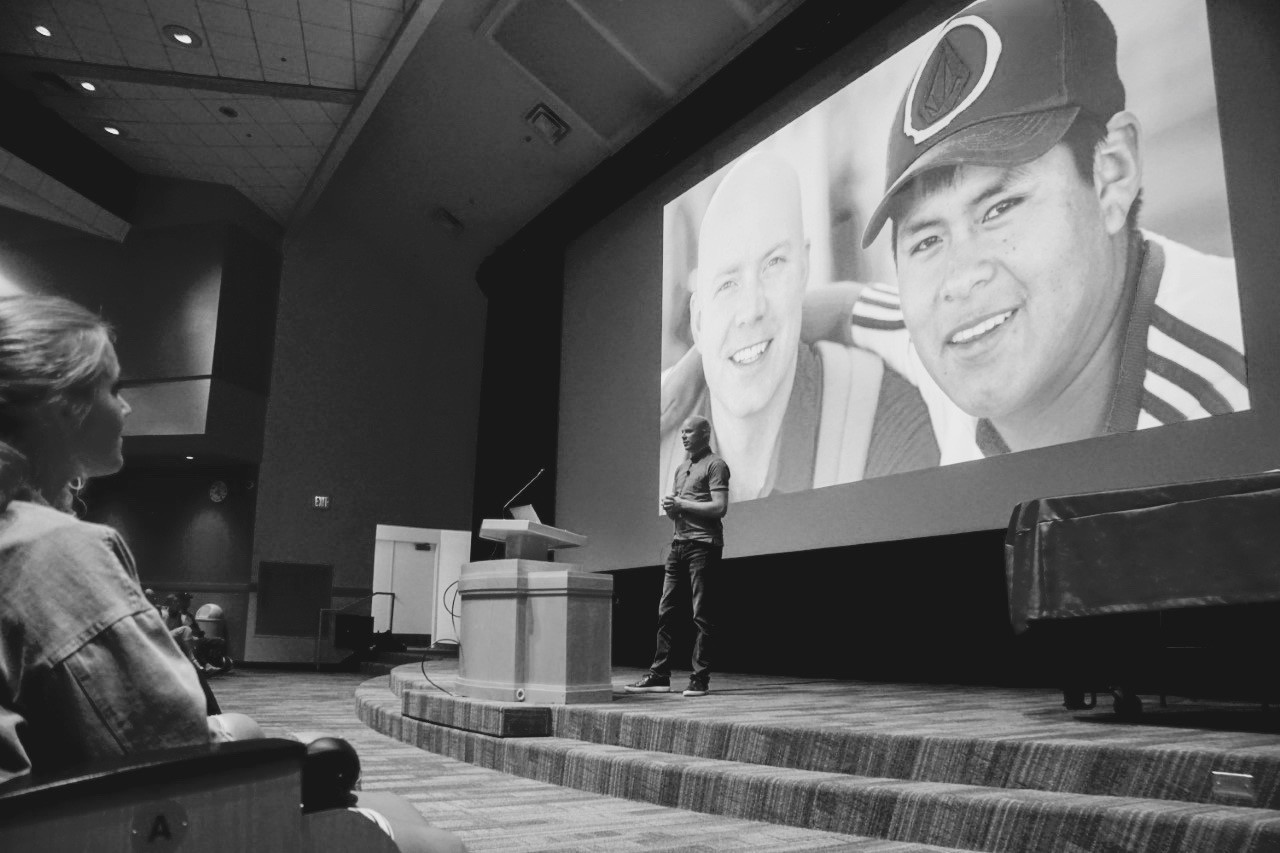
“Who is your Edgar?”
Davis Smith, speaking to BYU students, 2019
The unlikely apprenticeship: pool tables
Smith was born in Utah and grew up across the Dominican Republic, Puerto Rico and Ecuador. Poverty was part of the world outside his door, rather than a distant subject for a fundraising appeal. Adventure was close by, too. His father took the family camping and backpacking; Ecuador supplied the mountain that would eventually supply his company's name.
He studied international studies at Brigham Young University, graduating in 2003. Entrepreneurship entered the picture through Steve Gibson, whose work teaching business skills in the Philippines had caught Smith's attention. Smith hoped to help expand that work to Latin America. Gibson encouraged him to try building a business himself.
The resulting product was a pool table. A friend at eBay mentioned that people were selling them online, and Smith and his cousin, Kimball Thomas, began examining the market. They tracked listings in a spreadsheet and investigated manufacturers in China. Smith had no particular expertise in billiards. Fortunately, the spreadsheet did not require him to clear a table.
The business, eventually called PoolTables.com, made $1 million in revenue in its first year. Family financing helped fund inventory as it expanded. Smith later went to Wharton, earning an MBA and a master's degree through Penn's Lauder Institute in 2011. He and Thomas sold the company while pursuing their next venture. The first business had taught him that he could sell. It had left the question of purpose open.
Brazil, and the cost of going faster
Baby.com.br took Smith and Thomas to Brazil. The opportunity looked inviting: parents needed baby products, and online retail offered a way around inconvenient shopping trips. Smith had watched Marc Lore build Diapers.com and saw a model worth adapting. His own young family made the customer's problem easy to understand.
Growth arrived. So did the difficulty of operating in an unfamiliar business environment. In Smith's later account, the company scaled before it had built the efficiency needed to make that growth profitable. More business could mean more losses, followed by another need to raise capital. Speed was impressive on paper and expensive everywhere else.
His relationship with Thomas suffered, and Smith left. He has spoken plainly about the loss of that working relationship. The lesson he carried forward concerned how to choose a team: decide what problem you want to solve, then find people equipped to solve it. Friendship and family history could not do all the work.
That helps explain why Cotopaxi would become a gathering of people with different skills. Stephan Jacob, his Wharton classmate, joined him as a co-founder. Product expertise mattered as much as belief in the mission. Smith could describe what the business should accomplish; he needed colleagues who could turn the description into something a customer would actually carry.
First, persuade the investors. Then bring llamas.
Cotopaxi launched in 2014. Getting there required more than an appealing account of its purpose. Smith recalls making over 100 fundraising pitches. An early group of friends and family supplied $140,000; a later seed round brought in $2.8 million. The tidy phrase “raising a round” conceals a great deal of asking, waiting and hearing no.
Kirsten Green of Forerunner Ventures became an early backer. So did founders including Bonobos's Andy Dunn. Smith was asking people to believe that a new outdoor brand could find customers in a crowded market while committing money to social impact. The mission had to survive an investor's questions before it could appear on a backpack.
The public introduction was less solemn. Smith and Jacob bought two llamas through online classifieds and took them to college campuses. The animals attracted selfies; the founders used the attention to talk about an adventure race called Questival. A llama is a persuasive marketing asset, although the average landlord may require a different presentation.
The first Questival gave teams 24 hours to complete outdoor challenges and service projects. Around 5,000 people participated, producing 30,000 social posts. Backpacks became part of the event rather than objects waiting for an advertisement. Meanwhile, the website recorded 11 first-day orders, from supporters including friends, family and an investor. A crowd and a customer base were still two different things.
The first Questival, 2014. Figures recalled by Smith.
A little authority at the sewing machine
The bags supplied another lesson in letting people contribute. Remnant fabric helped the team make packs quickly for the launch. That practical constraint became part of the brand's visual vocabulary: colors that seemed unlikely to share a backpack began sharing one anyway.
The Del Día collection gives the people sewing the bags control over their color combinations. Leftover material becomes the palette. The Philippines-based makers decide how to put it together, so individuality enters through the factory rather than being specified entirely from an office. Product leader CJ Whittaker helped make that approach possible.
The arrangement makes a modest, visible argument about work. A maker's judgment can appear in the finished object. The customer gets a distinctive bag; the person assembling it has a decision to make. That is a useful detail in a story about Smith, whose ambitions would be considerably thinner if every interesting choice belonged to him.
Cotopaxi also incorporated as a benefit corporation from its beginning and became a certified B Corp. Those are different mechanisms: one concerns the company's legal form, the other an outside certification. Both give substance to the purpose Smith wanted to put inside the business. A slogan can be printed in an afternoon. Running a company around it takes rather longer.
The job he built, and the job he left
By 2022, Cotopaxi had passed $100 million in annual revenue. In January 2023, the company announced that Smith would transfer the CEO role to Damien Huang on July 1 and become chairman. Huang had joined as president in May 2022 after leading Eddie Bauer. The handover had preparation behind it.
The company committed at least 1% of annual revenue to fighting extreme poverty. Revenue matters here: giving tied to sales can continue even when profit is under pressure. At a $100 million revenue scale, 1% means $1 million. That arithmetic describes the commitment's scale; it is not a substitute for judging what the funded work accomplishes.
Smith was leaving for a three-year, unpaid assignment as a mission president for The Church of Jesus Christ of Latter-day Saints in Recife, Brazil. His family went with him. The chairman's role preserved a connection to Cotopaxi's purpose, culture and impact work while daily executive responsibility moved to someone else.
There is an awkward test inside that decision. A founder who builds a company around service eventually has to decide how service fits into his own calendar. Smith had a business capable of supporting his cause and a leadership team capable of running it. He chose to spend three years doing a different kind of work. The mission became an appointment he kept.
One highlighted square in a hundred. At a $100 million revenue scale, 1% equals $1 million.
The Smith household has a culture, too
The same questions follow him home. Smith and Asialene have four children. He has described realizing that he had thought carefully about company culture while allowing family culture to take shape by default. The organization closest to him deserved some of the attention he gave his professional one.
Together, the family developed values associated with the letters in SMITH, with service, faith, intellect, travel and hard work among their themes. Weekly meetings and traditions give those ideas somewhere to live. A household has a shorter distance between declaring a principle and being asked to demonstrate it.
He also runs a family savings system, the Bank of Smith Savings, and has discussed a 50/40/10 approach to children's money. The practical details sit comfortably beside the larger ideals. Learning to give and learning to save belong in the same conversation. A child can encounter both before ever encountering a pitch deck.
His public accounts reveal a recurring habit: return to an earlier decision and try to make it better. In 2021, he bought back PoolTables.com and recruited Kent Salisbury as CEO, aiming to apply the social-purpose approach he had developed at Cotopaxi. The first business, which had once felt incomplete, was offered another chance.
Back from Recife, into another classroom
In 2026, Smith announced that his family's mission in Brazil had ended. He described finding fulfillment in serving others and placing less emphasis on possessions and status. These are personal conclusions from a specific period of his life. The three-year commitment supplied time in which to discover whether his own priorities held up outside the job that had defined him.
His next public chapter includes education. Yale's Jackson School of Global Affairs lists him as a senior fellow for the 2026–27 academic year. His background combines business-building with nearly two decades lived across Latin America, fluency in Spanish and Portuguese, and a continuing interest in poverty alleviation. The classroom offers another place to examine how those experiences fit together.
The question he asked students at BYU in 2019 was brief: “Who is your Edgar?” It remains a revealing question for a founder. A beneficiary described only as a number can drift out of view. A person remembered from a plaza is harder to remove from the picture.
Smith's career has moved through pool tables, baby products, backpacks, a church assignment and now a university. The objects and titles keep changing. The boy in Cusco still belongs in the story. For someone who has spent years learning how to make companies grow, remembering why he started may be the more demanding daily task.