Norman Atkins and Dave Levin had a problem that success had made worse. They were building schools for children whose opportunities had too often depended on their addresses. Each needed capable teachers. Each kept looking in the same small pool. When they talked, the uncomfortable possibility emerged that their hiring victories were simply each other’s losses. A school could recruit well and still leave the larger problem untouched.
Atkins had already helped start North Star Academy in Newark and build Uncommon Schools. He could have continued adding classrooms. Instead, he began working on the people who would stand at the front of them. The question widened: how do you prepare enough good teachers for schools beyond your own?
It was a consequential change of scale. Buildings are visible. A new school has an opening day, a front door, a name. Teacher preparation asks for quieter evidence: a better explanation, a useful question, a lesson that survives contact with actual children. Atkins’s career increasingly turned toward that less photogenic work. The camera, as it happened, would become one of its tools.
A schoolboy’s journey across Evanston
Long before Newark, there was a bus ride in Illinois. Atkins grew up in Evanston, north of Chicago, and attended an integrated school across town from his predominantly white neighborhood. His classmates and teachers gave him an early experience of education across racial and economic lines. Years later, that experience remained central to the way he talked about opportunity.
His route into education was indirect. At Brown University, he studied history and edited the student newspaper. He graduated in 1984, then worked as a journalist, writing about education, poverty, politics and culture. His bylines appeared in publications including The New York Times Magazine, The New Yorker and Rolling Stone. Before he had schools to run, he had questions to ask.
Journalism is a useful apprenticeship for anyone tempted to believe the first convincing explanation. You ask another person. You visit the place. You discover that the neat account has inconvenient details. That habit offers one way to understand Atkins’s later career: he kept moving closer to the part of the problem that an earlier solution had left unresolved.
His Brown roommate, David Saltzman, helped connect him to the emerging Robin Hood Foundation. Atkins went on to serve as its co-executive director from 1989 to 1994. The job took him through organizations working against poverty in New York. Among the schools he visited, De La Salle Academy, led by Brother Brian Carty, gave him a concrete example of demanding education for children from low-income families.
He became troubled by the relationship between the school day and the charitable work that followed it. After-school help could be valuable, yet it was also being asked to repair failures from earlier hours. The timetable itself contained a question. What would happen if the education children received during the day needed less repairing afterward?
Seventy-two children, and a drum
In 1997, Atkins and Jamey Verrilli opened North Star Academy with 72 fifth- and sixth-graders. Verrilli brought teaching and school leadership experience. Atkins handled operations. Between them were the academic ambitions and community commitments on which the school would be built. Parents helped choose the name, drawing on the North Star’s association with freedom and Frederick Douglass’s newspaper.
Finding a building required an extensive search. Eventually they settled on a downtown Newark location where bus routes converged. The detail is pleasingly practical. An education philosophy can travel through conferences in immaculate prose; children still have to get to school. Operations had a place in the founding partnership because the bus route mattered alongside the lesson plan.
The school’s opening also had a sound. Its Community Circle brought students together around shared values. The gathering incorporated drums, call and response and academic exercises. Atkins contributed African drums and folktales to the ritual. A school with college ambitions could begin its morning with something more animated than an announcement about lost property.
That combination makes the founding story interesting. Rigor can look rather stern on paper. Community can sound vague until someone decides what people will actually do together. A daily gathering gave those two ideas a time, a place and a rhythm. The school was trying to make belonging a repeated experience.
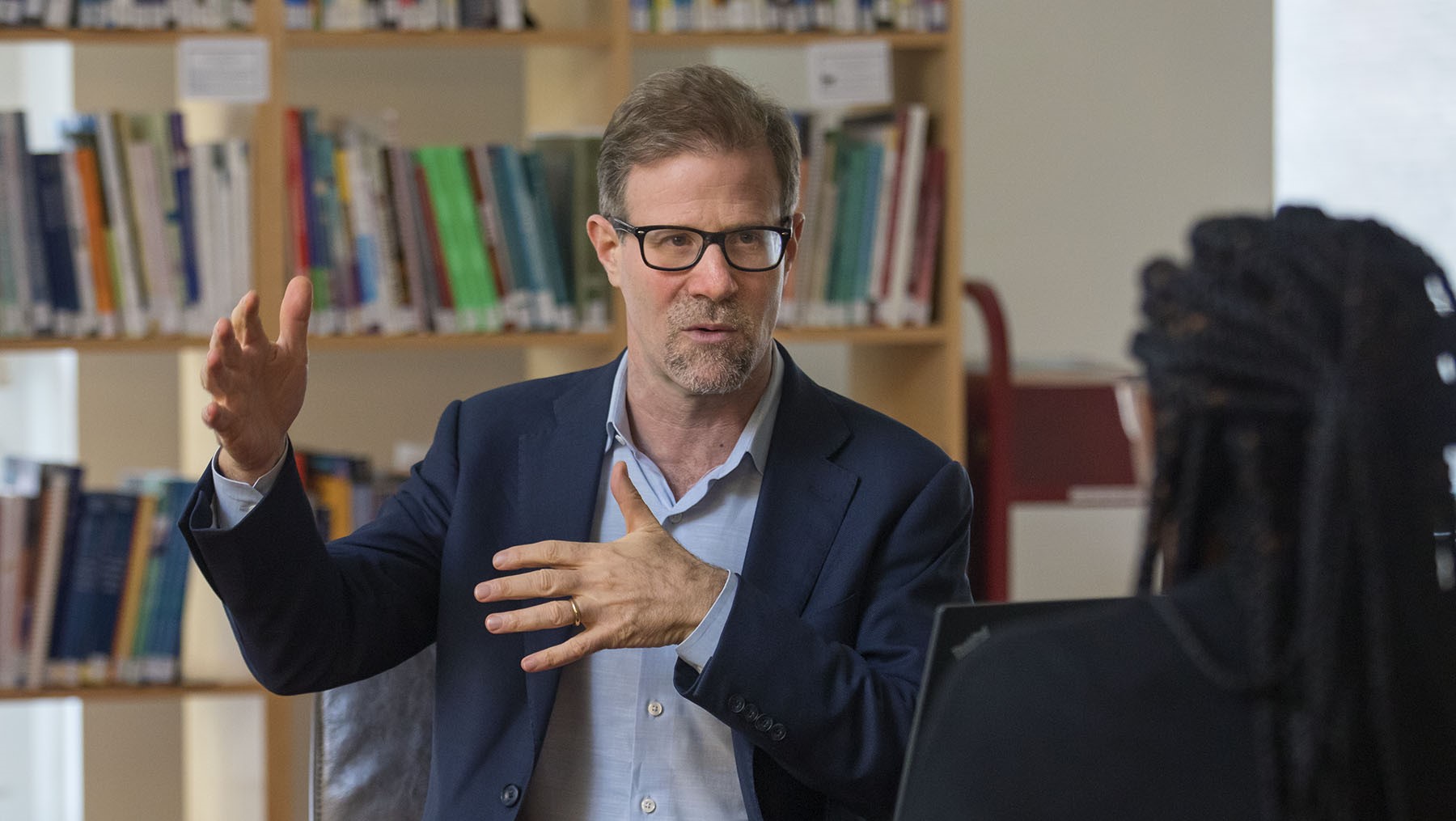
The early school would become part of a larger enterprise, but its starting size is worth keeping in view. Seventy-two children meant individual families had entrusted a new institution with something irreplaceable. Expansion would bring different challenges. At the beginning, the promise had to work for the children already sitting in the room.
The education of an institution-builder
Atkins became Uncommon Schools’ founding CEO, working with fellow school builders including Brett Peiser, Evan Rudall and Doug Lemov. The connections mattered because each brought experience from running schools. Their common project could draw on several sets of practical lessons rather than requiring every new school to discover every difficulty for itself.
One revealing feature was the division between instructional and operational leadership. Schools were co-led by a principal and a director of operations, giving the principal more room to concentrate on teaching. Teacher preparation also received substantial time before the school year. The organizational choices made an argument about priorities: if instruction mattered, someone had to protect the hours it needed.
That is a less glamorous version of entrepreneurship than the one with a founder sketching the future on a napkin. Somebody still has to solve the staffing problem, organize training and make the schedule behave. Atkins’s work repeatedly returned to these arrangements. A compelling mission would need habits and responsibilities capable of carrying it through Tuesday.
Graduates from Brown.
72 students in Newark.
Training at Hunter College.
An independent graduate school.
Uncommon has grown into a network of 53 schools serving more than 21,000 students annually. Those figures belong to an organization sustained by many educators, leaders and families over time. They give the founding experiment a sense of distance traveled without turning an entire school network into one person’s accomplishment.
When rival recruiters share a problem
The teacher shortage Atkins and Levin encountered changed the direction of their collaboration. Hiring from the same pool could move expertise around. Preparing teachers offered a way to enlarge it. Alongside Achievement First’s Dacia Toll, they developed the effort that became Relay Graduate School of Education.
The precursor, Teacher U, began at Hunter College in 2008. In 2011, Relay became an independent graduate school. Atkins served as its founding president. Its early design connected graduate study to the classrooms where participants were teaching, and graduation required evidence of their pupils’ learning. The institution asked prospective graduates to show what their teaching had accomplished.
That approach generated resistance as well as interest. When the new school was announced, established education institutions challenged aspects of its model, and the emphasis on measured learning gains was contentious. The disagreement belonged to a larger debate about what teacher preparation should value and how it should judge success. Creating a new institution did not make those questions disappear.
Atkins’s answer was to put more practice into the preparation. Teachers could watch instruction, rehearse, receive feedback and try again. They could bring recordings of their own work into the discussion. In that arrangement, a graduate seminar had something in common with a rehearsal room: everyone might admire your intentions, but eventually you had to perform the passage.
“There are no panaceas in public education.”
Norman Atkins
The warning came from someone who had helped found several education organizations. It gives his story a useful complication. Founding another institution was not, in his own telling, sufficient evidence that education would improve. The work remained demanding, with an obligation to attend to what happened after the new name was painted on the door.
A lesson gets another take
A Relay session in Newark illustrated the method in action. A teacher presented a mathematics solution. Colleagues then examined both the answer and how he had taught it. Their feedback covered the order of his explanation, the connections between students’ responses and the moments when he lost the lesson’s purpose. Then he taught it again.
The second attempt is the important part. Feedback had somewhere to go immediately. The exercise turned an abstract wish to improve into another explanation delivered to other people. A lesson could be examined in pieces, adjusted and attempted once more. There is something reassuringly ordinary about this: difficult work often improves when someone lets you practice it properly.
- 01 Observe
- 02 Rehearse
- 03 Get feedback
- 04 Try again
A simplified view of the practice and feedback approach in Relay’s early model.
In a 2016 interview, Atkins also argued for raising the status of teaching and creating stronger incentives to enter the profession. He described a gradual residency as valuable preparation before a novice led a classroom. The ambition extended beyond technique to the conditions under which people choose teaching, learn it and remain in it.
By 2019, Relay had also drawn attention for recruiting a diverse teaching corps. Its growth included pathways for career changers and people already working in schools. That broadened the question of preparation further. An institution could ask who had been overlooked as a potential teacher, alongside asking what a new teacher needed to learn.
The questions keep getting bigger
In 2018, Atkins received the Heinz Award in the Human Condition category for his work on teacher preparation and educational opportunity. His subsequent chapter includes Array Education, where he is managing partner. Array describes its work as supporting teaching and learning projects from early literacy through the beginning of a young person’s career. Relay now identifies him as its co-founder and president emeritus.
People who encountered the early North Star still remember its founders’ manner. In a July 2025 interview, longtime North Star leader Mike Mann described Atkins and Verrilli as unusually committed, candid leaders. “They scared me and inspired me,” he recalled. It is a compact recommendation with a little more personality than the average testimonial.
Across these chapters, the question keeps expanding: from the school day to the school, from the school to its teachers, and from teachers to the institutions that prepare them. Each move carries the same practical demand. Children need someone who can teach the next lesson well. All the founding, recruiting and training eventually arrive at that encounter.
A journalist learns to ask the follow-up question. Atkins’s career suggests what can happen when the follow-up becomes a working institution. After opening a school, he asked who would teach in it. After finding teachers, he asked how more people could learn the craft. The next lesson was always waiting.
Keep the conversation going
Visit Array Education, Uncommon Schools and Relay Graduate School of Education. Follow Atkins on LinkedIn or find his documented Twitter / X profile.
More reading: The Heinz Awards profile · Winning Formula · Relay’s 2011 launch · Mike Mann’s 2025 interview · Atkins’s 2016 interview · Ashoka fellowship profile · Inside an early Relay session · North Star’s founding account · Relay’s teaching corps · Uncommon’s anniversary account.