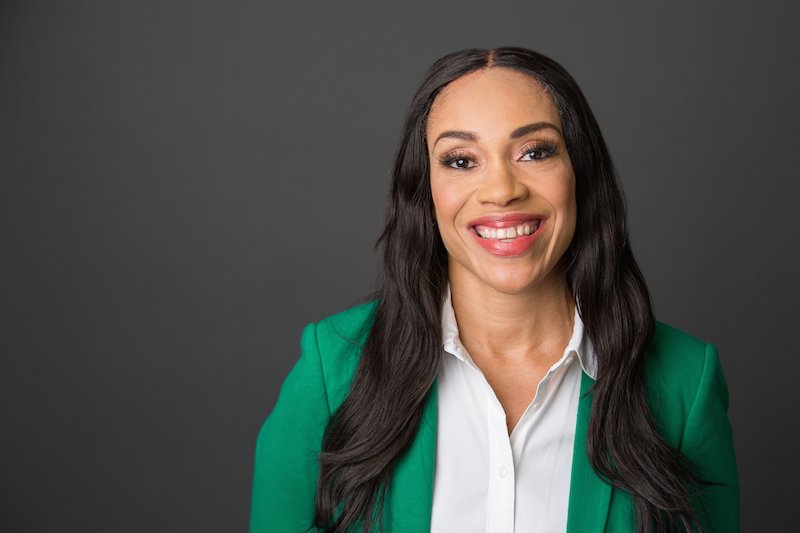
Julie Jackson runs one of the country's most closely watched public school networks, and she still talks like a teacher. As Co-Chief Executive Officer of Uncommon Schools, she oversees all 53 K-12 campuses across New York, New Jersey, and Massachusetts, a system that educates roughly 20,000 students, most of them in cities where strong public schools have been scarce. She is the first Black Co-CEO in the organization's history, and she reached the role the long way: teacher, dean, principal, managing director, chief schools officer, president, and now the top job.
What she is working on now is less a single project than a standard she wants held everywhere at once. Uncommon Schools is known for high test scores and college acceptance rates, but Jackson keeps pushing the conversation past acceptance toward completion, and past results toward the daily feel of a classroom. Her shorthand for that is "joy and rigor," two words she uses so often they have become a kind of mission statement. "I want our schools and classrooms to be a place of both joy and rigor," she has said. The pairing is deliberate. She does not think a demanding academic bar and a warm, engaging room are in tension. She thinks a school fails when it has only one of them.
Much of her energy goes into people rather than programs. Jackson has trained more than 25,000 teachers and leaders, in cities across the United States and abroad in places including China and South Africa, and she still frames leadership development in the plainest possible terms. "How can you lead a school at the highest level when you're not a strong teacher?" she asks. It is the question that organizes her whole theory of the job: build excellent teachers first, then build leaders out of them. She has watched it work up close, mentoring two teachers who went on to become principals of all-boys schools in Brooklyn.
"We're trying to create an impact. We don't have 30 kids. We have 20,000."
— Julie JacksonA two-year plan that never ended
Jackson did not set out to spend her life in schools. She joined Teach For America in 1994 expecting a two-year commitment, and arrived at School 30 in Paterson, New Jersey to a principal who had not been told she was coming. "I show up in Paterson, New Jersey, school 30," she recalled. "My principal, Mr. Carramico, he's like, who is Jackson?" The early days were hard in the way first-year teaching almost always is. "I was getting my ass kicked every day," she has said, "but it was fun and it was exciting to see kids learn."
Somewhere in that difficulty the work stopped being a resume line. "Once I got into that classroom, and I realized what kids know and don't know," she said, "it was like, wow, it's a calling." By 1998 she had been named Teacher of the Year, an honor that would have been a reasonable place to settle. Instead she reached the opposite conclusion. She decided she needed to get better, and went looking for a place that would push her. That place was North Star Academy, an early school in what would grow into the Uncommon Schools network.
Building the ladder as she climbed it
From founding teacher, Jackson moved through nearly every rung a school system offers: dean of students, founding elementary and high school principal, managing director, chief schools officer. In 2019 Uncommon named her President, a new position with oversight of K-12 instruction, operations, and the organization's diversity, equity, and inclusion work. Roughly three years later she became Co-CEO, sharing the leadership of the network she had spent decades helping build.
She describes the mandate of that seat in terms of access more than authority. "My job is to get people at the table who are not currently at the table," she says. That belief shows up in concrete recruiting: Jackson leads efforts to bring junior-year students from historically Black colleges and universities into a summer teaching fellowship, an early pipeline for a more diverse teaching force. For a leader who once arrived at a school where no one expected her, the emphasis on who gets a seat is not abstract.
"If you can make someone better in 40 minutes, and they can make students better in that same time period, that's impact."
— Julie Jackson, on teacher developmentScale without losing the single student
The hardest trick in Jackson's current role is holding two scales in mind at once. She runs a large organization with consistent systems and aligned curricula, the kind of standardization that lets a network of dozens of schools function. At the same time she resists letting the numbers flatten into abstraction. When she says the network has 20,000 students rather than 30, she is not bragging about size; she is reminding herself and everyone around her that the stakes multiply. A weak lesson is not one bad class period. Across a system, it is thousands.
Her recognitions track that arc of care and craft. She received the Dodge Leadership Award in 2002 and Teach For America's Peter Jennings Award for Civic Leadership in 2013. She is a Pahara-Aspen Fellow alumna and served on the Board of Trustees of the Oprah Winfrey Leadership Academy for Girls, extending her reach beyond a single network into the broader project of educating children who are too often underserved. Through all of it, the through-line is steady: get the teaching right, keep the joy, hold the bar, and widen the table.