Shahed Alam had already helped start an organization. Then he stepped away to finish his degree. There was another career waiting in the United States, one he had spent years preparing for. He could have followed it. Instead, he came back to Noora Health. When he explained that decision in 2023, he gave a reason that rarely gets much room in a founder biography: he wanted to work alongside Edith Elliott again.
Career stories tend to prefer a clean line. A person has an idea, starts something, and marches toward the inevitable. Alam’s story includes a departure and a return. That small bend makes it more interesting. A return requires a second decision. The enthusiasm of a student project has worn off; the work has acquired names, responsibilities, and consequences. You have a better idea of what you are choosing.
“This is my life’s work,” he said. The phrase is plain enough to disappear inside a longer conversation. Here it deserves a moment. It describes a commitment made after he had the opportunity to leave, with a partner he already knew. Noora’s origin matters, but so does the point at which its co-founder chose it again.
Today, Alam and Elliott are co-founders and co-CEOs. The shared title is a useful entrance into his personality and career. Before the awards, the public stages, and the international partnerships, there was a question about who he wanted beside him while doing difficult work. He answered it by coming back.
Two places, one widening view
Alam grew up in a Houston suburb. His parents had come to the United States from Bangladesh for college, and the family returned to Dhaka every summer. Those journeys gave his childhood two reference points. The place he lived in most of the year could not stand in for the whole world; the summer trips made that limitation tangible.
He later described the contrast between suburban Houston and the poverty he encountered in Bangladesh as formative. The observation is modest, but its implications reach far. Familiar surroundings can make a particular way of living feel universal. Repeated trips elsewhere interfere with that assumption. A child gets to see that the rules of daily life change with the setting.
His education eventually took him to Johns Hopkins, where he earned a bachelor’s degree in biomedical engineering and a master’s degree, and then to Stanford for an MD. His Stanford years, listed publicly as 2011 to 2017, overlap with Noora’s beginnings. The eventual organization did not arrive after every other part of his life had been neatly completed. It took shape while he was still working out his own route.
There is something useful about keeping those overlapping years visible. They resist the polished biography in which each qualification conveniently points to the next achievement. At Stanford, Alam encountered people with different skills and a class that would give them a shared undertaking. The degree was one destination. The people he met opened another.
A class with consequences
The course was called Design for Extreme Affordability. Four graduate students came together: Alam, Edith Elliott, Katy Ashe, and Jessie Liu. Their backgrounds differed. They had a common assignment and the permission, at least for a while, to work as students do: ask questions, try things, revise them, and learn from what failed.
Noora launched in 2014. A class project had become an organization. That transition has a certain comedy to it. An assignment normally ends with a deadline and the welcome disappearance of a group chat. An organization demands that the group keep answering messages. It also asks who is doing what, who can decide, and who will still be there when the original excitement becomes ordinary work.
The founders’ own later recollections retain the texture of those early days: editing videos, chai and idlis in the canteen, and long hours in a corner of Stanford’s d.school. These are the details that a tidy origin story often sweeps away. They restore the work to human scale. Before an enterprise has an operating model, it has people sharing food and trying to finish the next task.
For Alam, design became a continuing method rather than a course left behind. In a public statement about feedback, he described empathy, attention to community needs, and iteration with the people involved. The sequence matters. Listening comes before the next version. A founder who accepts that sequence has to remain available to information that may complicate the original plan.
an organization
and Skoll recognition
in Geneva
The photograph has room for five
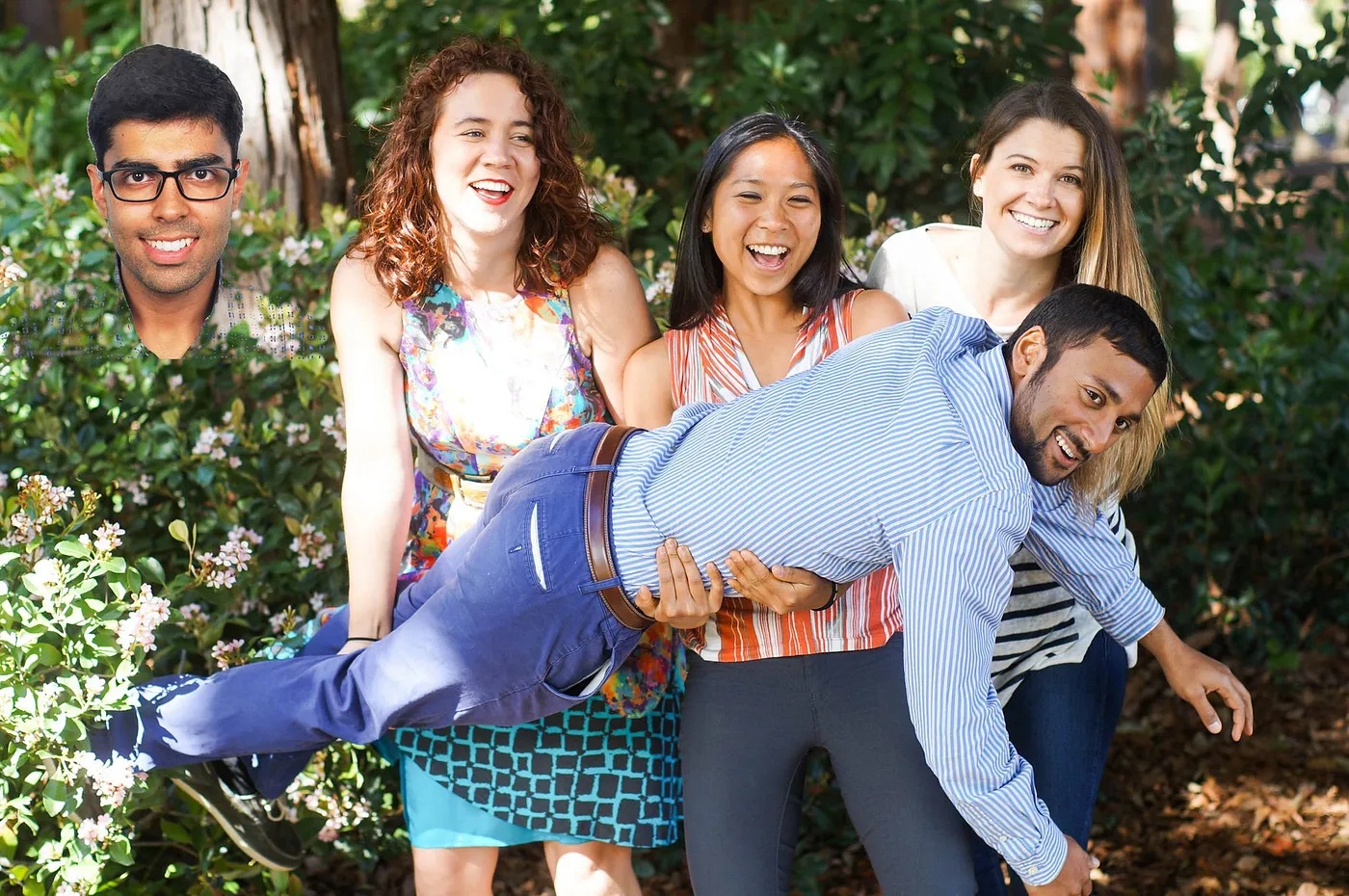
An early team photograph offers a pleasantly unserious picture of the founding group. Alam, Ashe, Liu, and Elliott appear with their first hire, Anubhav Arora, apparently floating across the foreground. The image was deliberately altered. Arora’s levitation is the joke, not a claim about the organization’s recruiting standards.
It is an apt picture for an enterprise that began with several people. Even the photograph refuses to arrange itself around a single founder. Alam’s place in the group was increasingly connected to partnerships, a role that suited the way his colleagues described his ability to make friends. That is a more personal explanation of a job than the usual list of competencies.
Friendliness can sound like a decorative quality in an executive. In partnership work, it has practical consequences. A conversation has to begin, another person has to feel able to speak, and the relationship has to survive after the first meeting. None of that replaces clear decisions or careful work. It gives them somewhere to happen.
A founding team also has to outgrow its earliest habits. Four people attending everything together can be charming for a time. Eventually the organization needs responsibilities that people can understand. The difficult part is preserving the confidence of the group while allowing each member enough space to act. The photograph catches the fellowship; the organization has to supply the machinery.
One decision does not need two signatures
The co-CEO arrangement puts that problem at the top of Noora. Alam has described shared accountability alongside different day-to-day priorities. His remit includes partnerships, program development, and research. Elliott spends more of her time on fundraising, communications, finance, and other external relationships. Those priorities divide attention without dividing responsibility for the organization.
In practical terms, a team member does not need both CEOs to approve every decision. Either leader can engage, with the other brought in when more information or discussion is needed. It is a distinction worth drawing carefully: shared leadership still needs a way to let work move. Two people at the top should not mean two queues at every doorway.
The model asks something substantial of both leaders. They must be willing to support a decision made by the other and remain candid when they disagree. Trust has to extend beyond a pleasant working relationship. It has to hold when a choice becomes consequential. A reassuring title on an organization chart cannot do that work for them.
The attraction for Alam is also personal. Having a partner lowers the threshold for talking something through. A thought can be shared before it becomes a formal position to defend. That is a valuable feature of any long collaboration: room to think aloud. A leadership partnership can make uncertainty easier to discuss, provided the people involved keep making room for each other.
The awards arrived. The work changed.
In April 2022, Noora received both an Audacious Project grant and a Skoll Award for Social Innovation. Alam and Elliott also appeared together at TED that year. The public recognition gave their work a larger stage, but it did not furnish a finished set of instructions for running a larger organization.
The leadership team worked with The Bridgespan Group on its operating model. Country teams would hold more ownership of strategy and work, supported by a smaller shared team. The choice moved decisions closer to the places where the work happened. It also required the founders to make their way of working understandable to people who had never been part of the original class.
That is one of the less photogenic demands of growth. Early colleagues can infer a great deal from shared experience. New colleagues need clarity. A value has to mean something when someone decides how to spend a day, handle a disagreement, or ask for help. An expanding organization cannot depend indefinitely on everyone having absorbed the same unspoken history.
Noora’s later workplace discussions show Alam examining an old principle, “do the needful,” as the team grew. A phrase that serves a small group can acquire different meanings when more people use it. Asking what should carry forward is part of leadership. Even a beloved piece of institutional language deserves an occasional conversation about what it asks of the person hearing it.
A larger team needs to know
what a value means on Tuesday.On turning a founding culture into everyday decisions
A future with more people in it
By November 2024, Alam and Elliott were describing a next chapter in which other organizations could adapt tools, processes, and frameworks developed through Noora’s experience. The ambition included moving toward a strategic and technical partner role. It is a revealing aspiration for founders: work can travel farther when its usefulness is not tied to their presence in every room.
In May 2026, Alam’s public schedule included Geneva and an event co-hosted with the Government of Indonesia and The Agency Fund. The evening included Threads of Care, a film made by Noora and The Agency Fund. He had spoken publicly of the team’s year-long effort on the film and his pride in the people who made it. The work still involved gathering collaborators around a shared undertaking.
There are smaller glimpses of him too. A podcast appearance with Elliott included an invitation imagined through pani puri at the office and dosas afterward. His institutional biography mentions two energetic dogs. Neither detail needs to carry a grand meaning. They simply give the professional record some air: food, company, a life beyond the next organizational decision.
Alam’s return to Noora is a good place to leave him. It connects the student who joined a group project with the executive who continues to share leadership. He chose the work, and he chose a colleague. Years later, the challenge is to make that kind of confidence available across a much larger team. The friendship helped bring him back. The organization gives that decision something to do every day.
Continue the conversation
Follow Alam’s work, revisit the founding team’s reflections, or watch his public appearances.