At fourteen, Matt Abrahams had a perfectly reasonable plan for his first speech tournament: talk about karate, then demonstrate it. Ten seconds into a ten-minute speech, he threw a kick. His trousers ripped. His friends were watching. So was the girl he liked. Anxiety had made him forget to change into the roomier pants intended for the demonstration. The audience got its attention-grabbing opening. Abrahams got a question that would occupy him for decades: what happens to us when speaking suddenly feels dangerous?
Think Fast, Talk Smart is the education business built around that question and its everyday relatives. What do you say when your manager asks for an unexpected update? How do you disagree without making an enemy? Its free podcast brings communication experts into conversation with Abrahams, a strategic communication lecturer at Stanford Graduate School of Business. Paid products add longer listening, community learning, and rehearsal.
The useful bits
- Start free: interviews, short lessons, transcripts, and vocabulary help.
- Give an answer a shape: what, so what, now what.
- Pay for depth or practice: Premium and the learning community are separate offers.
A studio with a gaming chair
The podcast began with a producer’s invitation. Jenny Luna heard Abrahams speak and asked him over coffee whether he wanted to make a show. They launched in January 2020. Within weeks, Stanford was occupied with moving classes online. Luna feared their new project would disappear.
Abrahams proposed keeping it alive at home. His teenage sons knew their way around audio and video editing; episodes were assembled in a room in his house. The subject also changed to meet the moment: how to communicate virtually. A production problem had arrived alongside an audience problem. The workaround addressed both.
In a later interview, Abrahams recalled that the school had canceled podcast production during the shutdown. He asked permission to manage it himself and spent six months producing with his sons on the younger boy’s gaming computer. The arrangement had an obvious rival use: gaming. It was a workable substitute for a studio, with a teenager waiting to reclaim the equipment.
This matters because Think Fast, Talk Smart was an experiment in making a university’s expertise accessible. Its early advantage included Stanford’s existing audience and reputation, as Luna later explained in a podcast-production interview. A new creator can copy its attention to listeners and practical topics. Borrowing an institution’s distribution requires having that institution behind you.

Three questions, one usable answer
The show’s appeal is clearest in a small lesson from April 2020. To enter a meeting’s conversation, Abrahams suggests paraphrasing a point, asking a question, or naming an emotion. These are ways to get the floor without waiting for a ceremonial invitation. Once you have it, your answer needs direction.
His recurring structure asks three questions. What are you discussing? Why should these particular people care? What happens next? It works as a guide for an update, a proposal, or feedback. The useful discipline is making significance and action explicit, rather than leaving colleagues to excavate them from a pile of details.
For example, a hypothetical project update could run: “We found a checkout bug. It blocks mobile purchases. We want to prioritize the fix before Friday’s release.” The framework does no fact-finding for you. It gives facts somewhere to go. In a later lesson, Abrahams recommends practicing by summarizing an episode, book, or meeting through those three questions. Spontaneity, in this account, benefits from repetition.
The listeners changed the job
Listen to how Abrahams describes the audience’s influence: the team initially understood its show as business content. Listeners pushed it toward careers. That distinction changes the assignment. A business story might explain an organization. Career advice has to help someone inside an organization speak, get heard, or handle the next difficult exchange.
“So we started thinking we were a business podcast and then the world told us we are a careers podcast.”
Matt Abrahams / Continuing Studies
The audience includes professionals, leaders, job seekers, and language learners. The company reports more than 1.25 million unique monthly listeners on LinkedIn and number-one Careers rankings in over 120 countries on its website. Those are its own figures, with no ranking period specified. A quieter sign of its international attention is the English Language Learning hub: episode vocabulary comes with definitions and examples, so an unfamiliar idiom need not derail the lesson.
Free ears. Paid practice.
Premium arrived in November 2024 after requests for deeper material and stronger community connections. The regular podcast remained free. Sponsors help pay for production; subscribers pay for additional access. Premium’s published price is $6 monthly, or $60 annually, with ad-free episodes, extended “Deep Thinks,” and curated learning playlists called eQuips.
US dollars / Prices checked 09 Oct 2026
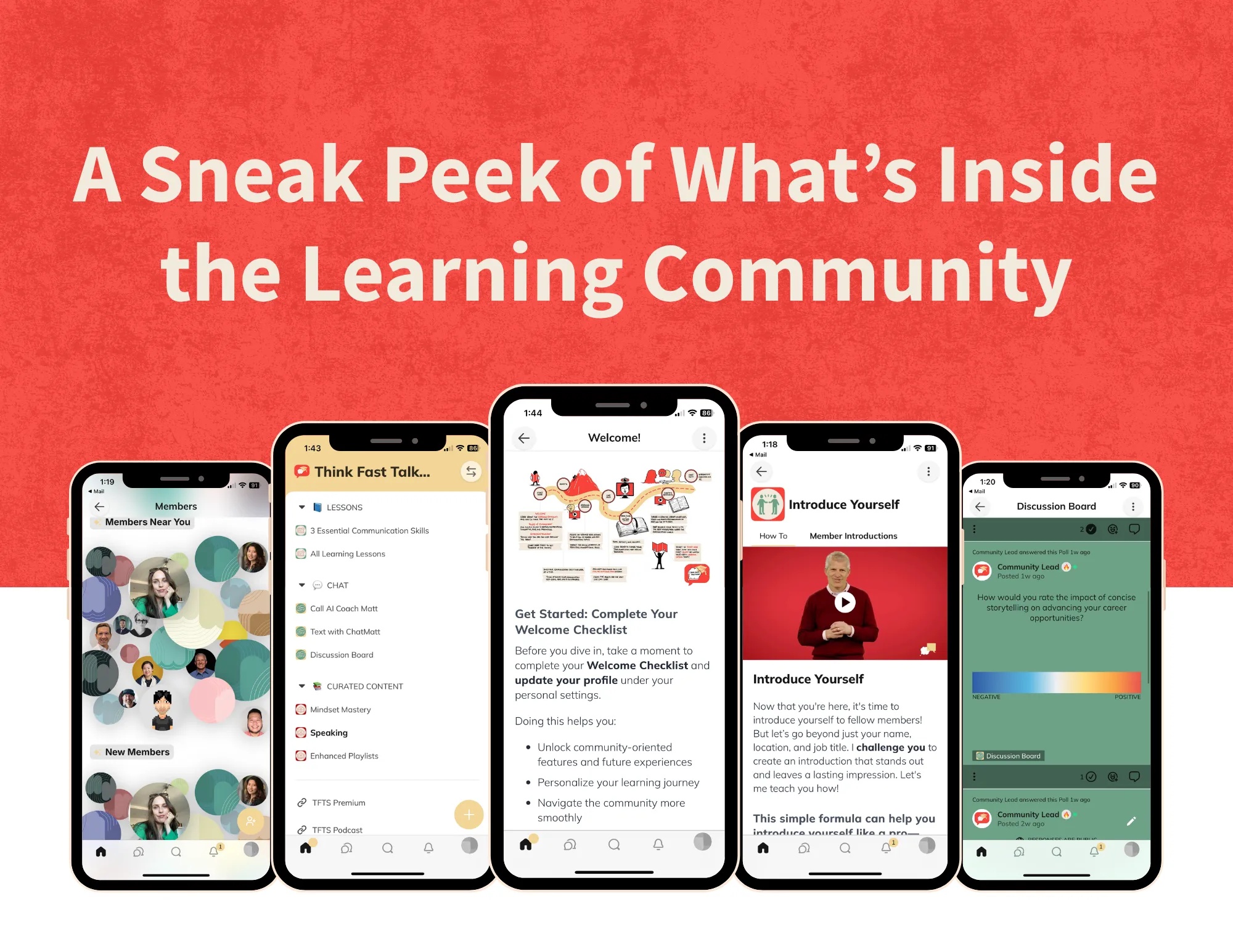
The learning community, opened in December 2025, is a separately presented offer. Its Fellow Level lists $19.99 a month for teaching sessions, guided challenges, book discussions, monthly Ask Matt Anything calls, and AI coaching. The distinction is useful for buyers: richer listening and structured participation are different purchases.
There is a sensible sequence here for someone preparing for an interview or a hard conversation. Use the free archive to identify a relevant method. Try it aloud. If you want extended episodes, consider Premium; if you want recurring activities and feedback, examine the community. Buying the larger package before trying a small exercise would skip the most informative step.
When Matt meets Matt
The company demonstrated two AI tools in December 2025. Coach Matt, created with SoundingBoard, offers a spoken conversation based on Abrahams’s writing and coaching. Chat Matt answers typed questions using the podcast archive. In episode 247, the human Matt asks his digital counterparts for advice, including how to handle a two-minute proposal to skeptical executives.
This places the business between media, communication training, and software-assisted practice. Toastmasters offers regular speaking and peer feedback in clubs; Yoodli offers AI roleplays. Think Fast, Talk Smart combines a recognizable teacher, an interview library, and community activities. That combination is a reason to choose it if you already find Abrahams’s methods useful. It is no guarantee that simulated feedback will predict a colleague’s response.
Take it into the room
The practical test comes after listening. Pick a real conversation. Try an answer with a clear point, a reason it matters, and a next step. Ask someone what they understood. Adjust. Passive listening cannot tell you whether your answer landed, and a polished structure cannot supply knowledge you lack. Think Fast, Talk Smart’s business increasingly makes room for that uncomfortable, useful part: opening your mouth and finding out.