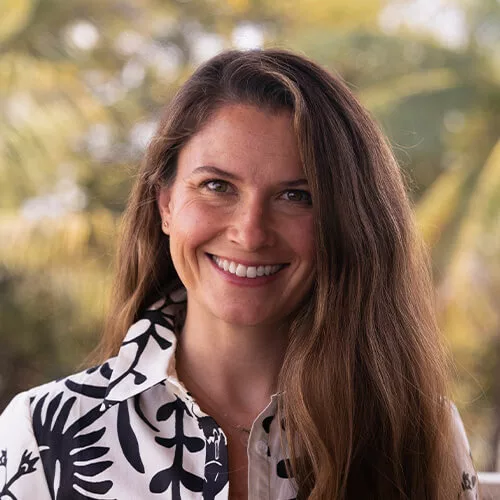
She teaches the people the system forgets. / Portrait: Noora Health
The Profile
Edith Elliott
She never meant to start an organization. Then she met a mother no one in the hospital would talk to.
Co-Founder & Co-CEO · Noora Health
She never meant to start an organization. Then she met a mother no one in the hospital would talk to.
Co-Founder & Co-CEO · Noora Health
Edith Elliott runs Noora Health alongside her co-founder Shahed Alam, and the premise of the whole enterprise is almost rude in its simplicity. Hospitals are full of people who love the patient, want to help, and are sent home with a pamphlet and a prayer. Elliott decided to teach them instead.
Noora Health turns the dead time of a hospital stay - the waiting, the worrying, the corridor pacing - into something useful. Family members learn the practical skills to care for a recovering loved one once they leave the ward: what to do, what to watch for, when to come back. The instructions are translated out of medical language and into plain speech. As Elliott puts it, boil it down and "it was actually pretty simple."
The model has spread from a single hospital in Bangalore to a network across India, Bangladesh, Nepal and Indonesia. More than a million family caregivers have come through it. For a woman who had a job lined up and no plan to become a founder, that is a strange place to end up - and a good one.
Reach figures per Noora Health and reporting on the organization. The number that started it all was one: a single mother, on a single ward.
What if we could democratize health care? What if we could unleash the healing power of all of those family members?
In 2012 two graduate students met at Stanford. He was in medical school. She was studying global health policy. They both signed up for a course with an unglamorous name and an outsized reputation: Design for Extreme Affordability, run out of the d.school. The course came with a field project. The field was India.
Elliott grew up in a small Colorado ski town; Alam was the son of Bangladeshi immigrants in suburban Houston who flew back to Dhaka every summer. Different maps, parallel instincts. In Bangalore they landed at Narayana Health and watched something nobody else seemed to find remarkable: families who wanted desperately to help, and a system with no time to teach them.
So they built the Care Companion Program - a way to train those families before discharge. The early results were stubborn enough to ignore the original plan. "We had no intention of starting an organization," Elliott has said. "Shahed was in medical school, I had plans to take a job." Neither of those things happened. In 2014 they founded Noora Health instead.
They named it after a woman they met who had just given birth. Her name was Noora. It means light.
One of the harder lessons came when Noora tried to grow into the United States too early and pulled back. Focus beat expansion. The organization sent its resources back to where the work was working.
Illustrative of a documented strategic choice: refocus on the work that scales.
She values honesty and makes decisions like someone who has had to choose between good options and better ones. The US pullback was a pragmatist's call.
By her own account she is willing to "bypass societal rules and expectations to craft the life I want." The job she planned to take is proof she meant it.
Ballet at 11, peer education as a teen, a million caregivers by her forties. The through-line was never health. It was showing people what to do.
• The organization's name means "light" in Urdu - chosen for a real woman, not a brand workshop.
• She grew up in a small Colorado ski town, about as far from a teaching hospital in Bangalore as a map allows.
• She had a job lined up. Noora Health was the detour that became the road.
• She holds associate faculty status at Ariadne Labs, the Harvard T.H. Chan School research center - the academy caught up to the practitioner.
"The most powerful untapped resource in health care" - Edith Elliott and Shahed Alam, TED2022, Vancouver.