A hotel can charge for the view. A farmer has to sell what grows in it. Astrid Juanita Stephanie built her early business around the distance between those two transactions: the produce leaving a field, the ingredients arriving at a kitchen, and the people earning a living somewhere along the route.
Before PanenID, she had worked on the customer side of the food trade. Hotels and restaurants were familiar territory. Then she and Johannes Kristanto began looking at the same business from the other end. Their company, PT Panen Indonesia Sejahtera, would connect growers with hospitality buyers. The proposition was plain enough to explain over lunch. Making it work required rather more than a lunch.
The attraction of this story lies in that change of position. Astrid did not have to imagine a customer for farm produce. She had worked around those customers. The harder question was how to organise a relationship that could serve both the kitchen and the field, with fewer stops between them and a worthwhile price at each end.
The buyer’s side of the field
Astrid studied food technology at Universitas Gadjah Mada. Her working experience included CERES GROUP, hotels and restaurants; she also held a national sales manager role. Johannes brought an agricultural background, alongside logistics and software experience. Together, they had reasons to pay attention to both the product and its journey.
They began developing their idea in 2016. Between September and December, Astrid observed farmers, hotels and restaurants, looking at how the market actually operated. In November, the team won a BEKRAF Startup Pitch Day competition. PanenID launched in January 2017.
Observation deserves a place in the founding story. A hotel’s demand for vegetables can look straightforward from a distance. Up close, it becomes a matter of which vegetables, in what condition, in what quantity, and at what time. The farmer has a corresponding set of questions. Growing something and selling it are separate pieces of work. An agricultural marketplace has to understand their meeting point.
Astrid chose hospitality customers: hotels, restaurants, cafés and catering businesses. That decision gave the undertaking a defined customer group. A business can learn a great deal by listening to people whose buying habits it already knows. Her earlier career supplied a starting point; the months spent observing growers and buyers gave the idea a test outside her former workplace.
A car becomes working capital
Astrid sold her car to help finance the business. By her account in March 2018, the sale provided about Rp100 million in starting capital. It is an unusually tangible opening balance. The vehicle was gone; the company had money to put to work.
The early trade included tomatoes, broccoli and bird’s-eye chillies. By March 2018, she was describing monthly turnover of roughly Rp500 million. Those are figures from that period, a view of a young company finding customers rather than a statement about its size today.
She also pointed to a less glamorous feature of hospitality trade: customers could pay on one-month terms. A successful sale and cash in the bank therefore belonged to different dates. That gap matters when a business needs capital to keep operating while it waits for payment. A growing order book can make the calendar surprisingly interesting.
Seen this way, selling the car belongs to the same story as choosing the customer. A buyer brings an opportunity and a set of conditions. Understanding those conditions is part of the founder’s job. Astrid’s account made space for the money required to sustain the trade, alongside the ambition to expand it.
Approximate initial capital Astrid said came from selling her car.
The work between two orders
PanenID’s early model included farmer managers who helped growers plan around demand. The platform carried practical information about produce: its type, price, production capacity, harvest date and location. These are the details that turn an introduction into something a purchasing team can use.
They also reveal the amount of work hidden inside a simple word like “direct”. Produce still has to be grown, gathered and delivered. Someone has to understand what the buyer will accept. Someone has to think about the next planting cycle. Removing steps from a trading chain leaves the remaining steps with responsibilities of their own.
By November 2017, Astrid was discussing farmer training, consistent procedures and planting plans matched to demand. PanenID was also part of GnB Accelerator’s third batch. Technology gave the company a way to organise information; field support addressed the conditions under which that information could become a dependable order.
This is a useful place to pause in Astrid’s story. Market access sounds like a door opening. In practice, the relationship continues after the door has opened. The second order is a test of the first. A farmer and a hotel both need enough confidence in the arrangement to return to it.
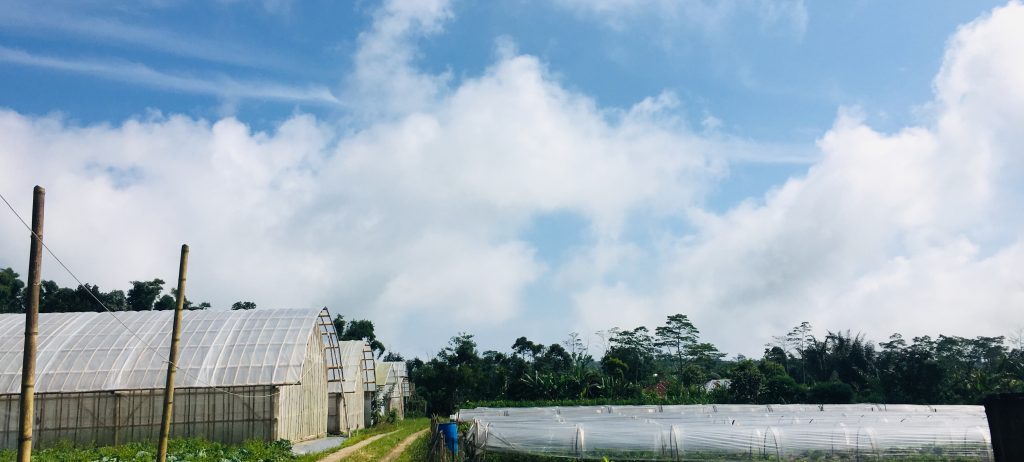
Her choice of customers makes the quality work easier to understand. A kitchen buying ingredients has a use for them already in mind. The grower’s planting decisions happen earlier, before that particular delivery. Connecting the two means carrying information in both directions: an order towards the field, and an account of available produce towards the buyer. The platform’s harvest dates and production details belong to that conversation. Astrid’s business put attention on the interval between the two decisions. The vegetables eventually travel one way; the information has to travel both ways for the arrangement to be useful.
Learning to leave Bali
Astrid’s plans did not begin with an appetite for expansion everywhere. In 2018, she recalled wanting to concentrate on Bali and hesitating to add people to the team. Kinara Indonesia’s Impact Acceleration Program helped change her view of what the company could attempt.
“IAP made a difference,” she said.
The support she valued was specific. Strategic investors helped with legal questions, the website, land matters, access to experts and office space. Her account treated investment as a relationship with practical consequences. Money was one contribution among several.
By November 2018, she described a team of ten, five patches of farmland around Bali and seventy hotel customers. She was considering Yogyakarta and Jakarta. For a founder who had previously preferred to remain on one island, expansion involved a change in her own willingness to build a larger organisation.
Yogyakarta became a concrete chapter in March 2019. PanenID entered the city and opened a PanenFresh retail outlet. In a photograph from that launch period, Astrid and Johannes stand behind baskets of fruit and vegetables. It is a pleasingly literal picture of a food business: the founders behind the stock.
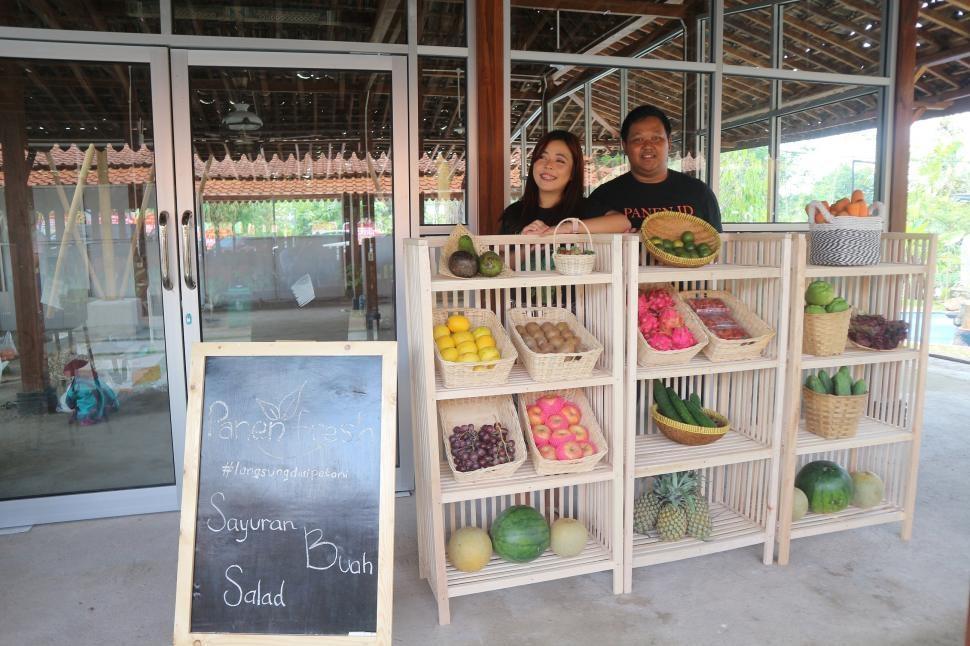
The shop also addressed produce left over from business orders. A retail outlet offered another route to customers. That is a small but revealing detail: an agricultural business has to consider what happens to the portion of a harvest that its main buyers do not take. The field and the order book will not always divide themselves neatly.
Lettuce, a classroom, and the next generation
In 2020, Astrid represented PanenBali at the HighPitch competition. The venture proposed hydroponic growing in urban spaces, including warehouses, and planned to begin with iceberg lettuce and other leafy greens. She described it as independent of PanenID, with PanenID intended to be its principal produce buyer.
The relationship between those ventures is worth keeping clear. One organised a route to market; the other proposed a way of growing. Her involvement placed her near another part of the same practical question: how to supply customers with the produce they need.
Her experience also became material for aspiring founders. She was named as a speaker for a food and agriculture entrepreneurship workshop in Denpasar on February 27, 2021. The programme covered finding and executing ideas, validating them, and researching markets and customers. Those subjects echo the observation work that preceded PanenID’s launch.
Earlier, the October 2017 EAT Asia-Pacific Food Forum programme had listed her as PanenID’s founder in a session about turning problems into innovative solutions. The idea had travelled into conversations beyond an individual farm or hotel. Even there, its underlying question remained close to the daily transaction.
The distance that still matters
PanenID’s March 2023 impact fact sheet describes operations in Bali, Jakarta and Yogyakarta, with 300 farmer suppliers. It names Astrid as CEO and co-founder. The activities remain recognisable: managing customer demand, collecting produce, checking quality and delivering it. Farm management and crop-cycle organisation also appear in the picture.
Astrid’s ambition extends to who might choose farming as a career. She has spoken about wanting younger people to find the profession attractive. A market for produce is part of that aspiration, alongside the pride of knowing where a harvest ends up.
“This is what makes the farmers who work with us proud with their job.”Astrid Juanita Stephanie, 2018
Her story invites a closer look at the distance between an ingredient and the person growing it. A hotel guest sees the meal. A purchasing team sees an order. Astrid built a business concerned with the relationship behind both. The farmer’s next planting decision belongs in that picture too. It is where the next meal begins.