A farmer harvests two tonnes of dragon fruit. A hotel wants 1.9 tonnes. That leaves 100 kilos, which is a rather substantial footnote to a successful sale. Johannes Dwi Cahyo Kristanto used this example in 2019 to explain why PanenID, the agricultural business he co-founded, also had a retail outlet called Panen Fresh. The shop gave the remainder somewhere to go.
The example is hypothetical. Its arithmetic is wonderfully specific. Kristanto was discussing an operation that sold farmers’ produce to hotels, restaurants and caterers. A large order could improve the economics for a grower, but it could still leave a gap between what the land produced and what the customer wanted. The retail channel supplied another destination.
It is a useful entrance into his working life. Before the executive titles, he had been a programmer and a food entrepreneur. He had sold drinks and sandwiches, built applications and written about coffee distribution. By the time he was explaining those leftover dragon fruits, food had already occupied several quite different corners of his career.
A business with a sliding door
In June 2014, Kristanto returned to his blog after a year away. He explained that he had left his job and gone back to Yogyakarta, where he had studied, to start a business with friends. Combimoo sold milk tea and sandwiches from a VW Combi. A cafe followed, then a shift toward a coffee-shop concept and franchising.
He described being financially independent during university through part-time work and several sources of income. Running a business brought a fresh education in people and practical decisions. Freelance programming helped support him along the way. He worked with Rails and Android, including point-of-sale applications and online shops.
His account gives the enterprise a human scale. Time that had belonged to him now went to employees and customers. The blog had fallen quiet because the business was noisy with demands. The Combi makes an appealing photograph in the imagination; his description supplies the work that would have happened outside the frame.
Combimoo also places him on the customer-facing side of the food trade before PanenID. Selling a sandwich is a small transaction, yet it carries a complete set of obligations: a product, a price and someone expecting to receive it. Those obligations grow with the business. They never become entirely abstract.
Coffee, code and a stubborn laptop
Five days after that return to blogging, he published a short piece called “Supply Chain Management Kopi.” He asked why Indonesians might not know or value the variety of coffee produced in their own country. His proposed way into the question was distribution: follow coffee from green bean to cup, then consider the companies and market around it.
The post is brief, but the question connects his interests unusually well. Coffee belongs to a food business; a supply chain belongs to his agricultural training; a process that can be examined step by step belongs comfortably beside programming. Here was a subject he could approach from several directions.
His technical writing could be cheerfully less philosophical. In July 2014, he decided to replace Ubuntu on his ThinkPad with Elementary OS, attracted by its appearance. The installation consumed roughly half a day and several attempts. Afterwards came the familiar chores: getting Wi-Fi working, connecting his phone and rebuilding his Ruby on Rails environment.
A beautiful desktop had earned itself an afternoon of troubleshooting. He liked the result and acknowledged its instability. The episode offers a small, recognisable detail of a developer’s life: the tool chosen to make work more pleasant briefly becomes the work.
By January 2016, his personal introduction listed a broad range of development tools, from Rails to JavaScript frameworks. It also listed cooking, reading and comedy and thriller films among his interests. The person behind the applications was quite willing to talk about dinner and entertainment.
“I’m an application developer.”
Johannes, in his 2016 personal introduction
Two graduates, one shorter journey
Kristanto and Astrid Juanita Stephanie both graduated from Universitas Gadjah Mada. His field was agricultural industry; hers was food technology. The two shared an ambition to build a business with social impact. Astrid brought experience in selling to hospitality customers. Johannes brought software and supply-chain expertise.
The idea was to connect growers more directly with the hotels and restaurants buying their produce. Bali offered an obvious concentration of those customers. The pair worked on the idea in 2016, and PanenID’s commercial operation began in January 2017. Kristanto had already listed the project in his earlier personal introduction.
Astrid funded the beginning with about Rp100 million raised by selling her car. Johannes’s earlier venture had put a vehicle to work selling food. Here, a vehicle helped finance a business moving food through a different route. Neither detail needs polishing to make the beginning interesting.
By November 2017, PanenID reported working with 120 farmers in Petang and Pancasari, Bali, and ten large hotels. Its application offered direct trading alongside help with crop choices and harvest planning. Kristanto, then identified as founder and CTO, described a service intended to make those connections accessible through a smartphone.
The appeal was practical. Growers needed buyers; buyers needed suitable produce. The platform also aimed to keep pricing, quality and quantity dependable. Shortening a distribution route was the business proposition. Making that shorter route work repeatedly was the operating task attached to it.
A simplified view of the business described in 2017-2019.
The part that takes a year
Near the end of 2017, Kristanto described an obstacle that could not be solved by releasing another feature. Convincing farmers to become partners took time. Some relationships developed in one or two months. Others could take a year. Maintaining the relationship required sustained attention.
His answer emphasised clear partnerships, honouring contracts and meeting obligations. “Tugas kami adalah bagaimana memenuhi ekspektasi mereka,” he said. Translated from Indonesian: “Our job is to meet their expectations.” It is a plain sentence, and a demanding one when the promise involves another person’s harvest.
He was also considering how different agricultural startups might work together. Urban farming could contribute supply. Precision agriculture could help observe soil conditions. Retail ecommerce partners were already another destination for produce that hospitality buyers could not absorb.
These remarks suggest a founder thinking about the connections around his own service. That is an interpretation of his stated interests, rather than a claim about his private motivations. His proposals concerned the practical fit between activities: growing, monitoring, selling and getting the product into someone’s hands.
A shop for the remainder
By 2019, Kristanto was being identified as PanenID’s COO. Discussing its arrival in Yogyakarta, he pointed to the city’s culinary businesses and local farmers. The setting brought the operation back to a city already familiar from his student years and earlier ventures.
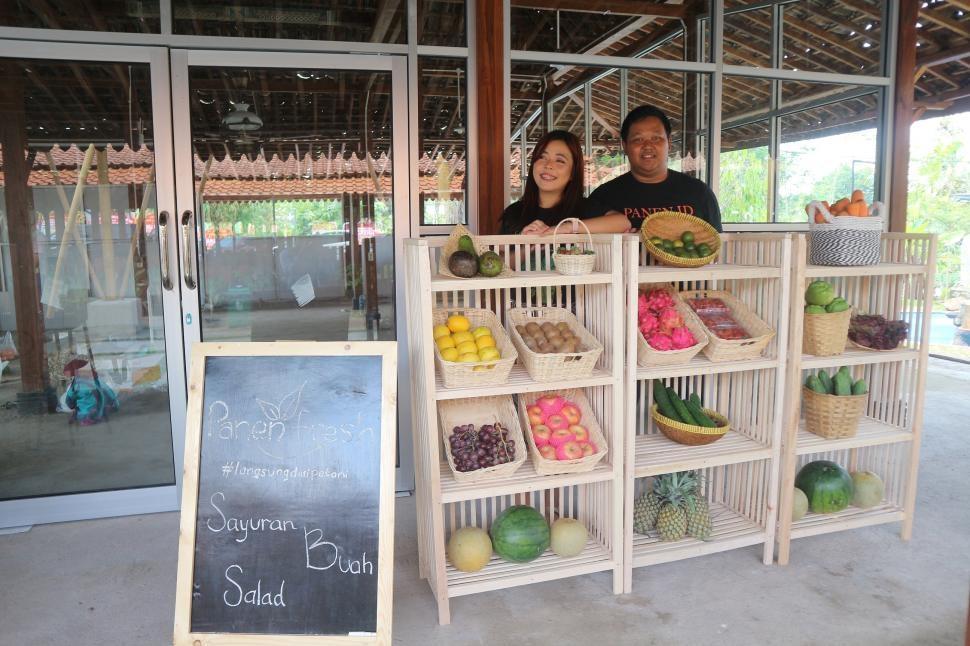
Panen Fresh made the business visible at street level. The photograph of Johannes and Astrid at the shop shows baskets of fruit and vegetables arranged on open shelves. The founders stand behind the display. It is a modest scene, with the merchandise doing most of the talking.
His dragon-fruit calculation explained the relationship between the wholesale business and that shop. The bulk buyer took most of the crop; smaller customers could buy the rest. The example describes a way to handle a mismatch, rather than a claim that every harvest found a buyer.
Illustrative arithmetic, not recorded sales volumes.
The CTO-to-COO change in the public record is worth pausing over. The title puts operations beside his technical background. Food ordering software deals in quantities and requests; the service around it deals in actual products. His explanation of the remainder gives that distinction a tangible form.
A wider network, familiar responsibilities
In 2022, Glife Technologies acquired a controlling stake in PanenID as part of its expansion into Indonesia and Malaysia. Kristanto was named PanenID’s CEO. The partnership linked the Bali business with a Singapore-based company building a regional food-distribution and technology operation.
The plan included introducing GlifeWare, an enterprise system for orders, warehouses and transport. Those categories sound dry until one remembers what they describe: what a customer wants, where the product is and how it reaches its destination. For PanenID, they sat directly inside the business it had been building.
“We are excited to join the team at Glife,” Kristanto said in the announcement. Later that spring, Glife’s Caleb Wu said Johannes would continue as CEO. Wu also credited Johannes and Yolek’s Desmond Tan with commitment, passion and tenacity. The acquisition brought a new shareholder and technology plans around established local teams.
The programmer’s thread continues in Kristanto’s public work. In March 2026, he published releases of sastrawi-ruby, a maintained library for reducing Indonesian words to their stems. Wokku Cloud appeared on AppVerse in April with his name as developer. His GitHub work includes a command-line tool and application starters for deploying through Wokku.
Those projects bring the story back to applications and the work around them. A deployment tool helps code reach a running environment. A distribution business helps produce reach a buyer. The parallel is an editorial reading of his career, but the projects on either side are concrete.
The milk-tea van, the hotel order and the software repository belong to different settings. Each contains something that has to reach another person in usable form. Follow those destinations and Kristanto’s career becomes easier to understand. There is usually another practical detail to handle. Occasionally, it weighs 100 kilos.