The quietest room in American Standard's operation was supposed to be its loudest. The home-services company's contact center was making 20,000 dials a day, yet its contact rate sat at 5.56 percent. The staff was there. The leads were there. The conversations were not. Faraday was technically in the stack, scoring prospects, but it had been reduced to a bouncer at the front door: reject the worst records, then let the rest tumble through the same machinery.
That is a crisp way to understand both Faraday's product and the mistake it wants customers to avoid. The Burlington, Vermont company sells a customer-context layer. It takes a brand's first-party records, matches them to an identity graph of roughly 240 million U.S. adults and their households, adds demographic, property, financial and lifestyle signals, trains models against the business outcome, then sends predictions back into the tools where someone can act. Conversion, churn, likely spend, next product and persona are the menu. A score by itself is merely a number with good posture.

The customer profile, after it has had coffee and remembered where it lives.
A model with no memory
Faraday's pitch lands on an obvious weakness in the current AI boom. A language model can produce an agreeable email, but it does not inherently know whether the recipient just bought a house, has the means to finance new windows or is shopping for a baby gift rather than a baby. A customer data platform can preserve clicks and purchases, but that history mostly describes the relationship with one brand. Faraday tries to fill the outside world back in.
Its Faraday Identity Graph, known as FIG, contains more than 1,500 curated attributes. The company says the data is licensed and permissioned from reputable compilers, public records, surveys, self-reporting and non-cash transactions. It does not scrape the web or build around tracking cookies. Identity resolution connects a name, address, phone or email with the graph; customer events provide the outcome; machine-learning models look for patterns; deployments deliver percentiles and explanations through an API, batch files, MCP or integrations.
The distinction from a CDP matters. Faraday is not asking to become the canonical home of every event. It supplies intelligence to the home you already have. Its integrations list reads like the modern data pantry: Snowflake, BigQuery, Redshift, Postgres, Salesforce, Shopify, HubSpot, Klaviyo, Iterable and ad platforms. For small jobs, Faraday Pro lets a user select attributes, upload a file or make a real-time lookup and pay per successful match. Enterprise is the sales-led version for custom models, cohorts and recurring deployments. Enterprise fees are not public.
What failed first
Back at American Standard, executive Eric Swanson initially distrusted lead scoring because he saw it doing exactly what many scores do: blocking leads at the top without solving the call center's deeper problem. outboundIQ chief executive Jason Cutter identified the operational flaw - the company was optimizing for calls, not conversations. Faraday's deeper consumer context, including household and financial indicators, existed but had not been turned on in the routing logic.
But Faraday is not a lead blocker. We're a lead optimizer.Faraday's account of the American Standard test
The change was procedural, not mystical. High-fit leads moved to the front for fast agent action. Middle bands entered the appropriate workflow. Lower-fit records went into slower nurture instead of consuming the same immediate attention. Nothing about the underlying leads changed. The route did.
Those are company-reported figures, not a universal promise, but they answer the question that most AI case studies dodge: what did the system actually do? It enriched known prospects, scored them against a defined outcome and changed the dialing order. What changed the skeptic's mind was a test that connected the score to contact and conversion, not a slide about model accuracy.
The machinery, and the price of guessing
Under the hood, Faraday tests approaches such as random forests and logistic regression against enriched data, validates performance and returns propensity scores with explanations. Its Recommendations product, released in beta in 2024, blends collaborative filtering with a random-forest ensemble so it can suggest a next offer for existing customers as well as new leads. Personas cluster people by shared traits. A forecast estimates spend. The technical work is packaged so a marketing or product team does not need to recruit its own miniature data-science department.
A subscription-box customer offers the neatest proof. Its existing recommendation logic was deterministic, rigid and vulnerable to human bias. The company ran a clean A/B test against Faraday's two-sided recommendation engine. Faraday reports 5 percent higher revenue per customer, 3 percent lower churn and five times monthly ROI. Again, the copyable move is less glamorous than the model: keep the existing rules as a control, change one decision system and measure business outcomes.
Faraday also tested whether an LLM could replace consumer data. In a locked-down environment, Claude wrote a demographic estimator using public birth and census information. Building the method cost $1.23. On 150 records, the model estimated gender about as accurately as Faraday, but missed age by 11.5 years on average. Individually matched Faraday records missed by 1.9 years. Telling the model that the customer base skewed older improved its error to roughly seven years, still far behind identity-resolved data. The lesson is pleasantly narrow: population inference can be cheap and useful, but it cannot reliably place a person inside the population.
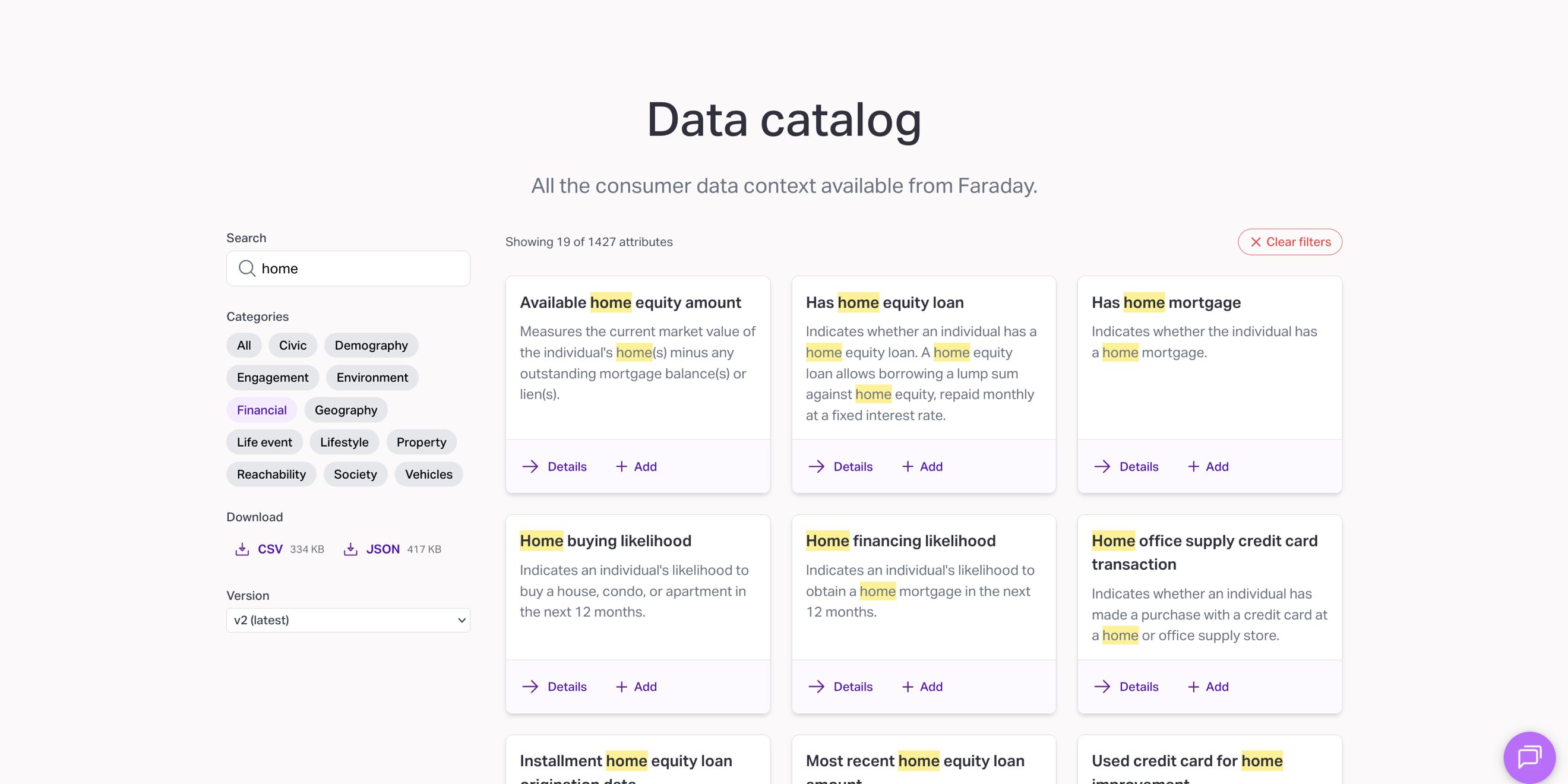
More than 1,500 attributes, because “probably owns a couch” is not a segmentation strategy.
The Vermont data company grows up
Andy Rossmeissl, Seamus Abshere, Robbie Adler and Ian Hough founded Faraday in 2012. FreshTracks Capital led the first outside round in 2014. A $4.1 million Series A followed in July 2021, led by Intercap with FreshTracks and LaunchCapital. In late 2024, former Clearbit COO Robin Spencer joined as Faraday's COO, investor Peter Levine became an independent board advisor and Intercap led additional financing whose amount was not disclosed.



Andy Rossmeissl, Seamus Abshere and Robbie Adler - three people who made “directed acyclic graph” a customer-facing phrase.
The long apprenticeship matters. Faraday's defensibility is not a novel algorithm alone. It is the accumulated work of buying, normalizing and documenting consumer data; resolving identities; building privacy and security controls; and delivering outputs into production. The company has completed SOC 2 Type II audits annually since 2020, says customer data is logically isolated by account, encrypts data in transit and at rest, runs a HackerOne program and builds bias mitigation and explainability into the platform.
That does not dissolve the tension of maintaining a detailed graph about U.S. adults. It makes governance part of the product. A team considering Faraday still needs to ask whether its proposed action is proportionate, whether protected attributes are excluded or controlled, how people can exercise privacy rights and whether a model's lift survives a holdout. “Responsible” is a practice with logs and review, not a sticker for the sales deck.
What changed in 2026
FIG v2 moved the graph from a current snapshot toward a historical system. Each attribute can carry a timeline, source metadata and precision. This attacks a subtle modeling error: if a home-improvement company trains on what customers look like after buying, the model may learn signals caused by the purchase. Historical data lets it rewind to the pre-purchase profile. The release also added continuous refreshes, a redesigned catalog and release pinning so regulated or change-sensitive teams can test new data before it reaches production.
Faraday's other move is toward AI agents. Its MCP server lets compatible assistants inspect account data, analyze results and manage configuration from a conversational interface. That positions Faraday as memory and instrumentation for agents rather than simply a batch score vendor. The opportunity is real: an agent can be far more useful when it knows the customer's likely needs. The risk is equally plain: context delivered faster can produce mistakes faster. Human approval, narrow permissions and measurable actions remain sensible defaults.
- Name one outcome that already exists in clean historical data: conversion, churn, appointment or next purchase.
- Enrich only the identities and attributes justified by that outcome.
- Map score bands to different actions before the first prediction arrives.
- Keep today's workflow as a holdout, then compare revenue, contact, churn or cost - not model theater.
- Watch drift, bias and downstream behavior, then retrain or stop when the lift disappears.
When the playbook breaks
Faraday fits best where a company sells to identifiable U.S. consumers, has enough historical outcomes to train against and can change a real workflow. Home services, retail, subscription commerce and financial services naturally produce those conditions. It is less compelling when the audience is mostly outside the United States, records lack stable identity fields, sample sizes are tiny or nobody owns the action after a score appears.
If the outcome is vague or inconsistently recorded, enrichment only makes the confusion more expensive.
If every score receives the same call, offer or message, prediction cannot change the result.
Anonymous or international audiences sit outside the graph's strongest U.S. consumer coverage.
High-stakes decisions and invasive personalization can create privacy, fairness and trust costs larger than the lift.
The market around Faraday is crowded from every direction: Experian, Acxiom and LiveRamp sell data and identity; Salesforce, Adobe and Amperity organize customer information; Optimove and Klaviyo automate marketing decisions; Hightouch and GrowthLoop move data into channels; internal teams can build models themselves. Faraday's argument is that the annoying middle - licensed data, matching, modeling, validation and deployment - works better as one service.
That argument is strongest when it stays concrete. American Standard did not need a smarter adjective for AI. It needed more conversations from the same leads. A score became valuable when it changed who called whom, and when. In a market stuffed with synthetic language, Faraday's most persuasive product may be an old-fashioned operational sentence: here is the next person worth calling, and here is why.