A useful way to understand Andy Rossmeissl is to begin with a Friday email he did not want to receive. Faraday was in diligence with a respected venture fund. Momentum looked good. The investor asked for client references, and Rossmeissl did what a founder is trained to do: he assembled an impressive list. The most senior people. The most recognizable brands. The sort of names that arrive on a call already wearing a halo.
Two conversations went well. The third featured an executive Rossmeissl admired at a long-standing customer. The executive, however, did not really know what Faraday was doing for the company. He seemed to confuse it with another vendor. The fund passed. Years later, Rossmeissl described the episode with the wounded economy of a footballer reviewing a replay: “Total own goal.”
The customer remained a customer. The executive became a better-informed ally. Rossmeissl changed the rule. When an investor wants a reference now, Faraday connects them to the person who uses the product. A famous title can signal importance; only a user can explain value. It is a small operating lesson with a large moral: proximity beats prestige when reality is being audited.
“Ever since, whenever we do a client ref, it’s always with the USER.”Andy Rossmeissl, reflecting on a missed venture deal
The first prediction was sunshine
Faraday began in 2012 with a problem that was concrete enough to draw on a whiteboard. Residential solar companies needed to find households likely to buy panels. Rossmeissl, Robbie Adler, and Seamus Abshere had already co-founded Brighter Planet, an enterprise sustainability platform. They knew the untidy business of gathering environmental information, normalizing it, and turning it into something a company could use. Solar customer acquisition offered a new application: combine consumer and environmental data, then predict where interest might become a sale.
The founders started in the Vermont Center for Emerging Technologies’ former coworking space in Middlebury. Early support mattered. Rossmeissl later told Vermont lawmakers that VCET’s David Bradbury was the first person in the state who met with the team, listened, helped sharpen the business plan, and delivered institutional capital. Without that intervention, he wrote, the company might not have lasted a year.
A company learns to widen the lens
Faraday launches around predictive customer acquisition for residential solar.
First institutional investment and a $1 million federal SunShot grant arrive.
A $4.1 million Series A backs the next stage of the company.
FIG v2 adds historical data, continuous refreshes, and a rebuilt attribute system.
A $1 million Department of Energy SunShot grant helped Faraday work with major solar companies. But the machinery beneath the solar use case was more general than the market around it. If data could help identify a likely solar buyer, it could also help a home-services company prioritize leads, a retailer recommend a product, or a financial-services business understand which customers were likely to act. The niche was not discarded; it revealed the platform hiding underneath.
This is the less cinematic version of product-market evolution. There is no thunderclap, only a sequence of increasingly portable decisions. Find a valuable outcome. Assemble relevant signals. Test whether the model improves the outcome. Put the answer into the system where somebody can act. Repeat until the original wedge becomes one use case among many.
The Faraday operating loop
A designer with a terminal window
Rossmeissl’s education makes an oddly precise preface to his career. At Middlebury College he studied architecture and mathematics. Architecture asks how a collection of parts becomes a system people can inhabit. Mathematics asks whether the structure holds. Software is where those two habits acquire deadlines, error messages, and customers.
Middlebury describes him as a designer by training and a lifelong software engineer. His remit at Faraday has ranged across product strategy, technical architecture, data-science methodology, and corporate matters. His public GitHub trail is correspondingly hands-on: data tools, geospatial work, Ruby projects, JavaScript, and a long shelf of practical experiments. This is not the biography of an executive who once coded. The builder remained present as the title grew around him.
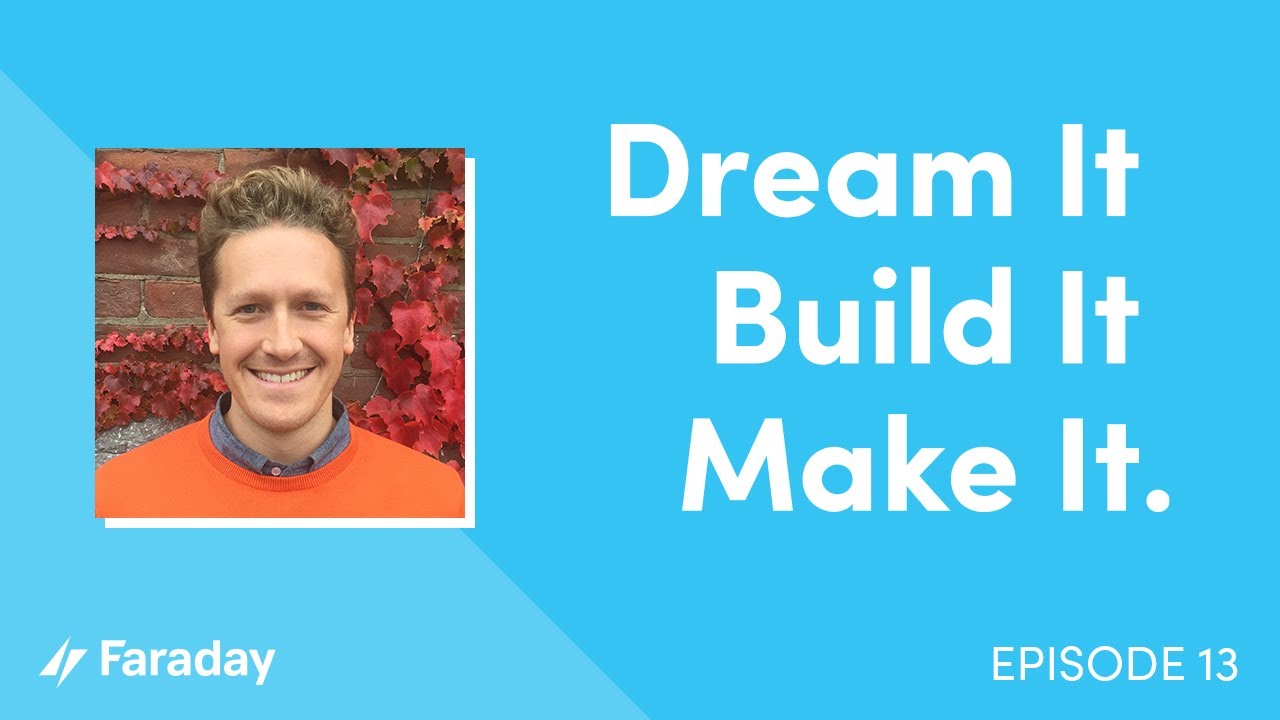
That combination of design and engineering shows up in his explanations of machine learning. He begins with the decision rather than the spectacle. In a guide to holdout testing, he called healthy skepticism a critical part of responsible AI. Predictions should meet data the model has not already seen. Accuracy should be inspected, not assumed. Bias should be reported and mitigated. The system must eventually leave the laboratory and reach an API, a sales queue, or a campaign where its output changes behavior.
“You want continuity between how you handle leads and how you handle customers. That means the architecture has to start early.”Andy Rossmeissl on operationalizing personas
Context, not confetti
By 2026, Rossmeissl’s preferred word for Faraday’s work was “context.” Large language models know an astonishing amount about the shared world. They may know almost nothing about the person who has just landed on a pricing page. A fluent system without grounded customer information can produce polished generalities at industrial speed. In Rossmeissl’s formulation, the missing piece is the context gap between what a brand records and what it needs to decide.
Faraday’s answer is the Faraday Identity Graph, or FIG: a maintained dataset covering 240 million U.S. adults with more than 1,400 verified data points, including demographics, property information, financial signals, life events, and lifestyle indicators. The company says it does not build the graph with third-party cookies or social scraping. It matches identities, enriches records, and produces inputs for lead scores, churn models, personas, product recommendations, and market analysis.
The more interesting part of FIG v2 is time. A current snapshot can accidentally teach a model what somebody looks like after buying. Historical data can show what that same person looked like before the purchase. For a predictive system, trajectory is often more useful than portraiture. The model should learn the conditions preceding an outcome, not merely admire its aftermath.
This is also where the restraint enters. More data is not automatically better. Rossmeissl argues that an AI system has a context budget; flood it with undifferentiated information and signal drowns in noise. The product challenge becomes curatorial. Which facts matter for this decision? Which outcome is worth optimizing? What evidence will show whether the prediction helped? AI, in this telling, is not a fog of possibility. It is a sequence of accountable choices.
Vermont is part of the architecture
Faraday’s geography is not decorative. In 2015, as the company expanded in Burlington, Rossmeissl said the founders stayed in Vermont because they and their colleagues valued the environment, community, and work-life balance. “Building a corporate culture is one of the hardest things you do,” he said. “We’re all here because we appreciate Vermont and the community.”
The choice carried friction. In his 2021 note to lawmakers, Rossmeissl argued that traditional big-city venture capital had long ignored Vermont and that local, nontraditional capital was essential to the state’s next generation of employers. It was an operator’s case for ecosystem design: if young people should be able to build careers without leaving, promising companies need support before distant investors can see them clearly.
Faraday’s own endurance gives the argument weight. The company moved from a Middlebury coworking space to Burlington, crossed industries, raised a $4.1 million Series A in 2021, and kept revising the product. It also kept the Vermont premise. Place helped shape the culture, while the culture gave the company a reason to stay.
The serious work and the weird print
A person can become flattened by a company biography, especially when every noun is infrastructure. Rossmeissl leaves a few useful dents in the official surface. Faraday’s author note says he lives in Vermont with his wife, lifts weights, makes music, and plays Magic: the Gathering. At Middlebury, he was involved with WRMC 91.1 FM. On GitHub, amid software notes and travel advice, there is a wonderfully specific request involving strips of real film cut from a theatrical reel of the original Blade Runner. He wanted one frame enlarged as a print and, quite reasonably, wanted the lab to return the film.
These details fit better than they first appear. Music, collectible cards, architecture, code, and an artifact from a film about artificial humans all reward attention to systems and particulars. Rossmeissl’s public personality is similarly exacting but not bloodless. He can write about bias mitigation, then tell a fundraising story at his own expense. He can advocate for validation while admitting the weekend panic caused by an ominously worded investor email.
The through line is not prediction for its own sake. It is usefulness. Brighter Planet tried to make environmental data actionable. Early Faraday tried to find likely solar buyers. The current company tries to supply the context that lets brands and their AI systems decide with less guesswork. Across each chapter, the technology changes while the question remains: what can this information help a person do next?
There is a humane modesty in that question. Models can rank, enrich, resolve, and recommend. They still need somebody to choose the outcome, inspect the evidence, mind the bias, and listen to the user. Rossmeissl’s career has been built in that last mile between clever machinery and accountable action. The signal is valuable because, somewhere beyond the score, a human being has to make a decision.