The Houston Company That Puts a Number on How Wrong It Was
Most forecasters bury their misses. Complete Intelligence, an eight-person Houston shop, prints its own error rate next to every prediction - and built a business on the discomfort that creates.
Ask anyone who has sat through a corporate planning meeting and they will tell you the dirty secret of forecasting: nobody keeps score. The confident chart from last quarter gets quietly replaced by a confident chart for this quarter, and the gap between what was predicted and what actually happened evaporates before anyone has to answer for it. Complete Intelligence, a small company headquartered in the northern suburbs of Houston, was built on the opposite instinct. It publishes how wrong it was.
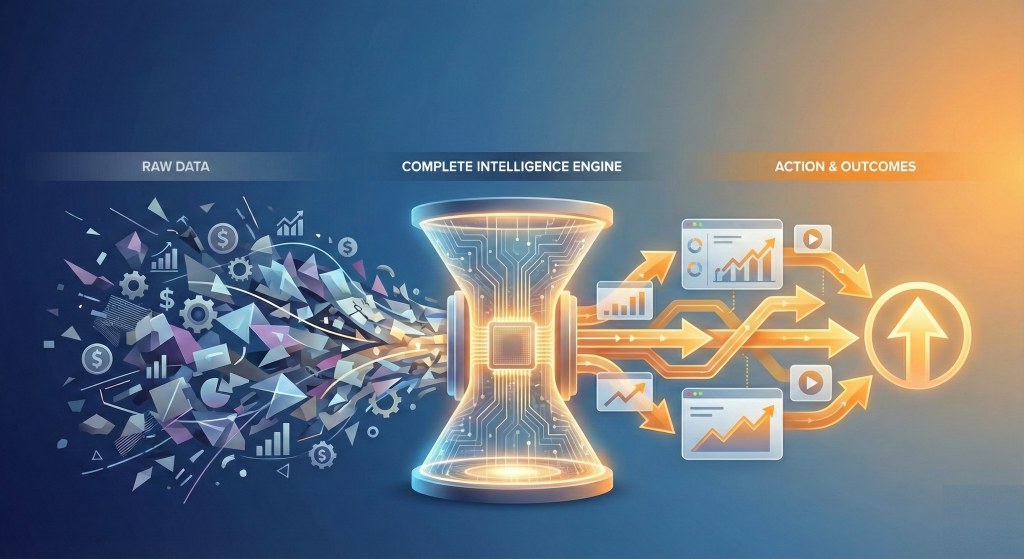
The company forecasts markets, revenues, costs and whole economies using machine learning, then attaches the error rate of its past predictions to each new one. The pitch is not "trust our AI." It is closer to "here is our track record - now decide for yourself." In an industry crowded with gurus and glossy PDFs, that single design choice is the thing worth paying attention to.
The originA forecaster who got tired of the misses
Complete Intelligence was founded in 2015 by Tony Nash, who spent roughly 15 years in Asia working on sourcing, procurement and global trade before starting it. His resume reads like a tour of the institutions that shape how the business world sees the future: he built the global research business for The Economist, where he was Global Director of Consulting and Custom Research, and he ran the Asia consulting arm of IHS, now part of S&P Global. He holds a master's from the Fletcher School at Tufts and a business degree from Texas A&M.
From inside those institutions, Nash noticed something uncomfortable. The experts - his own colleagues included - were routinely off. Corporate forecasts and industry analysts, by his account, lived with error rates in the range of 20 to 30 percent. That is not a rounding problem; that is the difference between a budget that holds and one that detonates in the second half of the year. He moved back to Houston to build a machine that could do better, and to be honest about it when it did not.
The productCI Markets, and the receipts it prints
The flagship platform is CI Markets, a cloud service that forecasts more than 1,300 assets: every stock in the S&P 500, plus global indices, the top US ETFs, currencies, commodities and economic indicators for roughly 50 countries. Forecasts run on a one-year horizon at monthly intervals and are re-run every week as new data lands. It began life under the name CI Futures and was rebranded to CI Markets in 2023.
The feature that sets it apart is not the coverage - plenty of vendors sell a firehose of numbers. It is that each forecast carries the measured error rate of previous predictions for that asset. You can see how close the model has been before you lean on what it says next. For a field that usually hides its homework, showing the marks is a genuinely different posture.
Forecast error: the industry vs. the pitch
Bars are illustrative of figures the company and press reports have cited (average error across an early set of ~700 tracked assets, and a 94.7% average accuracy claim on the market platform). Accuracy varies by asset and horizon; the point of the product is that you can check.
The proof points the company likes to tell are specific rather than grand. In one early test, the model called for natural gas to fall about 40 percent over the following year. It actually fell 49 percent. Not a bullseye - but a great deal closer than a coin flip, and closer than the analysts who missed the direction entirely. Across an early set of about 700 publicly tracked assets, the company reported an average error near 3.7 percent, running billions of calculations a month to get there.
Beyond marketsTools for the people who own the budget
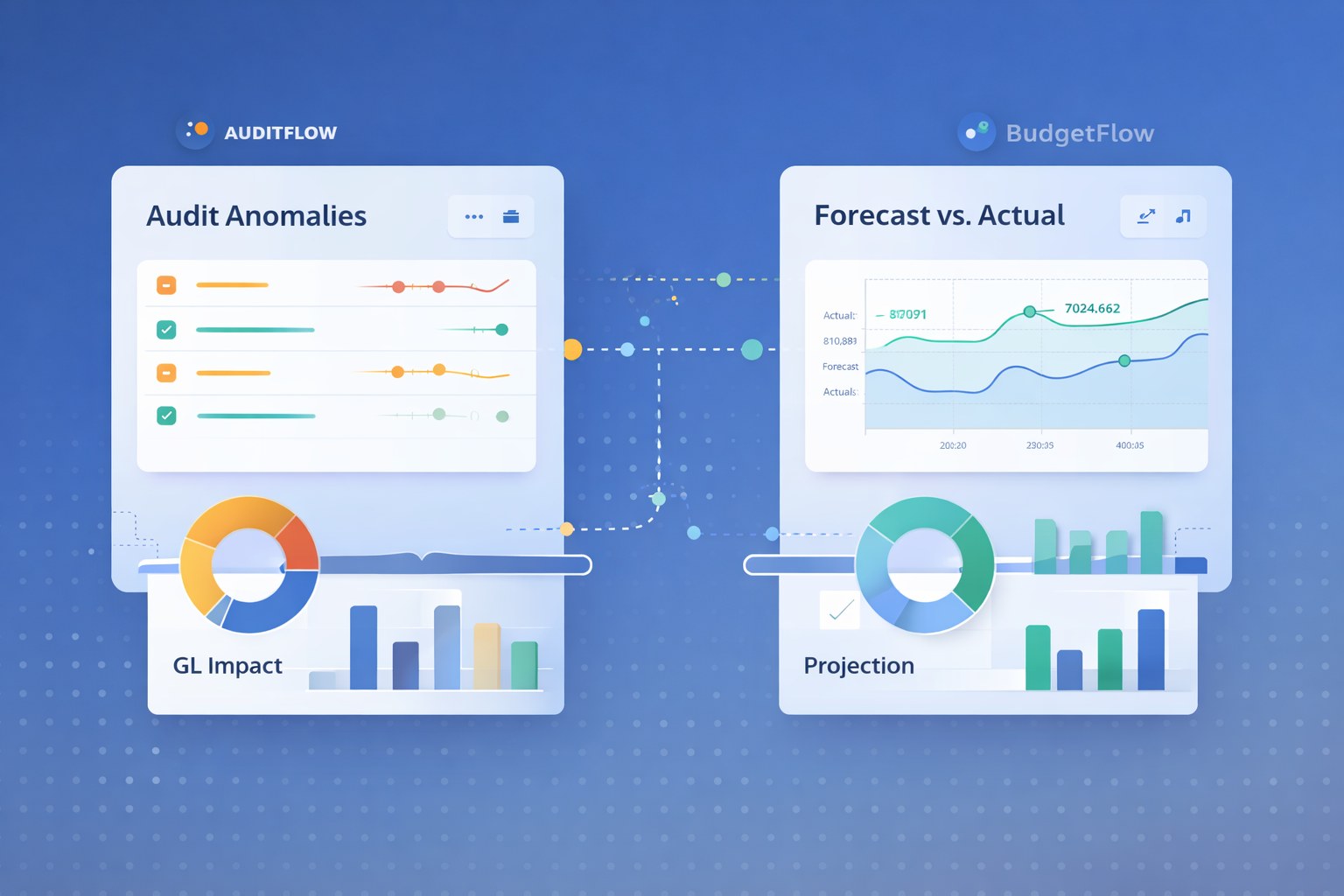
Investors are only half the audience. The other half sits in corporate finance, and for them the company has built an enterprise suite. CI Markets Alpha pushes into higher-frequency, institutional-grade territory - daily forecasts over a roughly 20-trading-day horizon, with sentiment analysis, options Greeks and portfolio optimization. BudgetFlow replaces the static annual budget with a model that updates itself as conditions change. AuditFlow hunts for anomalies in the ledger. Earlier products, CostFlow and RevenueFlow, aim the same machinery at procurement costs and sales.




The product family, rendered as glass. From left: the market forecasting core, its high-frequency Alpha tier, the audit engine, and the self-updating budget.
The businessFree at the door, enterprise in the back
The model splits neatly. CI Markets is self-serve, with a free tier that asks for no credit card and paid plans that top out around $24.95 a month - a deliberate move to put institutional-style forecasting in front of retail investors who could never afford a Bloomberg terminal. Alpha sits a tier above for active traders. BudgetFlow, AuditFlow, CostFlow and RevenueFlow are sold to enterprises, often wired into a client's own data systems so the forecasts sit next to the numbers they are meant to correct.
The customer list skews toward industries where being wrong is expensive: healthcare, energy, manufacturing, consumer goods, distribution and finance - CFOs, controllers, FP&A leaders, procurement teams and trading desks. One customer, a senior director, put the appeal bluntly in a testimonial the company likes to quote.
The fieldWhere it fits, and where it wouldn't
Complete Intelligence is competing, in effect, against three things at once: the giants of market data such as Bloomberg and S&P Global; the legacy planning software - Anaplan, Workday Adaptive Planning, Planful - that finance teams already run; and the humble spreadsheet, which remains the most-used forecasting tool on earth. Its wedge against all of them is the same: automated forecasts with a published, checkable error rate, delivered by a team small enough to move quickly. In 2020 the Texas accelerator Capital Factory named it Newcomer of the Year, and Oracle for Startups has featured the platform.
It is worth being clear about where this approach has limits. A model trained on history struggles when history stops being a guide - genuine regime breaks, shocks and one-off events are exactly the moments forecasts miss, and no published error rate rescues you from a future that does not rhyme with the past. The honesty helps you size the risk; it does not remove it. For a team that wants a single confident answer and someone to blame later, a tool that keeps showing you its uncertainty may feel less comforting, not more. That, arguably, is the point.
The bet underneath all of it is simple, and a little contrarian: that buyers are ready to trade the false comfort of a confident number for the real comfort of a measured one. Complete Intelligence has spent a decade wiring that idea into software - and printing, over and over, exactly how wrong it was.