Consider the drawer where the spare batteries live. Somewhere between the rubber bands and a key to something nobody remembers, there is a packet bought for a future inconvenience. A remote will stop responding. A flashlight will be needed. Energizer Holdings has built a business around being ready for that moment. But follow the company beyond the drawer and an unexpected object appears: a bottle of Armor All.
- Energizer sells batteries and lights, plus car-care brands including Armor All, STP, and A/C Pro.
- Two Spectrum acquisitions in 2019 carried contractual prices totaling $3.25 billion, before adjustments.
- Its factory reset has produced savings, charges, and an unusually useful lesson about transition costs.
A shopping basket with a theory
Batteries and dashboard protectant seem unlikely relatives. One involves electrochemistry; the other involves the condition of your car. Yet both are branded products sold through retail networks, bought to solve familiar problems, and purchased again when supplies run out. Seen from the checkout, the family resemblance becomes clearer.
Energizer’s battery portfolio spans household alkaline cells, lithium batteries, rechargeables, and specialty formats. Its portable lights include flashlights, headlamps, and lanterns. Eveready and Rayovac sit alongside the Energizer name. Car care stretches from appearance and fragrance to STP performance products and A/C Pro recharge kits. Consumers see individual brands. Retail buyers encounter a supplier with several reasons to call.
The business earns money by making or sourcing goods and selling them through retailers and distributors, with online channels and licensing extending its reach. Its expertise joins battery design and manufacturing with brand management and distribution. Duracell and Panasonic compete for battery purchases; store brands compete on price. Energizer’s broader portfolio gives it other aisles to work.
The customers have two faces. Households want working devices and maintained cars; retailers want products that sell. Walmart alone accounted for 12.8% of fiscal 2025 sales. Energizer also serves equipment makers and industrial, medical, office, and hearing-aid distributors. That range explains why distribution deserves as much attention as advertising: a recognizable packet helps only when it reaches the place somebody needs to buy it.
Buying the next aisle
The current standalone company emerged in July 2015, separating household products from the business that became Edgewell Personal Care. That distinction matters: the older Energizer Holdings, created in 2000, had included personal-care businesses. Today’s battery-and-auto-care company is a more particular construction.
In January 2019, Energizer closed its $2 billion cash purchase of Spectrum’s battery and portable-lighting business. Later that month came Spectrum’s global auto-care business, at a contractual $1.25 billion, split between cash and stock. Rayovac, Armor All, STP, and A/C Pro enlarged the portfolio. Regulatory approval also required a retreat: the Varta consumer battery business in Europe, the Middle East, and Africa was subsequently sold.

The logic was expansion through adjacent capabilities. The challenge was making the acquired pieces work together. A brand can change owners on a closing date. A production line has to be moved, restarted, and made dependable. Customers still expect deliveries while all of that happens.
The machines do not move themselves
In November 2022, Energizer’s board approved Project Momentum, a profit-recovery program covering manufacturing, distribution, supply chains, and overhead. Its scope subsequently expanded. Through fiscal 2025, the company reported approximately $206 million in savings and $221 million in cumulative restructuring and related charges.
Two measures of one reset. These figures are not a return-on-investment calculation.
Those figures should sit beside each other. Savings describe benefits; charges describe the work required to obtain them. Neither alone tells you whether the transformation has earned its keep. Severance, asset write-offs, consulting, and relocation were among the expenses. Separate network-transition spending added another complication.
In fiscal 2025, incremental freight and third-party packaging support cost $19.7 million as facilities were decommissioned and lines relocated. This is the revealing detail. A visible strain in the operating plan was the handover: keeping products available while changing how they were produced and packed. Production inefficiencies and higher warehousing and distribution costs ate into the benefits.
“an operating environment that remains dynamic”Mark LaVigne, CEO · August 2026
What changed the plan? Tariffs and a difficult economic backdrop helped push Momentum into a fourth year. The extension included sourcing changes, European network redesign, and investment in US manufacturing efficiency. A program meant to simplify operations had to accommodate another set of moving conditions.
A smaller product, a more precise problem
Meanwhile, another part of the business was asking a different question about familiar objects. Coin batteries power key fobs, tracking tags, and small household devices. Their usefulness comes with a serious ingestion hazard. Improving how long they last addresses only part of the product’s job.
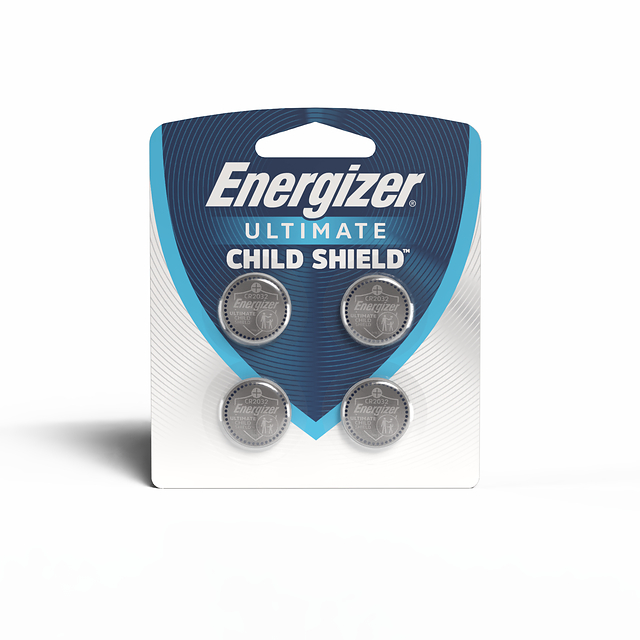
In May 2026, Energizer announced nationwide availability of Ultimate Child Shield in sizes 2032, 2025, and 2016. The company says its proprietary design prevents ingestion burns. It also includes bitter coating, child-resistant packaging, and dye that turns blue on contact with saliva. These are distinct interventions: discourage access, discourage swallowing, signal contact, and address the burn mechanism.
Reese’s Purpose, the advocacy organization, worked with Energizer over several years. Its account emphasizes conversations and persistence. The resulting product illustrates a concrete way to compete in a mature category: find a consequence customers care about and redesign around it. Battery ingestion still demands immediate medical attention; choking and obstruction remain possible.
What the drawer can teach an operator
By the third fiscal quarter of 2026, Energizer reported $734.1 million in sales, up 1.2% year over year, with organic growth of 2.7%. But unfavorable product mix and more promotional investment weighed on margins. Management moved annual adjusted earnings expectations toward the low end of its original ranges. More sales did not automatically buy more breathing room.
The transferable lesson is practical. Expand where capabilities travel. Budget for keeping customers supplied during a change. Give product development a specific problem to solve. These choices depend on retailers continuing to stock the products, shoppers accepting the price, and factories delivering the expected economics. Without those conditions, a larger portfolio can simply become more things to coordinate. In the drawer, the battery waits quietly. Behind it, very little stands still.