The potato chips were fine. The trouble was the cartons. At a PepsiCo factory in the Netherlands, boxes stacked for transport had to survive the journey and still come apart without damage. The old cold-adhesive arrangement made restacking troublesome. A little glue had become a supply-chain problem. This is a useful place to meet Nordson: beside a pallet, where a seemingly minor manufacturing decision can acquire a surprisingly large bill.
- Nordson controls how materials are applied, moved and inspected.
- Customers pay for less waste, reliable quality and more production time.
- Its business spans packaging, electronics, medical technology and industrial processes.
The glue is only the beginning
PepsiCo installed Nordson hot-melt equipment with pressure control. Cartons near the bottom needed less adhesive because the stack’s weight helped stabilize them; upper cartons needed more. The improvement was in the recipe as much as the machinery. In Nordson’s account of the project, PepsiCo’s manager estimated annual adhesive savings of €40,000 and another €100,000 from fewer complaints and rework. Those were customer estimates, not audited savings across PepsiCo.
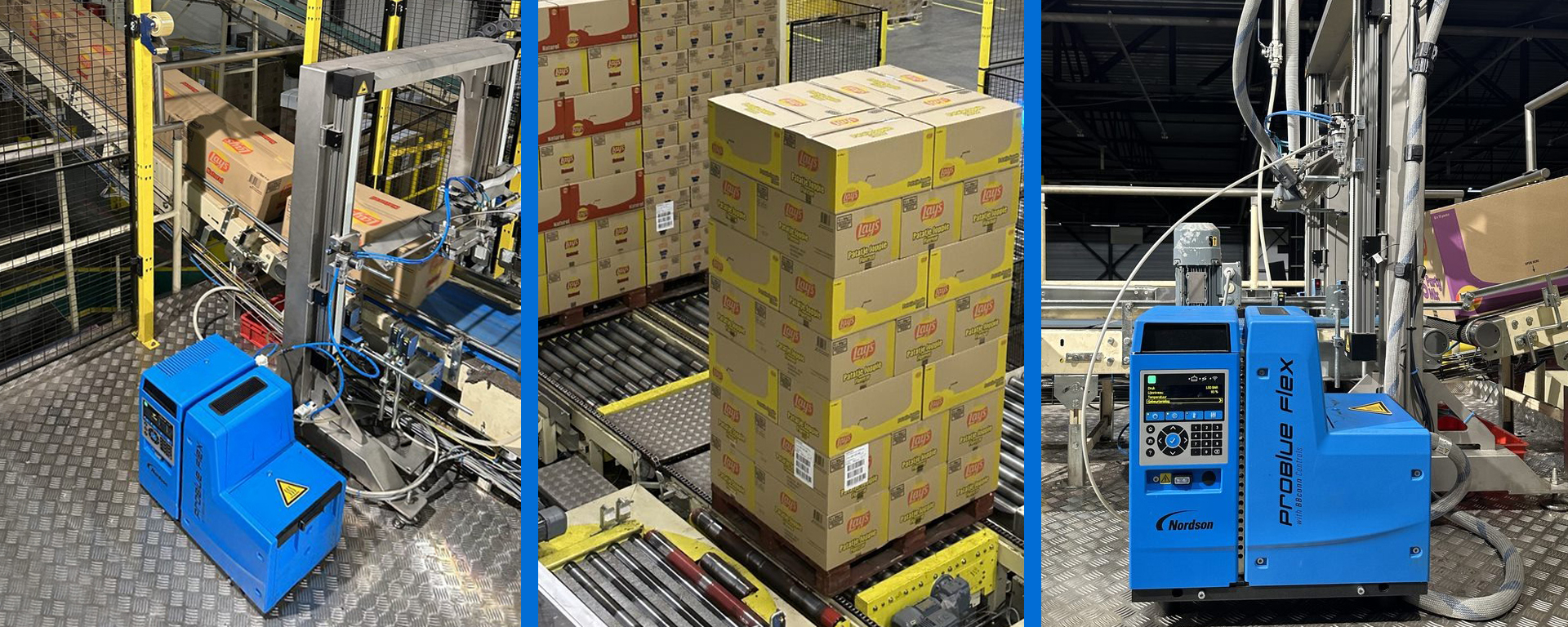
The technical detail is the interesting part. A machine can apply material consistently and still apply the wrong amount for the job. Precision begins with deciding what each carton actually needs.
A paint patent with a long afterlife
Nordson’s founders understood the attraction of owning a process. Brothers Eric and Evan Nord came out of U.S. Automatic, a business whose roots stretched back to automotive screw-machine parts in 1909. After World War II, the family sought a proprietary product. Acquired patents for hot-airless paint spraying supplied one. Nordson began in 1954.
Heated-coating experience subsequently led into hot-melt adhesives for cartons and product assembly. The connection was practical: learn to control a material, then find another production task that needs that knowledge. Later acquisitions brought dispensing, surface treatment and inspection into the same portfolio. The company’s history reads like a succession of increasingly particular answers to the question, “How do we put this exactly there?”
The sale continues after installation
A packaging customer might buy a ProBlue Flex melter, hoses, applicators and controls. Solid adhesive becomes a controlled supply of liquid adhesive. Optional tracking monitors consumption; melt-on-demand configurations reduce the need to keep a large quantity hot. The customer is buying a coordinated system whose settings must suit the production line.
Across the company, the catalogue extends to powder coating, polymer processing, medical fluid components and electronics inspection. The common customer is a manufacturer with a process to control. A consumer may never see Nordson’s name, even when encountering goods made with its equipment.
A simplified map of capabilities, not a required configuration.
Equipment brings the initial sale. Replacement parts, consumables and technical support extend the relationship. Nordson emphasizes application knowledge and direct service as competitive strengths. That matters because Graco’s InvisiPac offers an alternative in hot-melt packaging. A buyer can compare hardware, but must also judge who will help when the line stops.
The old machine was the bottleneck
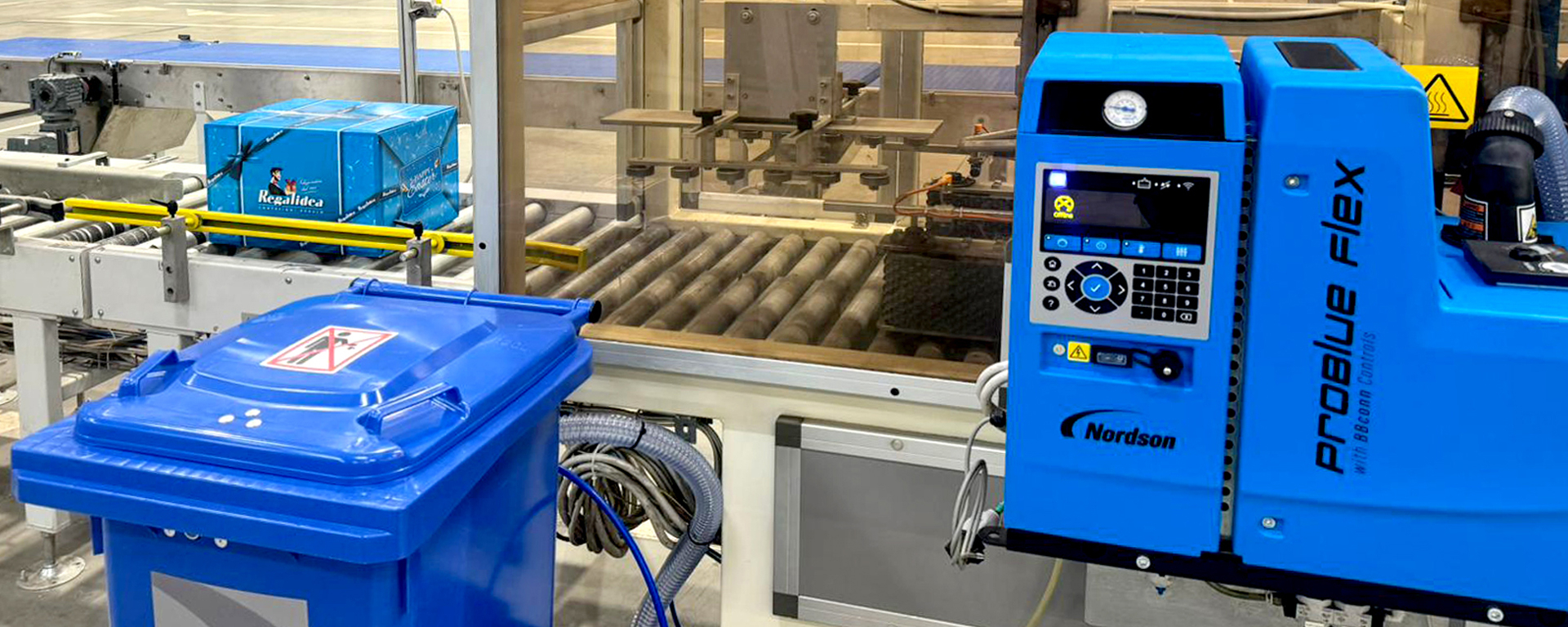
Sometimes the equipment needing improvement is Nordson’s own. At Italy’s Drink International, aging ProBlue systems had long warm-up times, clogged nozzles and inconsistent bonding. Familiar machinery had become a constraint. The proposed replacement put two newer melters on each of eight packaging lines, with updated applicators and hoses.
“The old systems were becoming a bottleneck”
Chiara Crosetto, owner, Drink International
In the published customer case, owner Chiara Crosetto estimated roughly 20% lower adhesive consumption after the upgrade. Previous experience with Nordson supported the decision to stay with the supplier. The lesson is refreshingly unromantic: a machine’s long service life does not settle whether it remains economical.
Put the savings on a pallet
One Interlock Adhesives case supplies unusually concrete purchase economics. A British pet-food manufacturer used Nordson PB Flex equipment and Henkel adhesive to stabilize cartons. Equipment and setup cost £10,000; services and bracketry added £10,000. Reported layer-pad savings were £1.50 per pallet, offset by 3p of adhesive. That leaves £1.47 per pallet.
Calculated from Interlock’s reported figures. Excludes financing and any costs outside that case.
Interlock reported 27-week payback. That outcome depends on throughput and the stated costs; it is one project’s arithmetic. Elsewhere, Nordson and Henkel collaborated at Boomex to replace manually inserted pallet layers with sprayed adhesive. The useful partnership pairs material chemistry with application equipment.
Buying a different kind of precision
Medical technology has widened the business. Nordson agreed to acquire Atrion at approximately $800 million in enterprise value, completing the deal in August 2024. Infusion components and cardiovascular technologies gave it more proprietary medical products. In September 2025, it sold selected medical contract manufacturing product lines. Growth included deciding what to stop owning.
The financial picture needs the same discrimination. Fiscal 2025 sales reached about $2.8 billion, up 4%, while organic volume fell 3%; acquisitions helped the total grow. By fiscal Q3 2026, quarterly sales were $818 million, up 10%, with approximately 12% organic growth. The two periods describe different operating conditions.
Product development continues alongside acquisitions. The August 2026 ASYMTEK Vantage XL announcement addressed larger semiconductor packaging panels, where warpage and temperature complicate dispensing. In October, Nordson announced a process-control software award for Sight, which brings inspection data together. The portfolio increasingly includes the information needed to correct a process.
Start with one recurring mistake
The approach worth copying is to measure a repeated production problem before shopping for automation. Count adhesive, rejects, warm-up time and interventions. Test the proposed change on the actual material. A cheaper bead achieves little if cartons open in transit. Low throughput can stretch payback, and integration can outlast installation: PepsiCo’s team was still fine-tuning its wider system. Nordson’s opportunity sits in that gap between a machine working and a production line working well.
Follow the material
Explore Nordson’s products, the company blog, investor updates and its 2026 packaging demonstrations.