Consider the copper fitting. It has no screen, no subscription and very little to say for itself. Installed correctly, it spends its working life somewhere inconvenient to photograph. Yet the business of making such objects can be surprisingly revealing. Mueller Industries, whose companies make the tube, fittings and components behind familiar comforts, reported $4.18 billion in sales in 2025. The overlooked part has a substantial economy attached.
- Mueller supplies the physical connections inside plumbing, cooling and electrical systems.
- Its customers are mainly businesses that distribute components or build equipment.
- Acquisitions have expanded its reach from copper tube into electrical wire and cable.
To understand Mueller, start with the distance between the thing we buy and the things that make it possible. A supermarket sells cold food. A building offers warm rooms. Somewhere underneath those promises sit valves, duct, tubing and connections. Mueller works in that less visible layer. Its attraction is the practical importance of a component that most people never learn to name.
A factory looking for its next job
The origin contains an awkward piece of timing. Mueller Metals was formed in Port Huron, Michigan, in 1917 to support wartime production. The museum’s account says the new plant reached production just as the First World War ended, leaving heavy losses. The original demand arrived with an expiration date. The factory, unfortunately, did not.
Oscar Mueller saw another use for its capabilities: brass tubing and fittings. In 1927, he exchanged his stake in the family’s Mueller Co. for the Port Huron operation, establishing an independent brass business. That distinction matters today. Mueller Industries and the fire-hydrant business associated with Mueller Water Products are separate companies, despite the shared family history.
The interesting move was finding another customer for the machinery and knowledge already assembled. A business conceived around one urgent requirement found a longer life supplying less dramatic needs. Water and refrigeration offered work after the wartime orders disappeared.
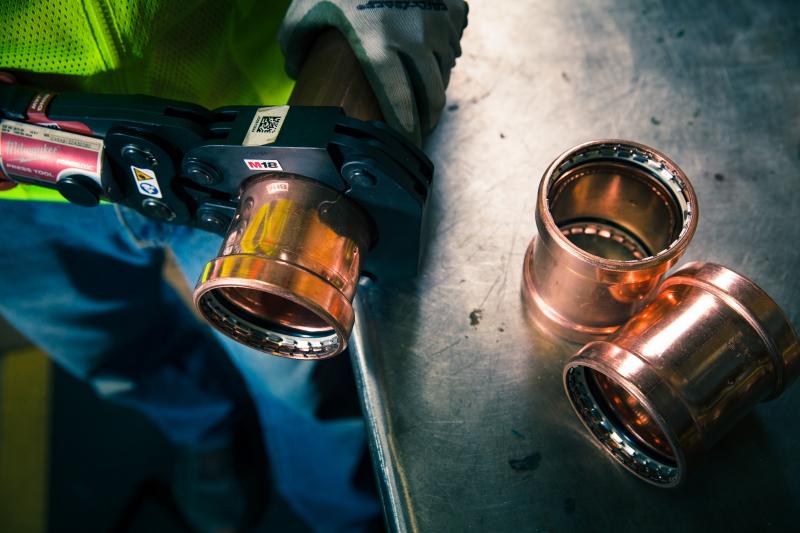
The wall is full of customers
Mueller now reports three segments: Piping Systems, Climate and Industrial Metals. They cover different routes into a finished building or machine. Streamline supplies copper tube and fittings. Climate businesses make refrigeration components, heat exchangers and flexible duct. Industrial Metals supplies materials and components, with electrical cable now part of the offering.
For a plumbing contractor, the useful doorway is a distributor carrying the appropriate tube and fittings. For an equipment manufacturer, it may be a component supplier capable of meeting a production specification. The end user gets running water or controlled temperature; the purchasing customer gets a part that must fit a defined system.
This is where Mueller’s expertise becomes tangible. Streamline’s plumbing tube is specified by copper grade, size and type, including K, L, M and DWV. Product documentation lists applicable standards and provides submittals. A buyer can check a requirement against a product before ordering. In this market, a good catalog does real work.
The alternatives vary by aisle. Cerro Flow Products and Cambridge-Lee compete in copper tube; NIBCO competes in copper fittings. Other applications allow plastic or different metals. Mueller’s distinguishing feature is its collection of related manufacturing businesses and product lines. That breadth gives it several ways into a project, while every individual part still has to earn the order.
What $569 million bought
In May 2024, Mueller completed its purchase of Nehring, a wire and cable producer based in DeKalb, Illinois. The final acquisition accounting put consideration at approximately $569.2 million. Nehring brought customers in utilities, telecommunications, electrical distribution and equipment manufacturing. Mueller said the existing management team would remain.
The logic is easy to follow. Mueller already understood metal products and industrial customers. Nehring added a platform in electrical infrastructure, opening another market for that experience. It was a substantial commitment of cash, with an existing operating business attached. Buying competence also meant keeping people who knew how to run it.
“What was evident from the start was the spirit of the people.”Greg Christopher, CEO · company culture statement
That sentiment has an operational counterpart. Mueller’s stated expectations cover safe products, safe workplaces, ethical conduct and community support. For a manufacturer, those commitments concern the daily conditions under which a product gets made. A factory’s capabilities reside partly in equipment and partly in the people who can make it perform consistently.
The tariff bill reaches Oklahoma
The next acquisition offers a more specific lesson. In March 2026, Mueller bought Bison Metals Technologies, a copper tube manufacturer in Shawnee, Oklahoma. Christopher explained that its domestic capabilities could help mitigate tariff costs on feedstock then produced by foreign subsidiaries for use in U.S. operations. Geography had become an operating expense worth addressing.
By the third-quarter filing, reported consideration was approximately $139.6 million. The intended benefit was concrete: more U.S. tube capacity and a domestic source of material for certain higher-value products. The announced rationale shows a supply-chain response to changed trade costs; it does not establish that the investment has already paid for itself.
Count the pieces, then count the dollars
There is a trap in reading this business. Copper prices affect selling prices, so revenue can rise without an equivalent increase in physical activity. In 2025, higher prices and acquired sales helped offset lower core unit volumes. The reported $958.5 million operating profit also included insurance and asset-disposal gains. A larger headline number needs an explanation underneath it.
Higher copper-related prices, volumes and acquired sales all contributed. Revenue measures dollars, not pieces.
October 2026 brought another useful distinction. Third-quarter sales reached $1.42 billion, while attributable net income reached $221.2 million. Management linked stronger demand to data centers and commercial construction. Residential construction remained weak. Owning several routes into infrastructure helped Mueller participate where spending was happening.
The copyable idea is to buy capabilities that address an identifiable customer or production problem. It requires capital, skilled operators and enough demand to use the capacity. Price competition, substitute materials, weaker construction or costs that cannot be passed along can spoil the arithmetic. The fitting may disappear behind a wall. The economics deserve to stay in view.