Cemtrex once had a rather glamorous problem: too many futures. There was SmartDesk, an integrated workstation meant to reinvent the office. There were virtual and augmented reality businesses. There was also the less glamorous work of watching buildings and installing industrial machinery. By November 2022, the company had decided which futures it could afford.
- SmartDesk and VR went out in 2022. Security and industrial work stayed.
- Three 2026 deals added flight instrumentation, a Tennessee base and press engineering.
- The test: convert useful capabilities into delivered projects and collected cash.
It sold SmartDesk and its VR subsidiaries to chief executive Saagar Govil. The announcement described those operations as unprofitable and said the remaining company would concentrate on Vicon Industries and Advanced Industrial Services, or AIS. That is an unusually revealing corporate edit. The factory floor survived the metaverse.
Today, Cemtrex is a collection of businesses serving institutions with physical problems: surveillance coverage, equipment installation, flight instrumentation. Vicon sells security hardware and software. AIS supplies industrial trades and project execution. Invocon, acquired in January 2026, adds aerospace and defense engineering. The family resemblance is reliability, although the customers, contracts and economics differ considerably.
A camera is also an installation problem
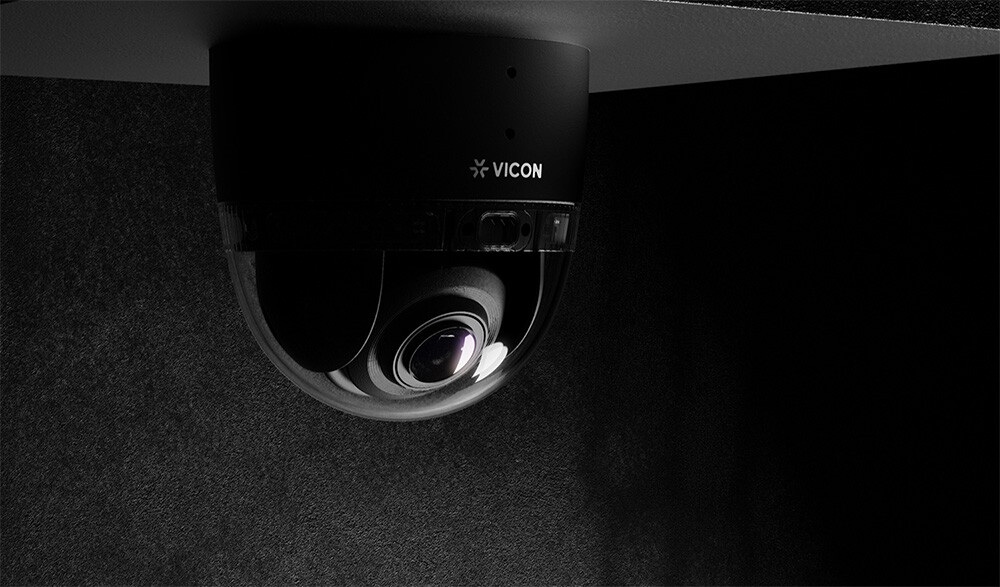
Consider the ceiling camera. Its buyer wants usable footage. Its installer wants to finish the job. Its operator wants to find an incident without watching an entire afternoon in reverse. Vicon’s products address all three, which is more commercially interesting than simply making another camera.
NEXT is a modular camera system with interchangeable components and a snap-and-twist mounting design. Vicon advertises a five-minute installation; that is a vendor claim, rather than a guarantee for every building. The practical idea is easy to grasp: reduce the labour and disruption attached to putting hardware overhead and servicing it later.
Anavio supplies cloud security management, bringing video, access and intercom into one view. Its tools include person searches, colour-based forensic searches and alerts. NEXT can also provide two-way audio and programmable lightbars. A camera can therefore help staff respond to an event while it is happening, as well as preserve evidence for afterwards.
The pricing wrinkle deserves attention. Vicon includes a Standard Anavio licence with each NEXT camera at no extra licence cost. That changes the comparison with systems charging recurring per-camera software fees. It does not make an installed security system free. Hardware, installation, the chosen feature tier, retention requirements and the wider deployment still belong in a buyer’s budget.
Vicon also offers Valerus for on-premises video management. This gives institutional buyers a choice of architecture. In May 2026, a roughly $2 million UK correctional-facility order included recording servers, workstations, software licences and several camera types. An integration partner placed it. The sale was an entire surveillance stack, with a channel relationship attached.
The company that moves the machine
AIS solves a different version of the same practical difficulty. Buying a machine is one decision. Getting it into position, aligning it, connecting power and piping, and making the installation work is a sequence of decisions that must agree with one another. A production manager cannot resolve a misplaced press by refreshing a browser.
AIS offers rigging and millwrighting, process piping, electrical work, fabrication, transportation and project management. Its own account of rigging starts with a plan, an experienced crew and equipment suited to the job. It also describes continuous in-house safety and technical training. That gives a more concrete glimpse of working culture than a wall of corporate adjectives would.
In February 2026, AIS bought Richland Industries’ business assets and property in Tennessee for $5.5 million, while assuming certain operating liabilities. Fulton Bank loans financed the transaction. The Pulaski site includes a 70,000-square-foot facility on 25 acres. The land and building matter: lifting capacity, yard space and logistics are part of the service, not incidental office amenities.
The July acquisition of Plant Engineering Services, or PES, added another piece. PES designs, modernises and relocates large hydraulic and mechanical press systems. AIS already performs the field work that those designs require. Bringing them together could let a manufacturer buy engineering through commissioning from one organisation. That is the acquisition’s commercial logic, rather than proof that integration has already succeeded.

“Each company is a natural customer of the other.”Saagar Govil on AIS and PES, July 2026
Buying a history you cannot hurry
Invocon brings a different kind of accumulated expertise. Its instrumentation has supported Space Shuttle and International Space Station systems. It develops sensing, telemetry, power and flight hardware for environments in which an ordinary electronics specification is merely the beginning of the conversation.
Its work on the ISS makes that expertise tangible. Wireless instrumentation has collected vibration data from station structures. Another system monitors micro-vibrations that can interfere with zero-gravity experiments. Distributed impact detection has addressed impact and leak monitoring. These are small measurements with large consequences; the customer needs useful data in places that are awkward to wire and difficult to revisit.
Cemtrex paid approximately $7.06 million in cash for Invocon. It bought an existing engineering organisation and its programme experience, instead of trying to manufacture a flight history from a fresh marketing department. In April 2026, Cemtrex announced Invocon’s selection as an apparently successful offeror for a NAVSEA Phase I SBIR contract in modular mine-warfare components. Phase I is an early research step, not a promise of production orders.
The three businesses occupy different competitive markets. Security buyers can compare rival cameras and video-management platforms. Industrial buyers can assemble separate engineering and installation contractors. Aerospace customers can use other specialist instrumentation suppliers. Cemtrex’s case rests on the capabilities of each subsidiary; common ownership alone gives a buyer little reason to sign.
The intended industrial handoff. Invocon adds a separate aerospace engineering business.
The bill survives the reinvention
The old experiments did not disappear neatly from the accounts. The 2022 divestiture was a related-party transaction with the serving CEO. In January 2025, the purchase agreement was revised to remove an $820,000 minimum royalty requirement for the XR business. The annual filing also recorded credit-loss allowances against royalties. Exiting an operation and collecting the price are separate achievements.
Expansion requires its own chequebook. PES cost approximately $3.5 million in cash, with up to $1.5 million more in performance-linked earnout consideration over three years. Cemtrex used cash on hand. Separately, a January 9, 2026 registered direct offering raised $4 million gross through common shares and pre-funded warrants. Public equity, bank borrowing and available cash are distinct tools, each with consequences.
The business earns revenue through equipment and software sales, industrial project services and specialist engineering work. These businesses require people, materials and execution capacity. They should be assessed on contracts delivered and cash collected, rather than treated as one frictionless software subscription.
The latest quarter makes that distinction useful. For the three months ended June 30, 2026, Cemtrex reported $18.4 million in revenue and a $1.2 million operating loss. Operating cash flow was positive at $0.2 million. Security revenue remained below the prior-year quarter; management pointed to component production and shipping delays. A better quarter still contained a supply problem.
September brought approximately $2.8 million in federal-agency orders for Vicon and about $410,000 in initial PES project awards. Orders are encouraging; they become revenue through delivery. The interesting question is whether the new capabilities can produce dependable results across more than one reporting period.
Copy the handoff, then check the economics
The useful lesson here is specific. PES engineers projects that need installers; AIS supplies installers whose customers need engineering. A company considering an acquisition can copy that test: identify a repeated customer handoff, price the missing capability, and ask whether bringing it inside will improve delivery. “Both businesses are industrial” is a much weaker argument.
Buyers can use the same discipline. A security team should test searches against its own footage and compare full deployment costs. A manufacturer should examine the installation plan, crew experience and commissioning responsibilities. An aerospace customer should match flight heritage and environmental testing to the actual mission, rather than accept a space-related label as qualification.
The approach needs repeat demand, competent teams and enough capital to finish the work. It becomes less persuasive when customers want independent vendors, integration absorbs the expected savings, or schedules outrun available labour and components. Cemtrex’s reinvention is interesting precisely because those conditions remain visible. The future it now sells must fit through a factory door, work on a ceiling, or survive a launch.
See the work for yourself
Explore the businesses, product demonstrations and company updates.