The first ATCO product was not a power line, a hydrogen furnace or a C$2.9 billion pipeline. It was a trailer. In 1947, S.D. Southern and his 17-year-old son, R.D., started Alberta Trailer Hire with 15 units for workers chasing the province’s first oil boom. First-year revenue was C$1,077. The equipment was modest; the observation was excellent: before ambitious projects can happen, somebody has to make the place livable.
Seventy-nine years later, Calgary-based ATCO still lives upstream of everyone else’s work. It transmits electricity and gas. It makes and leases classrooms, homes, offices and workforce camps. It operates remote facilities for miners, governments and armed forces. It sells energy to Alberta households, stores hydrocarbons, develops carbon-storage infrastructure and owns 40 per cent of a ports operator. The inventory has changed. The job has not.
The portfolio that looks odd until it doesn’t
On a spreadsheet, ATCO can resemble a corporate junk drawer. Canadian Utilities, which ATCO controls, contains regulated energy networks in Canada and Australia. ATCO Structures runs a global factory and rental fleet. Frontec handles facilities and logistics in places where a broken boiler becomes an operational emergency. ATCO Energy sells retail plans and home services. Neltume Ports moves copper, forestry products, consumer goods and crops through 17 facilities in the Americas.
The organizing idea is “life’s essentials,” but the less polished translation is better: ATCO tackles the things a customer cannot postpone. A mine can delay new signage. It cannot delay beds, heat, water and dinner. A community can live without a clever app. It cannot live long without electricity. A defence client does not want to coordinate six contractors at a northern site; it wants the site to function.
That is the difference from a specialist competitor. A modular rival may deliver rooms. An engineering firm may design the utility connection. A caterer may feed the crew. ATCO can bundle the building, installation, operations and maintenance, then keep the whole apparatus running. The bundle is valuable when failure is expensive and geography is unfriendly. It is less persuasive in an ordinary city project where specialist vendors are plentiful and the buyer is good at managing them.
Own the boring base. Rent the flexible edge.
The decisive move came in 1980, when ATCO bought a 58.1 per cent controlling stake in Canadian Utilities. The trailer company acquired the sort of earnings that arrive more regularly than oil-camp orders. Today, the utility base earns regulated returns on long-lived electricity and gas infrastructure. That stability supports dividends, debt capacity and patience. Around it sit businesses with more cyclical upside: modular construction, workforce lodging, energy storage and development projects.
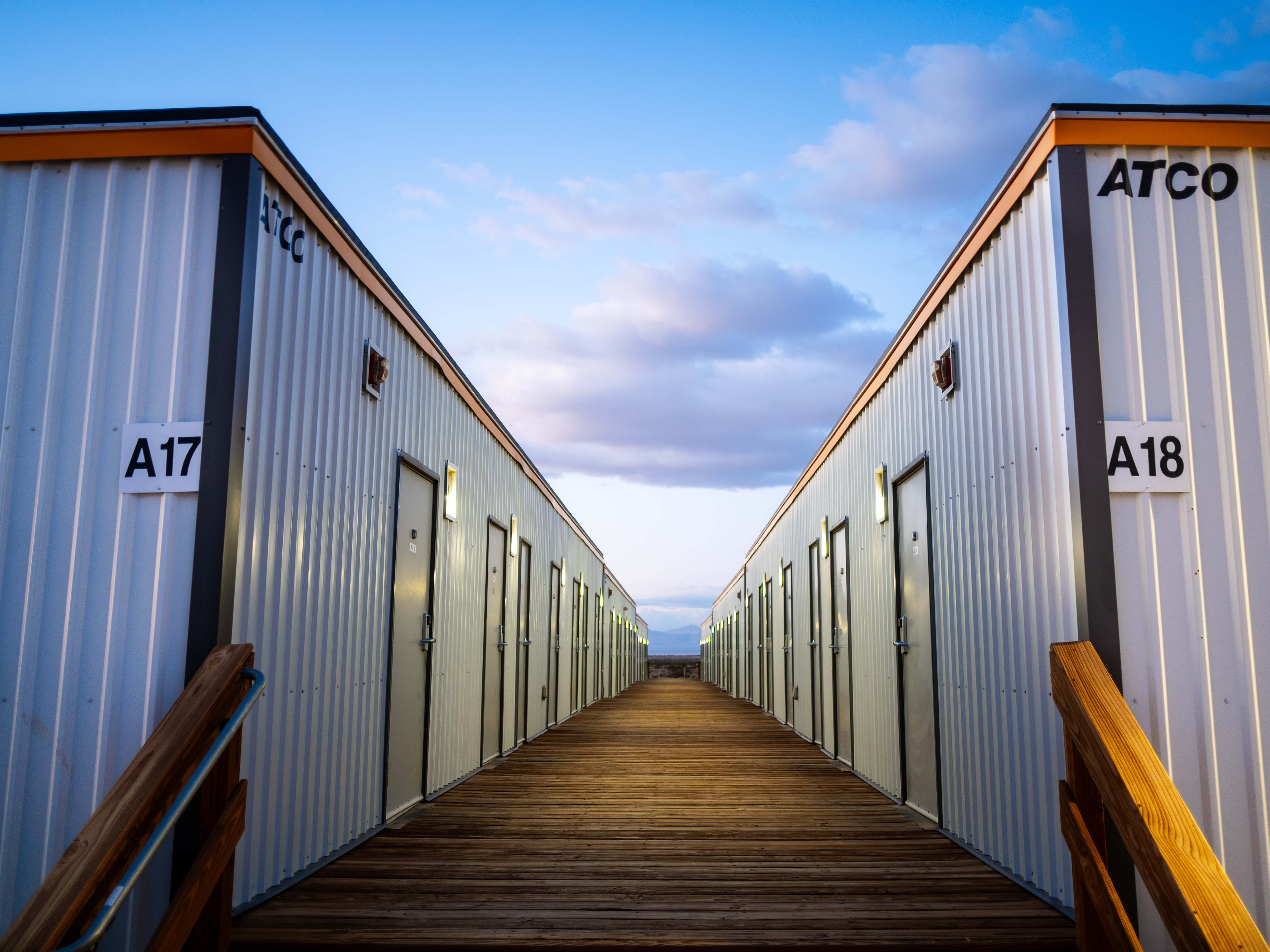
Structures adds another layer of resilience through leasing. ATCO ended 2025 with more than 28,500 units across 44 operating locations and 13 manufacturing locations. A sold building produces revenue once. A leased classroom or site office can earn repeatedly, be refurbished and travel to the next customer. Manufacturing gives ATCO control over supply; the branch network keeps assets near demand; services enlarge the invoice.
The customer list shows why flexibility matters. Structures supplies mine camps, school space, affordable housing, offices and construction support for data centres. In the second quarter of 2026, the division reported C$249 million in new contracts across three continents. One C$179 million assignment for Perpetua Resources calls for a 1,052-person dormitory lodge and offices in Idaho. These are not impulse purchases. They are schedule-critical systems attached to bigger capital projects.
Who pays, and what they are buying
ATCO’s customers sit on both sides of the meter. More than 4 million homes and businesses depend on the group’s energy operations. In Alberta, ATCO Energy also served more than 360,000 retail customer sites at the end of 2025, competing on plans and service rather than owning a monopoly over the customer relationship. At the industrial end, mining companies, data-centre developers, petrochemical producers and construction firms buy temporary space or permanent modular buildings. Governments and defence agencies hire Frontec for facilities where remoteness, security or climate makes ordinary property management a different sport.
Each line charges differently. Regulated utilities invest capital, maintain networks and earn approved returns recovered through rates. Structures collects sales revenue when a customer buys a building, lease income when it rents one, and service revenue for transport, installation and site work. Frontec works under operating contracts. The retail business earns margins on energy and home services. Storage, generation, ports and property add their own tolls, capacity payments, commodity exposure and investment returns.
The expertise connecting them is operational, not ornamental. ATCO knows how to manufacture repeatable physical units, finance long-lived infrastructure, navigate utility regulation and keep crews safe in remote conditions. It can also draw on local relationships: the group reported 73 Indigenous partnerships, memorandums and other arrangements in 2025. Those relationships can create community participation and make projects more durable, but the number alone is not proof of quality. The test is whether ownership, work and benefits persist after the ribbon is cut.
This mix places ATCO between a conventional utility and an industrial-services platform. Fortis, EPCOR and ENMAX overlap in energy. Black Diamond, Civeo, WillScot and Dexterra overlap in modular space or site services. Enbridge, TC Energy, TransAlta and Capital Power compete for pieces of the infrastructure opportunity. Few alternatives mirror the entire bundle. That breadth helps only when customers value one accountable operator; otherwise, a focused competitor can be cheaper and quicker.
What failed first
Infrastructure portfolios look serene until physics, regulation and markets vote. In 2025, ATCO recorded C$253 million in after-tax impairments and write-offs. The largest piece was C$214 million at EnPower, mainly tied to Alberta renewables. Elevated curtailment, inadequate transmission, electricity oversupply, low prices and weak carbon economics battered the assets. The turbines and panels were not necessarily the first thing to fail. The surrounding system failed to carry and reward their output.
Another lesson arrived in hydrogen. ATCO had advanced plans for a large low-carbon ammonia facility in Alberta’s Industrial Heartland, designed to carry hydrogen to export markets. Development work paused in late 2025. The company pointed to market conditions, infrastructure limits and policy uncertainty. It did not abandon every hydrogen experiment: demonstration work continues, including a hydrogen-heated home with Qualico and blending projects. But the posture shifted from deadline-shaped confidence to selective exploration.
What changed the mind?
Not a single technical embarrassment. The commercial stack weakened: uncertain rules, missing infrastructure and buyers unwilling to commit at the required scale.
What did it cost?
The clearest disclosed bruise was C$214 million after tax for EnPower impairments and write-offs, part of C$253 million across the 2025 group.
This is the useful counterweight to ATCO’s “Possibilities for Generations” language. Long-duration capital can wait, but it cannot pretend. A project needs transmission capacity, permits, counterparties and a credible route to cost recovery. Technology is one square on the bingo card.
The C$2.9 billion test
Yellowhead is the newest expression of old ATCO. The roughly 235-kilometre high-pressure natural-gas pipeline is designed to add more than 1.1 billion cubic feet a day of delivery capacity in Alberta. Its estimated spend is C$2.9 billion, with the disclosed estimate carrying a plus-or-minus 20 per cent accuracy range. Final provincial approval arrived in July 2026, and ATCO said construction would begin immediately.
The project is 100 per cent contracted, an important answer to “who pays?” Its customers include industrial growth around Fort Saskatchewan, where new petrochemical, power and other facilities require enormous energy flows. ATCO expects about 2,000 direct construction jobs. The company also advertises much larger downstream effects, but those depend on associated investments actually arriving. A contract reduces demand risk; it does not eliminate execution, labour, regulatory or cost risk.
Yellowhead also clarifies ATCO’s place in the market. This is not a pure clean-tech company and not merely an incumbent utility protecting yesterday’s pipes. It is an allocator of capital to essential systems, sometimes lower-carbon, sometimes conventionally fuelled, usually chosen for reliability and contracted demand. Climate-minded readers may find that mix unsatisfying. Customers facing a cold Alberta morning may find it practical. Both reactions belong in the same profile.
The parts worth stealing
- Start beside the boom, not inside it. ATCO did not drill the wells. It housed the workers. Look for the unavoidable prerequisite around a growing market.
- Turn projects into a fleet. Standardized, reusable assets can convert one-time demand into repeated rental income.
- Bundle the nuisance layer. Installation, maintenance and operations are unglamorous until they become the reason a customer renews.
- Pair stability with experiments. Durable cash flows buy time, but experiments still need milestones and a willingness to pause.
- Contract before concrete. Yellowhead’s full subscription does not guarantee success, but it makes a multibillion-dollar commitment more legible.
The conditions are just as important. The playbook works when demand is essential, contracts run long, assets can be redeployed and capital remains available at tolerable rates. It falters when units sit empty, regulators block recovery, local partners are treated as an afterthought, or the surrounding grid cannot absorb the output. Integration also becomes bureaucracy if the customer can buy each component more cheaply and coordinate it without pain.
ATCO’s enduring trick is not diversification for its own sake. It is remembering the first trailer. Find the essential bottleneck. Put an asset against it. Operate it well enough that the customer can forget it exists. Then, when the market changes its mind, move what can move and be honest about what cannot.
Keep exploring ATCO