Keel Infrastructure sells something that sounds abstract until a new AI cluster needs it tomorrow: a believable path to electricity. The New York company assembles land, grid connections, permits, fiber and data-center design into campuses where high-performance computers can eventually move in. Its customers are not people shopping for cloud storage. They are the hyperscalers, neoclouds, large enterprises and government buyers whose machines require industrial quantities of power, cooling and construction. Keel's promise is to shorten the wait between deciding to deploy compute and actually switching it on.
The company arrived under its current name on April 1, 2026, when Bitfarms completed a U.S. redomiciliation and put a new ticker, KEEL, on Nasdaq and the Toronto Stock Exchange. The corporate lineage reaches back to 2017 and industrial Bitcoin mining. That history matters because a Bitcoin mine and an AI data center are not twins, but they are familiar cousins: both begin with dense electrical loads, utility negotiations, substations, cooling and relentless attention to uptime.
The product is a place on the grid
Most AI stories start with chips. Keel starts several layers lower. A customer may know which GPU architecture it wants, yet still lack a site that can accept hundreds of megawatts on a useful schedule. New interconnections can take years. Permits move at civic speed. Transformers and switchgear have long lead times. Fiber must reach the property. A campus layout has to accommodate machines whose power density keeps climbing.
Keel tries to do those jobs in parallel. It secures powered land in constrained markets, advances zoning and environmental approvals, orders critical equipment and refines designs while its commercial team looks for a creditworthy tenant. The result is less a standardized product than a de-risked starting position. Its five-campus portfolio sits in Pennsylvania, Washington and Québec, close to data-center corridors and cooler climates. Management reports 341 megawatts already energized, 430 megawatts of secured growth capacity and a total multiyear pipeline of 2.2 gigawatts.
The flagship is Panther Creek in Carbon County, Pennsylvania: 336 acres, 350 megawatts of secured capacity and a path management says could exceed 500 megawatts. Sharon, in western Pennsylvania, is smaller and aimed at a different slice of demand. Moses Lake, Washington, has begun receiving modules from Vertiv under a critical-infrastructure agreement worth roughly $129 million. Sherbrooke is a clever reuse proposal: Keel wants to consolidate 96 megawatts from three existing Québec mining sites into one HPC campus, rather than ask the province for additional power. That project still needs provincial and other approvals.
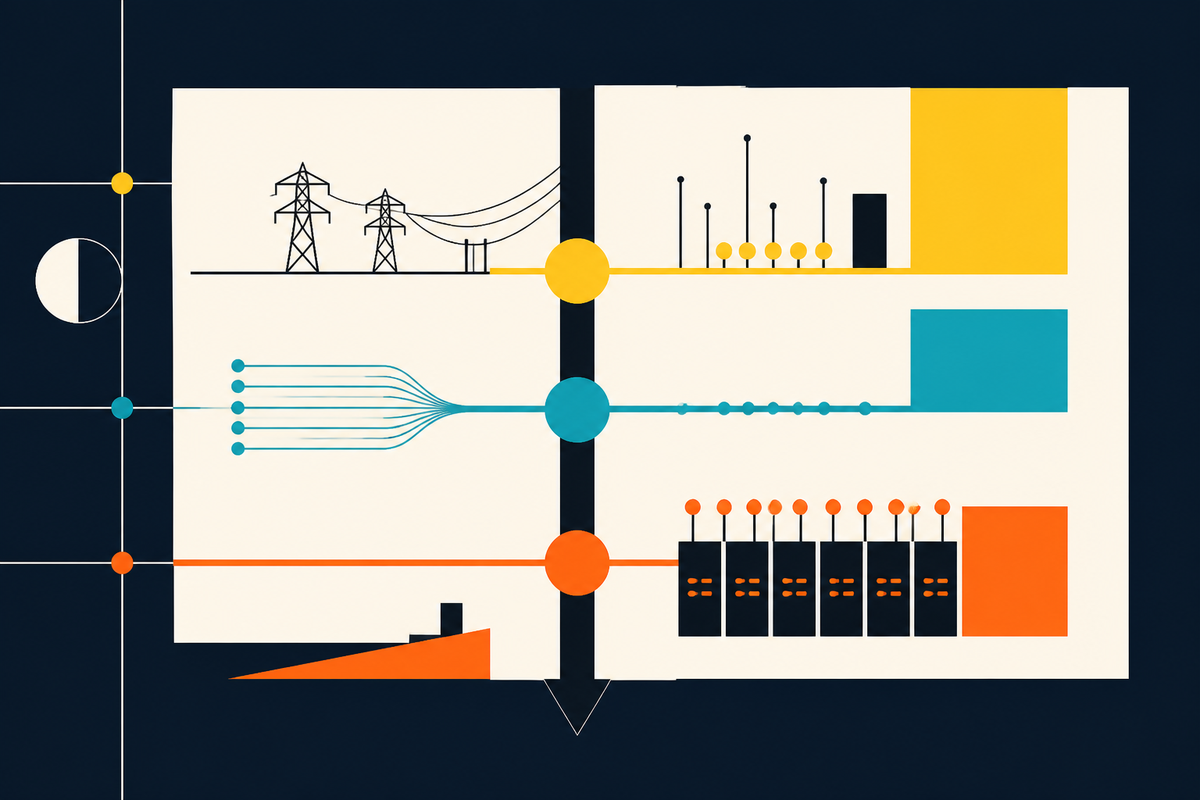
A miner changes its cargo
The pivot is Keel's most useful differentiator and its most obvious risk. The predecessor knew energy markets and high-density facilities, then spent nearly two years dismantling the parts that did not fit. It exited sites in Argentina and Paraguay, decommissioned all U.S. Bitcoin mining operations and concentrated its development capital in North America. In April, the sale of Paso Pe in Paraguay made the geographic break complete.
Keel also recruited experience from the industry it wants to join. Ganesh Aiyer became president in July after serving as chief business officer at Digital Realty, a global data-center owner. Chief Financial Officer Jonathan Mir brought energy-infrastructure and project-finance experience. Management has named T5 Data Centers, Turner Construction, Corgan, World Wide Technology and Vertiv among the specialists supporting design, construction and equipment.
The proposed business model resembles infrastructure development more than cloud computing. Keel spends money to advance a site through the expensive uncertainty before construction, negotiates a long-term lease with an investment-grade user, and expects to finance and own the completed facility. The tenant brings demand and, depending on the agreement, the computing equipment. Keel earns from the physical platform beneath it. A long lease can support project financing, which is why tenant quality matters almost as much as tenant appetite.
Different sites invite different buyers. A hyperscaler can absorb a large campus in phases and may bring a highly specific technical template. A neocloud, built around rented GPU capacity, needs speed and dense power but may not carry the same credit profile. An enterprise or government user could want a smaller deployment, more control or a particular region. Keel's job is not merely to find demand. It must match the size, schedule, design and credit of that demand to a site without giving away the economics that made the land valuable.
For customers, the alternative is a menu of compromises. They can build for themselves, lease from an established colocation operator, contract with another power-first developer or place workloads in a cloud that already owns capacity. Keel sits closest to the build-for-me end of that spectrum. It is useful when a buyer needs a large, customized physical footprint and would rather not spend years assembling the underlying property and utility relationships. It is less relevant to a company that simply wants to rent a few GPUs by the hour.
The moat is measured in calendars
Keel's pitch is not that rivals cannot find land. It is that the right combination of land, power and delivery date is scarce. A megawatt beside a hyperscale cluster is worth more than an identical megawatt stranded far from fiber or stuck behind a long interconnection queue. The company calls this “megawatt location,” but timing is the sharper point. A customer choosing where to place a new generation of GPUs may care more about credible 2027 delivery than theoretical capacity later in the decade.
There is no shortage of companies pursuing the same insight. Hut 8, Applied Digital, IREN, TeraWulf, Cipher, Core Scientific and others are repurposing mining-era energy expertise for AI. Traditional operators such as Digital Realty and Equinix bring established tenants, operating records and access to capital. Utilities, communities and equipment makers can become bottlenecks for everyone at once. Keel's pipeline is meaningful, but a pipeline is not contracted revenue.
Its differentiation is therefore cumulative, not magical. Keel owns or controls sites in difficult markets, has existing grid relationships, has hired people who have delivered data centers before, and has enough liquidity to keep advancing work while negotiations continue. Any one ingredient can be copied. The claim is that having all of them ready at the same moment can save a tenant time. The test will be whether a buyer sees enough schedule certainty to sign, and whether Keel can preserve attractive returns after construction costs and financing.
That distinction is especially visible in the financials. Keel reported $30.4 million of second-quarter revenue, down 50 percent year over year, from continuing legacy operations. Adjusted EBITDA was negative $23.7 million. Those figures describe the old engine winding down while the new one is still being assembled. The balance sheet, however, gives the company time: after a $458 million convertible-note offering, liquidity stood near $819 million on August 7, including $698 million in unrestricted cash and $121 million in unencumbered Bitcoin.
The next milestone cannot be rendered
Data-center developers traffic in seductive campus renderings. Keel has plenty of physical progress behind the pictures: zoning and land-development approvals, long-lead equipment, fiber contracting and delivered Vertiv modules. Its Q2 update said multiple prospective tenants were negotiating for each of the three priority sites. It did not name one. That is the honest hinge of the story.
There is a civic hinge, too. A data center is a neighbor before it is a node. It competes for electricity, changes land use, employs construction crews and asks local officials to believe its long-range plans. Keel says collaboration, accountability and community guide its culture, and it has stressed ongoing dialogue around Sherbrooke. That language will be judged locally, campus by campus. Efficient reuse of existing capacity, as proposed in Québec, is a stronger opening argument than simply asking a constrained grid for more.
A signed, financeable lease would turn a collection of assets and schedules into a customer-backed project. Several would begin to validate the platform. Until then, Keel occupies an awkward but interesting place in the market: below the cloud, above the raw grid, and between a profitable past it deliberately abandoned and an infrastructure future it has not yet contracted.
The name is unusually apt. A keel sits below the waterline, converting force into stable forward movement while passengers pay attention to almost everything else. AI infrastructure works the same way. Models get the applause. Chips get the launch events. But if the power arrives late, the computers are just very expensive furniture. Keel is betting that customers will pay to make that invisible foundation arrive first.