A contractor leaves two things behind: the work and an account of the work. The first gets the photograph. The second gets opened years later, when someone asks who was there, what was measured, and which precautions were taken. Merico, an industrial abatement contractor, makes that second deliverable unusually visible. Its business includes removing hazardous material. Its promise also includes remembering.
- The work: asbestos and lead abatement, plus access, insulation and remediation services.
- The buyers: industrial operators and institutions with complicated facilities.
- The telling detail: digital job records maintained on a decades-long horizon.
The file has a longer shift
Merico says it electronically retains job documentation and air-monitoring results on a thirty-year schedule. Full-time employees organize the archive. The interesting word here is employees. Someone has to make memory an ordinary responsibility, rather than a heroic search through a departed colleague's drawers.
There is a practical reason for the long horizon. OSHA's exposure-record rules generally require preservation for at least thirty years, with specific exceptions; medical-record requirements differ. The agency permits different storage formats, provided the information remains preserved and retrievable. Buying storage space is easy. Keeping an intelligible record through changes of staff, software and ownership is the harder assignment.
Record created2056
30 years later
Calendar arithmetic, not a project forecast. The file may outlast several generations of office software.
A sensible buyer can take a useful question from this: could a new person reconstruct the job without finding the person who ran it? An archive earns its keep when the answer is yes. The pile of files is only the beginning.
A safety program with a mariachi band
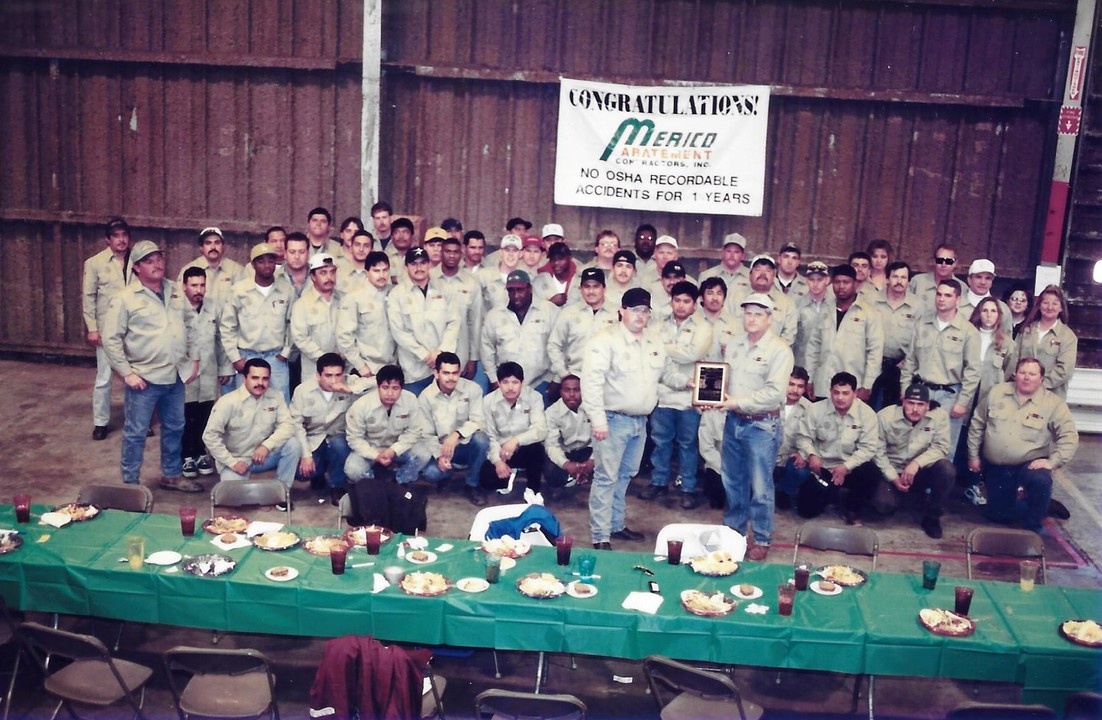
In a September 2018 retrospective, Jeff Shannon recalled a Merico employee lunch held in 1998. Then-president Mike Merritt and his family hosted the meal; there was a mariachi band, and employees received embroidered shirts. The occasion celebrated a year without an OSHA-recordable incident or a lost-workday case. Merritt challenged the staff to keep going.
This is a pleasingly human detail in a business usually described through licenses and equipment. Recognition had a meal, music and something to wear home. Shannon's account suggests that Merritt wanted safe work to be noticed, and its continuation to be a shared ambition. That is an interpretation of the story, rather than a measurement of what caused the results.
“Merico has successfully completed 21 years without a Lost Time Accident.”
Jeff Shannon · company retrospective · September 2018
The date and definition belong beside the number. A lost-time accident is a particular measure; it cannot stand in for every possible safety outcome. In 2019, Shannon reported another milestone: more than seven million work hours without a lost-time injury for the combined Gregg/Merico team. Those are historical employee-reported claims, with different scopes. They deserve to keep their labels.
The ordinary Monday matters
A celebration occupies an afternoon. A safety system occupies the rest of the calendar. Merico's published routine includes weekly safety and health orientation meetings, a core program for newly hired workers, and additional training matched to job duties or customer requirements.
The core list includes respiratory protection, confined-space entry, scaffold use, fall protection and hazard communication. The additional list ranges from hydrogen sulfide and hazardous-material transport to hoisting, manlifts and construction safety courses. Reading it gives a clearer picture of the workplace than a polished slogan could: heights, restricted spaces, moving machinery, and substances that require attention.
Training is therefore a matching problem. Which person, doing which task, needs which preparation? Merico's published menu distinguishes general induction from instruction required by a particular assignment. For another service business, that distinction is worth copying. An orientation slide deck cannot answer every question that appears at the worksite.
The company's award list adds a dated trail: Eastman Chemical recognition in 1996, an Exxon award in 1997, a National Safety Council million-hour award in 2002, and a fifteen-year zero-lost-time award in 2012. These entries describe past recognition. A buyer assessing a new project would still want evidence relevant to the crew and assignment being proposed.
One hazard, several trades
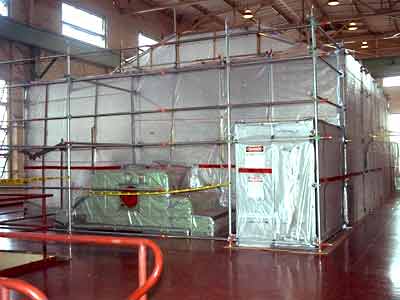
Merico's service list joins asbestos abatement and lead-paint abatement with industrial insulation, remediation and scaffolding. Its homepage also identifies painting. The mix makes commercial sense for facilities where access, removal and subsequent work have to be arranged together. Each additional handoff creates another schedule to reconcile and another boundary of responsibility.
Its affiliated company, Gregg Industrial Insulators, offers a broader range of industrial trades. The firms explicitly present their relationship as a way to meet more of a customer's needs. That is the competitive proposition: a specialist can participate in a wider service package. Whether it saves a particular customer time or money depends on the actual scope and arrangements.
The customer mix helps explain the package. Chemical plants, refineries, power generation, gas processing and paper manufacturing are central to Merico's stated market. Its work also extends to institutional facilities. These buyers have reasons to care about who coordinates the work as well as who performs it. A low unit price tells only part of that story.
Read the small print on the big number
One concrete view of the business appears in an Austin City Council record from October 3, 2002. Merico was among four contractors named for industrial asbestos-abatement service agreements for the city's Electric Utility Department. The annual spending authorization was capped at $450,000, each and combined. Three extension options could bring the total ceiling to $1.8 million.
An authorization to spend, shared across vendors. It is neither Merico's revenue nor a current project quotation.
This distinction is easy to miss and expensive to misunderstand. A spending ceiling sets permission; it does not report invoices paid. Extension options create a possible longer relationship, subject to their terms. They do not guarantee that every option will be used or that one vendor will receive the full amount.
Merico earns its place in this market through contracted services. The record shows procurement for a defined category of work, with evaluated proposals and bounded spending. Anyone comparing offers should compare the scope behind the figures: what work is included, which supporting activities are covered, and what documentation arrives at completion. A number detached from its scope has excellent manners and very little useful information.
A specialist finds a larger family
In November 2013, Brand Energy & Infrastructure Services announced its acquisition of Gregg Industries and affiliate companies, including Merico. The announcement described complementary capabilities: insulation, abatement and heat tracing. Merico now identifies itself as a BrandSafway company.
The acquisition offers a straightforward explanation of its market position. Merico supplies a particular expertise inside a larger industrial-services family. The family gains a specialist; the specialist sits alongside other trades. The acquisition announcement supports that logic without telling us how every subsequent job was sold or staffed.
Alternatives include regional abatement specialists and broader industrial contractors. Partner Industrial, for example, lists overlapping scaffolding, insulation and coating capabilities. That overlap gives buyers a comparison to investigate, rather than proof that the two companies compete for every job. Geography, qualification and the requested package narrow the field.
Make remembering part of the job
The lesson extends beyond hazardous materials. Decide what evidence a customer will need later, assign someone to preserve it, and make retrieval possible after the original team has moved on. Then connect the daily work to role-specific preparation. Merico's published approach makes both responsibilities visible.
The case for bundling services is strongest when a project actually needs several trades. A simple, isolated task may offer little coordination benefit. Likewise, a tidy archive cannot establish that the underlying work was sound. The record needs useful content, and the job needs competent execution.
There is something quietly persuasive about a contractor whose service includes an account of its own actions. The customer gets work performed today and a chance to understand it tomorrow. Long after the scaffolding is gone, that second deliverable is still on duty.