A quilt has two sides worth showing off. Between them sits the material that decides how the quilt feels, hangs and survives the wash. Hobbs Bonded Fibers has made a business of that overlooked middle. The same Texas company that sells batting to quilters also manufactures acoustic and thermal materials for cars. One customer wants a pleasing drape. Another wants less noise. Both are asking a collection of fibers to behave.
- Hobbs develops nonwoven materials for automotive, industrial and consumer uses.
- Its craft brands include Heirloom, Tuscany, Poly-Down and Thermore.
- Its history includes making batting for other brands, turning rivals’ demand into factory work.
The interesting question is how those customers came to share a manufacturer. A quilt shop and an automotive supply chain seem to occupy separate worlds. At Hobbs, they meet in the practical business of choosing fibers, holding them together and making the result repeatable. The finished product changes; the underlying problems rhyme.
01 The label needn’t be yours
In its 2026 account of Carey Hobbs’s career, the nonwovens association INDA describes a remarkably accommodating approach to competition. Hobbs produced its own quilt-batting brands while manufacturing for other leading labels. A sale lost at the shop counter could still become an order at the plant. The consumer saw a choice of packages; the manufacturer saw several routes to the same machinery.
“at least I could manufacture most of it”
Carey Hobbs, recalling his approach to quilt batting
That distinction matters. Owning a brand means persuading a shopper to choose you. Supplying another brand means persuading a business that you can deliver what it promises. Hobbs participated in both arrangements. The strategy asks an unfashionable question: must every successful product carry your name? For a manufacturer, an anonymous contribution can still be excellent business.
The chronology stretches further back than the familiar batting packages. Hobbs’s corporate capabilities page dates production to 1953. INDA records Carey joining the predecessor, Clark Brothers Felt Company, in 1963. Hobbs Quilt Batting dates its own manufacture to 1978. Those layers help explain a company whose craft identity sits on a much older industrial base.
02 When the customer might leave
The Waco Chamber’s 2019 retrospective describes Hobbs supplying insulation for Walls Industries ski jackets, then learning that its customer was considering moving production offshore. That threatened a market for an existing capability. Research into other applications helped lead Hobbs into automotive materials. The company also streamlined quilt-batting production after a private-label customer abandoned that market.
The transferable lesson is precise: inventory the problems your production knowledge can solve, then look for buyers with those problems. This requires more than putting a fresh industry name on a brochure. An unfamiliar market brings unfamiliar specifications. A material that satisfies one customer may need substantial development before another can put it into production.
03 The useful part is the recipe
Hobbs sells engineered nonwovens: fibers assembled and bonded into useful material rather than conventionally woven cloth. Its published capabilities include needle punching, thermal bonding, coating, lamination and fabrication. It can supply rolls, pads and die-cut parts. That range lets customers specify both the material and the form in which it reaches their own production line.
Its on-site research department works on new materials and existing processes. Outside A2LA-accredited laboratories supplement internal testing. The published test menu covers compression recovery, durability, fire and smoke, acoustic performance, thermal conductivity and mechanical strength. For an industrial buyer, those measurements connect a promising sample to the application it must serve.
Beyond cars, Hobbs lists filtration, appliance insulation, protective apparel, construction acoustics and temperature-sensitive shipping among its industrial applications. The business sits upstream of products people recognize. Its work is valuable precisely where the customer needs the material to perform and has little reason to display its maker’s name.
04 A crease is a product problem
Quilters encounter that engineering in more intimate terms. Heirloom Premium 80/20 combines long-staple cotton with polyester. Light needle punching and a soft resin treatment stabilize the fibers. Tuscany offers another distinction: its products are cut, folded and packaged by hand to reduce wrinkles and creases. Retailers can buy individual units rather than only cases.
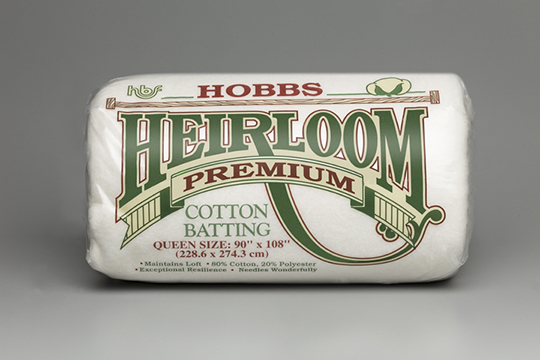
Thermore serves a different brief. Originally designed for clothing and miniatures, this polyester batting has approximately 1/16-inch loft. Hobbs lists no shrinkage and allows stitching up to nine inches apart. A quilter seeking pronounced puffiness would have reason to choose another material. More loft is a preference, not a universal improvement.
The Warm Company and Quilters Dream offer alternative batting ranges. Hobbs’s distinction is its combination of craft brands with custom industrial development. Within the craft range, fiber content, finish and handling give buyers concrete points to compare. The appealing package still has to yield the quilt its owner intended.
05 Two ways to reach the buyer
Most Hobbs craft products move through distributors, then retailers. Its listed network includes businesses in the United States, Britain, Norway, Spain, Canada and Belgium. Shops can establish direct wholesale accounts with a resale tax number and minimum orders; smaller buyers can use distributors. The industrial side offers customer-specific development and manufacturing.
For a household-scale price reference, Fat Quarter Shop listed a 90-by-108-inch Heirloom 80/20 package at $32.98 when checked in October 2026. That is one retailer’s price. On the capital side, Ironwood announced a 2015 investment of subordinated debt and common equity alongside Taglich Private Equity. The two transactions belong to very different buying decisions.
06 Try the middle before the masterpiece
Hobbs recommends making samples before committing batting to a major project. Check how it needles, launders and looks with the intended fabric. Keep the product instructions close. Stitch spacing and washing requirements vary across the range, and a successful choice for a wall hanging can disappoint in a frequently washed quilt.
That small experiment captures the company’s appeal. Hobbs gives makers and manufacturers ways to specify what happens beneath the surface. Before spending hours on the visible work, decide how the unseen part should behave. The quilt will eventually leave the sewing table. The material inside it has to keep doing its job.