A trailer is a brutally honest product. It either carries the skid steer, survives the gravel road and tips its load, or it does not. There is no freemium tier and no clever onboarding sequence to disguise a gate that jams with mud. Southland Trailers has spent more than four decades in Lethbridge, Alberta, making this sort of object: steel dump boxes, equipment decks, enclosed cargo haulers, sled trailers, gravel bodies and commercial flatbeds built for work that leaves dents.
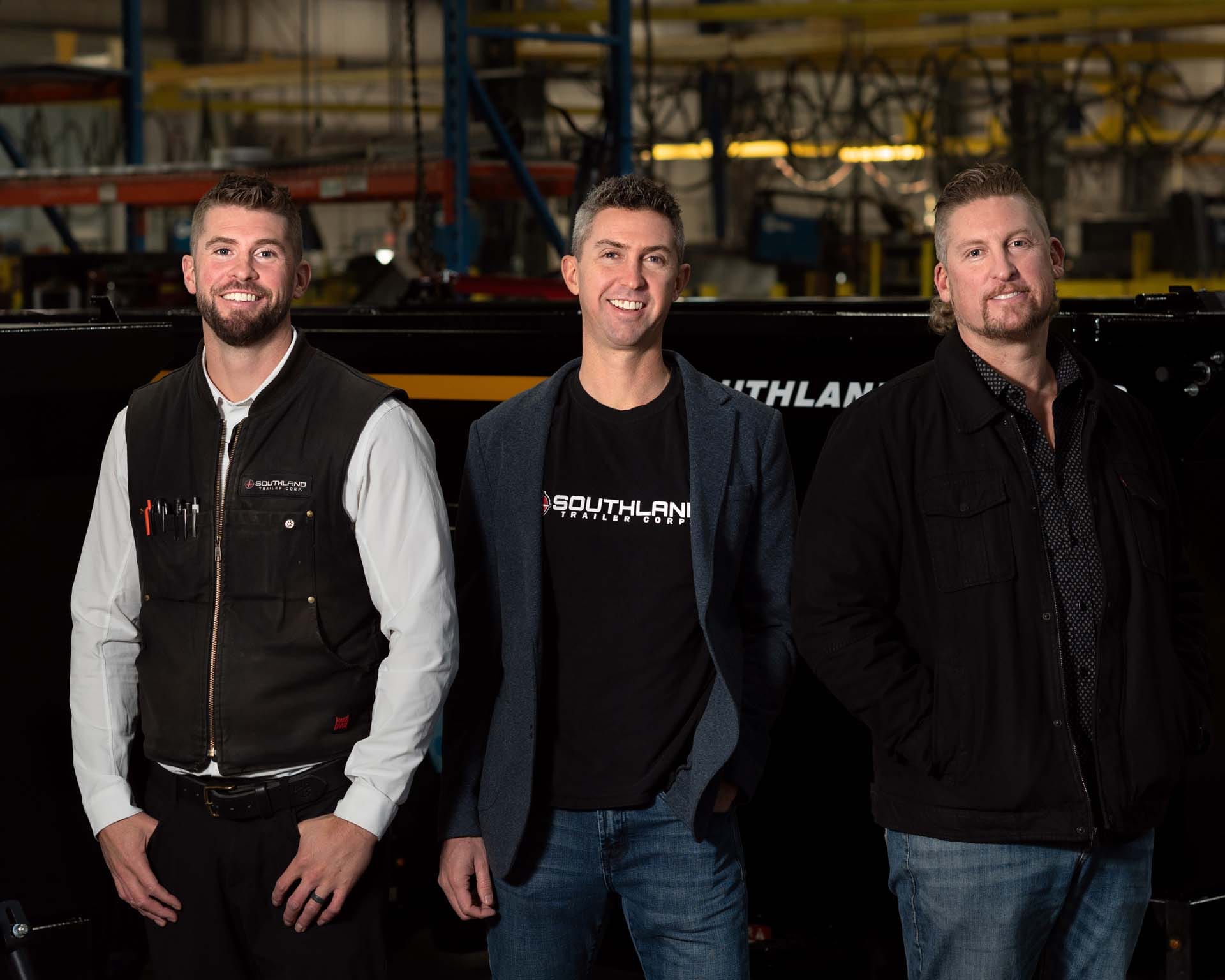
The company began in 1980 with Monty and Shelly Sailer. What started as Southland Welding became Southland Trailer Corp., a family-owned manufacturer now led with the involvement of their sons Jason, Ryan and Scott. The change in scale is stark. Southland says it had about 70 employees in 2012 and has more than 500 people today. Its dealer reach runs across Western Canada, the territories and Ontario, with sales into several U.S. border states.
Its catalogue spans the practical and the enormous. A compact tandem-axle dump trailer might spend its life behind a contractor's pickup. At the other end, Southland lists 53-foot commercial flat decks rated above 84,000 pounds gross vehicle weight. The common customer is not buying transportation as decoration. Contractors, farmers, landscapers, equipment operators, rental fleets and powersports owners buy these machines to move something expensive, awkward or dirty.
The bottleneck gets a building
By 2022, the cargo operation had a problem many founders would enjoy for about five minutes: demand had outgrown the useful flow of the plant. Ryan Sailer described the existing facility as constrained by size, limiting how efficiently work could move. Southland's answer was not another motivational poster about productivity. It planned an 85,000-square-foot advanced manufacturing facility in Lethbridge County.
The public project estimate was CA$15 million. Alberta supplied CA$2.06 million through the rural stream of its Investment and Growth Fund. That incentive covered only part of the bill, but it mattered. Southland examined other Canadian and international locations, and Ryan said the provincial investment directly influenced the decision to keep the expansion in Canada and, ultimately, southern Alberta. This is the rare corporate location story with a clean answer to “what changed their mind?” Money, partnership and the economics of staying close to an existing manufacturing base.
The announced design paired more room with robotic processes and aimed to lift cargo-trailer output from 20 units a day to 41. A separate estimate put the workflow gain around 30 percent. Those numbers measure different things - maximum unit capacity and broader throughput efficiency - but the direction is the same. The old arrangement hit the wall first. The new plant was intended to remove travel, waiting and awkward sequencing before demanding that people simply work faster.
“This investment directly influenced our decision about keeping this expansion within Canada and ultimately southern Alberta.”Ryan Sailer, on the Alberta incentive
The product is a feedback loop
Southland's competitive argument begins with vertical integration. The company keeps engineering, prototyping, steel fabrication and much of production under one roof. That means fewer handoffs between a field complaint and a revised part. It also means expensive equipment: robotic welding cells, CNC machines, automated laser cutting and guided vehicles need enough steady volume to earn their floor space.
The engineering pitch is easiest to understand through weight. Every pound of trailer consumes a pound of legal towing capacity that could have been payload. Southland promotes high-strength structural tubing, engineered sills and deck camber to put material where loads demand it. The customer payoff is plain: carry more useful stuff within the same rating, tow with less dead weight and reduce the temptation to overload.
Its constant-radius cambered deck is a good example. The slight engineered curve helps distribute weight as the trailer loads, reducing concentrated stress through the frame. Finite element analysis lets designers model likely weak points before steel is cut. None of this makes compelling cocktail conversation. It can make a compelling Tuesday when an excavator rolls aboard and the deck behaves predictably.
Innovation, measured in fewer annoyances
The 2026 dump-trailer refresh reads like a list written by people who have opened a tailgate in sleet. Southland enclosed gate-holdback springs in structural tubing to keep out mud and gravel, added galvanized strike plates against rust, revised spreader latches and introduced sacrificial hemlock sideboards. It also advertised a 44 percent increase in lifting power across the updated range.
That is what the company does differently when it is working well: it translates manufacturing capability into small reductions in customer friction. The protected spring is not a category-creating invention. It is one less exposed mechanism on a tool expected to live outdoors. The sideboard is designed to take abuse and be replaced instead of passing every impact into more expensive steel. Good industrial design often looks like deciding which part should lose a fight.
The broader range spreads that logic across several jobs. Dump models serve construction, landscaping and agriculture. Low-boy and high-boy equipment decks move machines and vehicles. Goosenecks trade pickup-bed space for stability and payload. Royal cargo and XR recreational trailers protect tools, toys and sleds from weather. RENN gravel bodies and roll-off equipment take the company into truck-mounted material handling. Commercial flatbeds serve freight customers with very different duty cycles.
How the money moves
Southland is privately held and does not publish detailed financials, valuation or unit economics. The visible model is conventional manufacturing with a useful distribution twist. It designs and builds branded equipment, then sells primarily through independent dealers. Dealers provide local inventory, configuration help and service for a purchase that buyers often want to inspect in steel. Southland supports that network with product education, manuals, warranty infrastructure and marketing.
The company is also adding direct ecommerce around the edges. Parts are available online, including through Amazon Canada, while merchandise has its own shop. This does not replace dealers for high-consideration equipment. It attacks the smaller delay: a customer who needs a component tomorrow should not have to wait for a local parts counter to place a special order.
Alternatives are plentiful. Big Tex, PJ, Diamond C, Load Trail and Sure-Trac compete across North America, while regional fabricators can win on proximity or customization. Used inventory and rentals are rational substitutes for occasional hauling. Southland therefore has to sell reduced risk: a dealer nearby, a documented payload, available parts, engineering behind the frame and a manufacturer likely to answer after the paint gets scratched.
The culture claim meets the shop floor
Southland's preferred sequence is “people, processes and then product.” Its public values include hard work, open communication, calculated risk, continuous improvement and humility. Recruiting material advertises apprenticeships, internal promotion, a cafeteria and four-day workweeks for some production roles. The 2022 expansion was projected to add up to 250 jobs and create more skilled positions as manufacturing grew more intricate.
There is a useful caution here. Public employee reviews are mixed, with the four-day schedule and cafeteria praised alongside criticism of pay, workload and management. A culture is not proven by changing “employees” to “team members.” It is proven when the shift, supervisor, training and feedback system make the word feel accurate. Southland's scale-up has made that gap between stated culture and daily experience one of the company's real operating tests.
What another operator can steal
- Find the physical constraint. Southland named floor space and workflow before buying automation.
- Own the learning loop. Keep customer feedback close to the people who design, test and build the fix.
- Sell an economic outcome. Strength-to-weight ratio matters because payload and fuel matter.
- Improve the annoying part. Mud-proof hardware can create more loyalty than a dramatic redesign.
- Use incentives as leverage, not a business model. The Alberta grant influenced location, but Southland still carried most of the CA$15 million bet.
When the playbook breaks
Vertical integration is not automatically virtuous. It works when volume keeps machines busy, the company can recruit technical talent and product knowledge compounds across a stable category. It fails when demand is too small or erratic, when customization destroys repeatability, or when capital gets trapped in equipment that ages faster than it earns.
Automation also cannot rescue a confused process. A robot can repeat waste with terrific consistency. The Southland lesson is to design flow first, automate the repeatable constraint second and keep humans close enough to notice when the system produces a beautifully welded mistake.
Forty-six years after the Sailers began, Southland occupies a particular place in the market: larger and more automated than a local custom shop, still family-owned, and broader than a single-category trailer brand. Its future depends on a humble proposition. If the factory learns faster, the trailer gets lighter, tougher or less irritating. If those improvements survive a Canadian winter, the dealer has a better story to tell. And if the customer gets home with the machine still behaving, the story becomes a repeat sale.
Keep rolling