Consider a cutting tool. It appears in a purchasing spreadsheet as an item with a price, a supplier and a part number. On a factory floor, it acquires a second identity: something that determines how fast a machine can run, how often an operator stops and whether a finished part survives inspection. The distance between those two identities is where MSC Industrial Supply Co. does some of its most interesting work.
- MSC supplies the tools and everyday materials that keep industrial operations running.
- Its specialists and inventory services address wasted machine time, missing supplies and purchasing friction.
- The useful buying question is what an item does to production cost, alongside what it costs to order.
The expensive part is the pause
MSC occupies a peculiar position in manufacturing. It usually does not make the customer’s finished product. It supplies things that make production possible: end mills, measuring instruments, abrasives, fasteners, gloves and maintenance supplies. Its catalog runs to approximately 2.5 million products. Buyers include small machine shops, large manufacturers and public-sector organizations.
That breadth puts MSC in the same purchasing conversation as Grainger, Fastenal, local distributors and online sellers. MSC’s particular emphasis is metalworking expertise. Alongside selling a tool, it can examine the operation in which that tool will work. For a customer facing recurring machining problems, advice and availability become part of the product’s economic value.

A catalog learns to listen
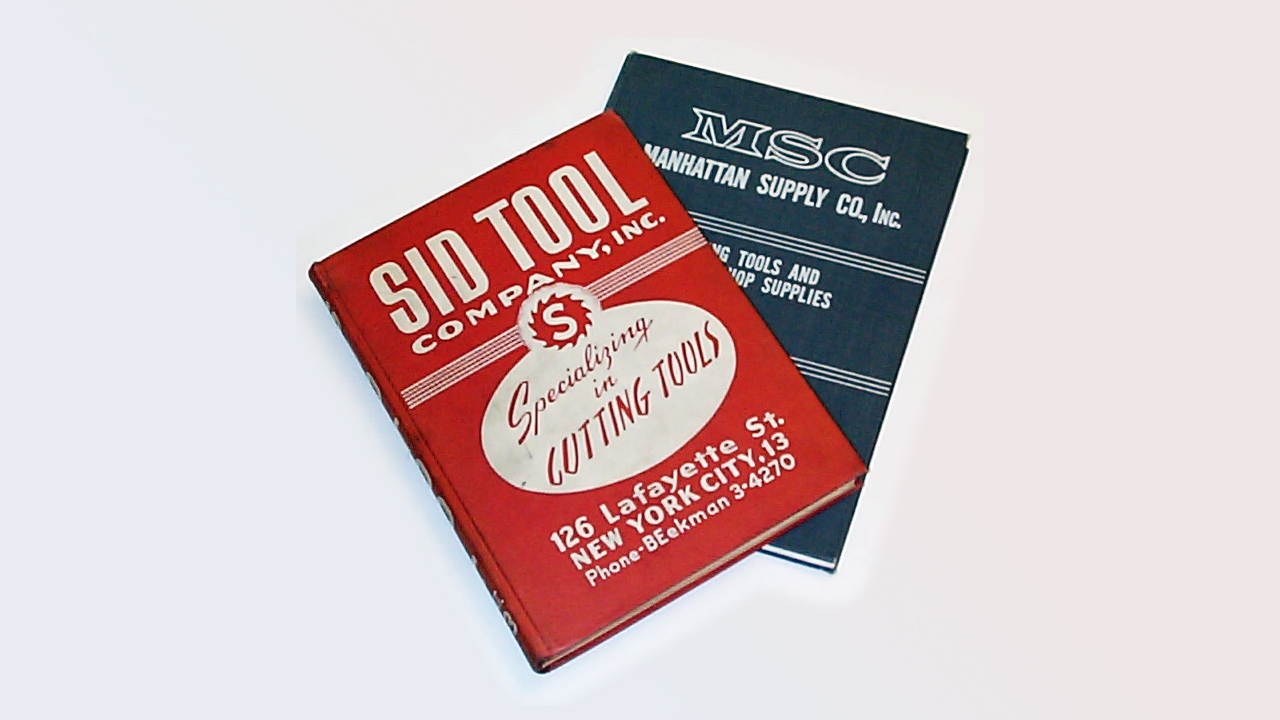
The business began in New York in 1941, when Sidney Jacobson founded Sid Tool. In 1964 came the first Big Book catalog. In 1969 came computerized inventory management and order processing. These were successive answers to a practical distribution problem: helping a customer identify something, then getting the right thing into the customer’s hands.
The chronology matters because MSC’s digital business did not arrive as a sudden discovery of the internet. The company had been organizing products and orders for decades. It began trading on the New York Stock Exchange in 1995; Big Book items went online in 2000. The catalog’s underlying promise survived the change of medium. A searchable website shortened the search; services inside the plant addressed what happened after the order arrived.
The machine has an opinion
Take VMAC Global Technology, an air-compressor manufacturer. Its problem involved an extended-length milling tool. Long tooling can make vibration and surface finish difficult to manage. Simply selecting a cautious speed does not tell an operator where the useful operating conditions lie.
MSC’s published case study describes a specialist performing a MillMax tap test on an 11-inch tool and delivering a dashboard in 15 minutes. MillMax, introduced in 2020, measures a tool assembly’s vibration response. A specialist interprets that response to recommend cutting parameters. The machine’s behavior becomes something to examine before committing to another round of trial and error.
For that application, MSC reports an 18% increase in spindle speed, a 122% increase in feed rate and a 121% increase in material removal rate, with 183 machine hours gained. These are vendor-published results for a particular job. They illustrate the opportunity; they do not establish what another machine will deliver.
“Time is money, so the faster you can get things working at peak efficiency, the quicker you see the payback.”
Jason Weber · Machining supervisor, VMAC
Another customer, Oregon CNC shop BDE Manufacturing Technologies, had insufficient finish, excess scrap and repeated passes on a part. MSC brought test tools and a more rigid holder, then identified stable operating conditions. The company’s case study reports five passes eliminated. Here the useful detail is the intervention: test the assembly and change a specific operation.
A vending machine with a purchasing department
A perfectly chosen cutter is useless if nobody can find it. ControlPoint, MSC’s inventory offering, tackles that adjacent problem through app-based ordering, vendor-managed inventory, industrial vending, tool crib systems and onsite associates. A vending machine places selected supplies near their users while recording consumption. Replenishment can follow actual withdrawals.
the work
what leaves
what is needed
The business model remains distribution: source products and resell them to organizations that need them repeatedly. Services give customers reasons to keep buying through MSC. They also put the supplier closer to everyday operations. At fiscal 2026 year end, MSC had 31,078 vending machines in service and 431 in-plant programs. There is a substantial physical presence behind the online storefront.
For a purchasing team, the attraction is visibility. A box on a shelf tells you what is there now. A record of withdrawals can help explain what is being used and what needs replacing. That makes the supplier relationship more demanding: the customer has to maintain usable processes, and the distributor has to help keep the system working. The benefit depends on that everyday discipline.
The $41.8 million rethink
MSC also offers a recent example of how difficult improving your own operations can be. Its Digital Core program was intended to modernize purchasing and order-to-cash processes. After reviewing timelines, resources and expected returns, the company discontinued that approach. The resulting fourth-quarter impairment and related charge was $41.8 million before tax.
That figure includes written-down implementation assets and future contractual obligations; it is not a tally of every dollar ever spent. On the October 2026 earnings call, CEO Martina McIsaac described a move toward smaller, modular systems improvements using AI. Management wanted greater speed and flexibility. The replacement approach still has to produce results.

The financial picture resists a tidy verdict. Fiscal 2026 sales reached $4.01 billion, up 6.4%. Fourth-quarter sales increased 10.3%, while reported diluted earnings per share fell to $0.85 from $1.01, with the impairment weighing on results. Higher sales and a costly change of direction happened together.
Start with the minutes
The transferable lesson is modest enough to use tomorrow. Choose one recurring source of lost time. Establish a baseline. Test a change. Compare the result before expanding it. That approach can guide a tooling decision, a storeroom redesign or an internal software project.
It needs the right conditions. Milling recommendations depend on the assembly and application. Inventory systems need reliable usage data and workers who use them. A shop with few recurring purchases may gain little from elaborate onsite support. MSC’s deeper services make the most sense where enough repeated friction exists to repay the effort of removing it. Start there, with the work waiting to be done.