When Martina McIsaac was considering a job at Hilti in 2013, her husband supplied the sort of due diligence an executive recruiter might overlook: she had been inside Home Depot only twice. She liked the company. He wondered whether the company understood quite how new she was to the world of construction tools. It was a fair question, and a rather good joke.
She had already run a substantial manufacturing business. She had also spent nearly five years away from paid work, raising her children. Returning meant asking an employer to recognise both things at once: the experience she possessed and the industry she still had to learn. Hilti offered that combination. The route would eventually take her to the leadership of its North American operation, and then to MSC Industrial Supply.
On January 1, 2026, McIsaac became MSC's president and chief executive officer. The neatness of that title conceals the more interesting career underneath it. There was an international manufacturing apprenticeship, a deliberate departure, a return at a smaller level of responsibility, and a series of people willing to see what she might do next. A résumé can make all that look inevitable. Living it required rather more imagination.
A map before a ladder
McIsaac was born in Tennessee and grew up mainly in Ontario. Her education combined economics at Western University with international business at the University of South Carolina. The university lists her graduate qualification as a 1995 MIBS. That distinction matters: international business was the subject of her training well before it became the geography of her working life.
Her Avery Dennison years took her through Mexico, Argentina, Chile, Canada and the United States. She worked across sales, marketing, business development and operations, eventually becoming vice president and general manager of the Performance Polymers Division. The company describes a 14-year tenure. It was an education in the awkward business of making something, selling it and delivering it across borders, with all three activities expected to agree.
Those jobs also gave her several viewpoints on the same enterprise. A salesperson encounters the promise a customer has been made. An operations manager encounters the work required to keep it. Someone running a business has to reconcile both. McIsaac's career moved among those responsibilities rather than remaining inside a single professional department. At MSC, where products pass between manufacturers and industrial customers, that breadth has an obvious use.
In 2008 she stepped away. The break is sometimes treated as the surprising interruption in her story. An equally interesting part is what happened when she came back: she was prepared to become a learner again without accepting that her earlier experience had ceased to count.
“I had great sponsors who saw it before I did.”
Martina McIsaac, on becoming a CEO
The job that came with homework
Avi Kahn, then leading Hilti Canada, played an important part in her decision. McIsaac had reservations about taking a job under someone younger whose business was smaller than the one she had previously run. Kahn approached the conversation as an exchange. She understood things he could learn; he understood Hilti, which she needed to learn. Neither person had to pretend to possess the other's experience.
It is a useful little scene because it gives sponsorship some practical content. Encouragement is pleasant. A boss who can explain how an unfamiliar job might develop, and who is comfortable learning from the person he hires, offers something more concrete. McIsaac accepted a role that provided access to a new business and a visible possibility of advancement.
She joined Hilti in 2013 as a senior management candidate and became a division manager in 2014. By 2017 she was general manager of Canada. When Hilti announced Kahn's move to its group executive board in September 2019, it named McIsaac his successor in North America, effective January 1, 2020. The appointment followed an internal search. The newcomer had become a candidate the company knew from the inside.
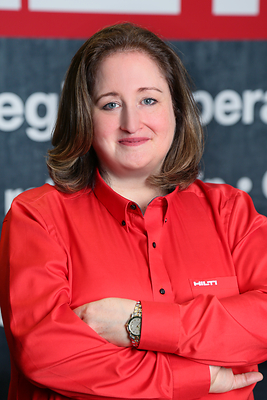
The red-shirt chapter. McIsaac in the press photograph accompanying Hilti's announcement that she would lead North America. Photograph: Hilti / PR Newswire.
Even that promotion involved preparation. She described spending six months shadowing Kahn before the handover. A succession announcement usually compresses the process into a date and two names. Here, the incoming chief had time to watch the job being done. For an executive whose return had depended on permission to learn, it was a fitting way to take over.
A tool has a life beyond the sale
At Hilti, McIsaac talked about the work surrounding the product: planning, design, software, services and the management of equipment. Construction customers needed completed jobs. A tool was one ingredient. Her discussion of asset tracking had a pleasingly awkward implication for a tool seller: helping a customer use existing equipment properly could mean selling that customer fewer tools.
That is a more demanding relationship than a transaction. It requires knowing what the customer actually does, where time disappears and which part of a process a new product might improve. It also asks a supplier to take the customer's economics seriously. A bigger collection of equipment is not automatically a better-run business. Sometimes it is merely a bigger collection.
She was already describing connected tools and digital building models in 2020, along with the need to help customers use them. Her emphasis was practical: equipment that signals a maintenance need, information shared between trades, work organised before someone reaches the site. The attraction of technology lay in the task it could change. A new interface still had to earn its place in a working day.
She also spoke about opening construction careers to women and showing the range of jobs available. Her own arrival from a different industry made that argument tangible. A person could have substantial business experience and still be new to construction. An industry interested in recruiting talent had reason to make room for both qualities.
Three steps into MSC
MSC announced her appointment to a newly created executive vice president and chief operating officer role in September 2022. She started on October 3. Her remit covered the daily operations of the United States and Canadian businesses, including sales, procurement, pricing and supply chain. The appointment brought her experience with manufacturers and construction customers into an industrial distribution business.
The remit widened in September 2024, when she became president while retaining the COO title. All day-to-day operations now sat within her responsibilities, including information technology and sustainability. The sequence matters because the CEO appointment followed several years of operating work inside MSC. She had already been managing much of the business she would be asked to lead.
The handover preserved family involvement in the company. Erik Gershwind, who had spent thirteen years as CEO, moved to non-executive vice chair. Mitchell Jacobson remained chairman. McIsaac's appointment therefore combined a change in executive leadership with continuity on the board. She would also become a director.
Her operating assignment had included unglamorous work that customers notice when it goes wrong: pricing, the website, digital marketing and sales territories. MSC returned to growth among its core customers in the fourth quarter of fiscal 2025. Operations changes delivered $15 million in first-year operating expense reductions. These were company results produced by teams, and they supplied a concrete backdrop to the succession.
First-year operating expense reduction from operations changes under McIsaac's leadership, as reported by MSC for fiscal 2025.
Making room for the next person
The sponsors in McIsaac's story recur because she gives them a place in it. She has described other people recognising CEO potential before she recognised it herself. That admission takes some of the theatre out of executive ambition. A career can develop through invitations and responsibilities accepted along the way, with the explanation arriving after the experience.
Her activities outside her operating roles have included chairing Dallas Habitat for Humanity's Women Build and serving on the board of United Way of Metropolitan Dallas. Those are past roles. Her current corporate biography also lists the Texas Women's Foundation's Economic Leadership Council and Appalachian State University's Supply Chain Advisory Board. The connections range from women's economic opportunity to the practical concerns of an industrial employer.
There is a continuing link with South Carolina, too. She serves on the Folks Center for International Business board, returning to the institution where she studied the subject. For students, her working history offers an unusually concrete illustration of what international business can involve: different countries, different functions and the willingness to carry experience into an unfamiliar setting.
Her publicly described approach to talent leaves room for people who do not arrive with a perfectly matching résumé. That seems a reasonable lesson to draw from her own experience. Hilti had to see a future construction executive in a former polymers executive. McIsaac had to believe that learning a new business was a worthwhile use of what she already knew.
The factory gate, from both sides
By September 2026, her public conversations at MSC were focused on technical expertise, connected manufacturing and helping customers apply new technology. The underlying problem remained familiar from her Hilti years: customers need useful improvements in the way work gets done. Distribution puts a business between the people developing equipment and the people trying to make it productive.
That position suits the shape of her career. She has worked inside manufacturing and inside a supplier of tools, software and services. She now leads the company helping connect those worlds. The earlier jobs have acquired a new relationship to one another, though that relationship could hardly have been certain when she took them.
Her story allows for a less tidy understanding of professional progress. An interruption can remain an interruption. A smaller job can still be worth taking. A capable executive can require instruction. McIsaac reached MSC's top job with all of those experiences intact, and with a fairly good answer to her husband's question: there was plenty to learn, and she learned it.