Elizabeth Eastland planned to take nine months off. The break became four years of sailing. For an executive whose work had included a global role at telecommunications company Alcatel, this was a substantial revision to the schedule. It also makes a useful introduction to a life in which a change of direction has often produced something worth keeping.
There were pastels from that voyage through the Mediterranean, Atlantic and Caribbean between 2002 and 2006. There would later be films about scientific discovery, an incubator in a steelmaking region, and an exhibition assembled from a thousand kilometres of walking. In July 2026, four pilgrims from her imagination took to a theatre stage in Manly. Her play was called Le Chemin: the path.
A career summary can make this sound like a succession of departures. Look more closely and the same questions keep returning. How does an unfamiliar idea get a chance? Who gets to participate? What happens when the person with the plan pays attention to something unexpected? Eastland has approached those questions with a business program, a camera, a box of pastels and, occasionally, a boat.
Two subjects that refused to stay apart
Eastland is Canadian Australian and based in Sydney. Her father was a rocket scientist; her mother was an artist and designer. The family background has the pleasing neatness of a biographer’s invention, except that her education carried the combination forward. At Concordia University in Montreal, she studied creative writing and computer science. Her creative-writing degree, completed in 1985, came with distinction.
These interests were followed by a telecommunications career that took her through North America, Australia and Paris. She ran a telco startup and held a global role at Alcatel. Along the way came an Executive MBA at the Australian Graduate School of Management at UNSW, completed in 1998. Business education supplied another set of tools alongside the literary and technical ones.
Then came the sailing interval. An itinerary offers structure, but weather reserves the right to edit. Eastland’s own art catalogue dates the resulting Mediterranean and Caribbean work to the four-year voyage. The journey had a tangible afterlife in pictures: places encountered slowly enough to become subjects, and subjects that could travel home on paper.
Back in formal study, she completed a Bachelor of Fine Arts at the National Art School in 2009, graduating as dux. Her film Pythagoras’ Journey entered the school’s permanent collection. By then, art had academic credentials and a body of work behind it. It would continue alongside the executive appointments that followed.
A place to stay in a city people left
At the University of Wollongong, Eastland’s responsibilities included innovation and commercial research. In 2011, she developed iAccelerate, with the support of vice-chancellor Gerard Sutton. A founding symposium brought together people from government, business and academia. The ambition required a community before it could require a building.
The practical problem was local. Graduates needed opportunities that would let them build careers in the Illawarra. Eastland described launching the program to create jobs for people who otherwise had to leave Wollongong. Entrepreneurship, in this setting, carried a regional purpose: give knowledge and ambition somewhere nearby to become a business.
The offer included premises, professional services, education and mentoring. Founders could get help with accounting, intellectual property, marketing and the other disciplines that arrive uninvited once an idea becomes a company. A pitch and demonstration day put them in front of potential investors and the wider community. The work involved introductions as much as inspiration.
In December 2013, the NSW government announced A$16.5 million for a dedicated centre. Its planned 4,000 square metres and capacity for more than 280 entrepreneurs gave the project physical scale. Eastland’s explanation was practical: a permanent home would help sustain the events, activities and incubator. Even a program built around change benefits from knowing where to put the chairs.
Early iAccelerate outcomes reported in February 2016, at the end of Eastland’s five years leading the program.
The invitation needed more than a mission statement
One of Eastland’s clearest accounts of running iAccelerate concerns women’s participation. Gender equity was part of the mission. Making that intention visible in the program took additional work. The details included pitching panels with women entrepreneurs, speakers of different genders, scholarships and a children’s eClub that helped parents attend networking activities.
The women’s entrepreneurial breakfasts proved particularly useful. Eastland described the intake after the first breakfast: women accounted for 30 percent of applicants, while half the accepted companies had female founders. In the same historical account, 16 of 34 startups in the program had a female co-founder. These figures belong to that early period; they describe a change in participation, rather than a promise about every subsequent intake.
“we saw real change once we took specific actions”
Elizabeth Eastland, on iAccelerate’s gender-equity work
16 of 34 startups had a female co-founder.
Yellow marks companies with at least one female co-founder. Each dot represents one company.
There was also an adjustment on the capital side. In 2015, iAccelerate described reducing the minimum commitment for female wholesale investors in its seed fund from A$100,000 to A$25,000. Eastland said this had prompted interest from women who would otherwise have stayed out. The program was looking at both the people starting companies and the people able to back them.
The revealing part is the willingness to examine ordinary arrangements: an event’s timing, a panel’s composition, the amount required to participate. Each can shape who shows up. Eastland’s example makes inclusion an operational question, with invitations, childcare and investment thresholds to consider. A mission statement has a comparatively comfortable working day.
Watching discovery happen
While helping other people develop ventures, Eastland was also pursuing a PhD. Her research at Sydney College of the Arts used ethnographic film to follow four women scientists. Supervised by Ross Gibson, the doctorate was awarded in 2015. Its subject put her artistic and institutional interests in the same room.
The films explored researchers at work across materials, biochemistry and physics. Eastland was interested in how people operate at the boundary of what they know, and how the studio and laboratory might resemble one another as places of investigation. A completed discovery can look orderly in retrospect. Her attention was on the less tidy experience of reaching it.
The project’s film portraits examined personal accounts of discovery, including the role of accident and serendipity. Her installation Double Double appeared at Wollongong’s Digital Media Centre Gallery and, in 2016, at the Powerhouse Museum. This was art made during the years when her professional remit also involved helping research find a life beyond the university.
That overlap offers a way to read her career. The person developing support for new companies was also observing how new knowledge actually emerges. Both activities require patience with work whose value is still taking shape. Neither supplies a dependable timetable for the useful surprise.
From the Illawarra to the national stage
Eastland moved to CSIRO in 2016 as General Manager, Strategy, Market Vision and Innovation. The role included strategic direction and an entrepreneurial program intended to develop investable ventures. That July, she introduced eleven research startups at an ON Accelerate demonstration event in Sydney. The scale had changed, while the task of connecting researchers with business remained familiar.
In June 2017, UNSW announced her appointment as Director Entrepreneurship. The remit included expanding startup networks and commercial relationships, and scaling the university’s student startup program. Her CV records the appointment through 2019, alongside a board role at Cicada Innovations. A later public reflection credited Brian Boyle’s support and placed people at the centre of what UNSW Founders became.
Climate technology provided another application for that experience. In 2023, Investible identified her as an adviser to its Climate Tech Fund and Greenhouse. She described the investment problem as balancing commercial returns with environmental impact, and argued for an advisory group with enough breadth to support companies as they develop and change direction.
“Investing in Climate Tech opportunities is inherently a balancing act of profit and impact”
Elizabeth Eastland, February 2023
A thousand kilometres, recorded one by one
In 2023, Eastland and her husband Paul walked the Camino Frances, continuing beyond Santiago de Compostela to Finisterre and Muxia. She recorded a reflection at each kilometre using a voice-to-text app that mapped the entries to their locations. Fellow walkers contributed their own hopes. The archive grew as they moved.
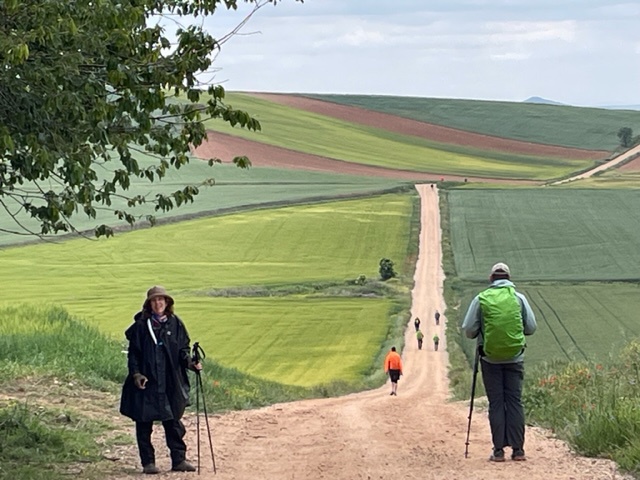
The material became A Thousand Prayers / (on the Camino Frances), exhibited at Curl Curl Creative Space in May 2024. Pastels, a 60-metre installation and the film A Thousand Moments brought the journey into a gallery. The work moved between forms: a walk became recordings, recordings became fabric, and encounters became images.
The method has a connection to her earlier Pacific sailing poetry. During six months around Fiji and New Caledonia in 2022, she sent poems by satellite to a weather app, which mapped them to the places where they were written. The technology served a deliberately slow activity: noticing where she was, then leaving a record of it.
Her travel writing also describes bringing drawing materials to Makogai in Fiji and finding that half the village turned out to draw. The scene is sociable and practical: people making pictures together, rather than an artist keeping experience at a polite distance. The same career that made room for founders contains these smaller gatherings around a shared activity.
The path acquires a cast
In July 2026, Manly Theatre Group presented Le Chemin at the Sky Theatre. Directed by Kathleen Walker, Eastland’s play followed four pilgrims on the Camino trails of France and Spain. It shared a double bill with Barbara Courtille’s The Life and Death of Harry Bennett. A journey that had already generated drawings, recordings and film had become material for actors.
By October, her website was also inviting audiences to Aqua and eleven other short plays. The former accelerator chief was still making things whose final form depended on other people joining in. A stage brings a particularly literal version of that arrangement: the writer must eventually let somebody else speak.
Eastland’s life gives professional reinvention an unusually concrete texture. There are degrees, jobs, programs, exhibitions and scripts. There are also long stretches of sea and road between them. She has repeatedly made space for an interest before knowing everything it would become. The nine-month break ran over. There was quite a lot to bring back.
Follow the work
More from Eastland, plus conversations and career coverage.