A scientist can explain an invention. A purchasing department wants to know whether it solves a problem, what it will take to install, and who answers the phone when something goes wrong. Connect Bogotá has made a business out of working across that gap. Its raw material is other people’s expertise. Its ambition is to help that expertise become something a company can use.
The Colombian nonprofit sits among universities, established businesses, entrepreneurs and government. It organizes introductions, advises on innovation and helps research reach the market. That sounds like a crowded job description. In practice, the combination is the point: a promising technology can need a business model, a license, a customer and a public-sector partner before anyone can sell it.
Connect’s appeal is less about the glamour of invention than the awkward work that follows. It gives organizations somewhere to take a question that does not fit neatly inside their own walls. Who already knows how to do this? Which researcher should we call? Is this startup ready for a corporate customer?
Forty-nine partners, one coordination problem
Connect emerged in 2011 from Bogotá’s university-business alliance. Its early account describes 49 founding partners and an inspiration drawn from the Global Connect network associated with San Diego Connect. This was an institutional coalition, with universities and businesses building an intermediary they could use together.
The origin matters because it explains the customer mix. Connect was built to work across organizations whose incentives differ. Researchers need routes for their knowledge to travel. Businesses need usable answers. Governments want economic development. A successful introduction has to give each participant a reason to keep showing up.
By the third Rueda de Innovación, reported in March 2013, the format was already concrete. Twenty-two member universities participated; 700 researchers and 300 companies took part in 1,000 business appointments. Universidad Jorge Tadeo Lozano, which identifies itself as a founding member, brought groups working on design, entrepreneurship and engineering. The point was to put research in front of people with commercial questions.
One early meeting ground: the third Rueda de Innovación, reported in 2013. These are event participation figures.
Start with the problem someone will pay to solve
Bio-B gives the clearest view of the machinery. Financed by the Inter-American Development Bank, the program sought biotechnology solutions to business needs. Its sequence began with challenges from the productive sector, then searched for potential answers among researchers and entrepreneurs, including outside Colombia.
That ordering is useful. A call organized around an existing business problem gives a laboratory a clearer target than a general invitation to “innovate.” It also gives the company a way to compare proposals against the need it originally described.
The historical offer included specialized services worth up to COP 70 million per innovation challenge to validate and accelerate a solution. That amount described a support portfolio, rather than a universal cash prize or a fee charged to every participant. The work was meant to establish whether the proposed biotechnology could meet the company’s expectations.
There is a lesson here for a corporate innovation manager: write the problem before collecting pitches. Decide what evidence would make a proposed solution worth adopting. Otherwise, the organization can accumulate interesting demonstrations without getting closer to a purchasing decision.
- 01A business needIdentify an innovation challenge.
- 02A relevant solutionSearch research groups and ventures.
- 03Evidence to proceedUse specialized validation support.
A program sequence, not a guarantee of commercial success.
The deal has to survive the laboratory
Connect’s regional technology transfer office handles another part of that journey. Its offer includes evaluating research, preparing it for commercial discussions and helping negotiate technology agreements. Potential routes include co-development, licensing, assignment of rights and the creation of spin-off businesses.
These are different transactions with different consequences. Licensing can let another organization use an invention while the original owner retains rights. A spin-off creates a business around the opportunity. Choosing a route requires more than enthusiasm for the underlying science.
The office also describes work on technology valuation, including the financial ranges relevant to fixed payments and royalties. For a university team, that can help turn an abstract claim of value into a negotiation. For a prospective buyer, it makes the proposed relationship easier to examine.
This is where Connect occupies a distinctive position in the market. An organization could seek a university transfer office, an innovation consultancy or an accelerator separately. Connect brings those kinds of work into a regional network. The benefit depends on whether the problem actually crosses those boundaries; a straightforward purchase may require much less intermediation.
Borrow a method. Adapt it to Bogotá.
For entrepreneurs, Connect uses Springboard, a methodology originating with San Diego Connect and adapted locally. Its published description targets science and technology ventures with a product or service already validated in the market. Support covers areas such as the business model, sales, marketing, legal questions and finance.
The entry condition is consequential. A founder still testing whether anyone wants the product has a different problem from a founder trying to organize growth. Springboard’s stated focus gives applicants a useful way to judge fit before investing time in a program.
A 2016 account in Semana named taxi application Tappsi, credit-technology business Zinobe and IT lifecycle services provider LCS Colombia among Springboard examples. Those businesses illustrate how broad the technology category can be. Connect’s historical work extended across consumer convenience, financial operations and the management of equipment.
Its other entrepreneurial routes include 100 Open Startups and BogoTech Abierta. Developed with Bogotá’s economic development secretariat, BogoTech Abierta lets participants present solutions and respond to organizational challenges. The offer is practical: a place where a company’s question and an entrepreneur’s answer can become visible to each other.
Who pays for the introductions?
Connect publishes three ways to participate: membership, consulting and calls for applications. Each serves a different need. An institution can join an ongoing network, buy help for a defined assignment or participate in a program whose eligibility and support are set by its particular call.
The membership page describes annual contributions being reinvested in strengthening the network. Consulting covers innovation strategy, open innovation, commercialization and financing support. Sponsored projects add another route for delivering services. Being a nonprofit therefore coexists with selling expertise and managing funded work.
Climate acceleration offers a specific funding example. Connect’s 2024 report records support for 15 startups and USD 100,000 secured with BID Lab and Climate-KIC for a planned 30-startup effort in 2025. That is program funding tied to a stated purpose, not a venture round valuing Connect itself.
The same care matters when reading its annual results. Connect reported mobilizing approximately COP 12 billion in 2025. Resources mobilized describe a different thing from organizational revenue. A profile of an intermediary becomes misleading very quickly if every peso passing through its wider relationships is treated as money it earned.
“La red primero”
“The network first” - one of Connect’s published values
Yes, the dinners are called clandestine
Some of the network’s most memorable offers are also its least technical. Its university benefits page lists “cenas clandestinas”: gastronomic and cultural experiences at an undisclosed location where leaders meet one another. The name gives professional networking a little intrigue.
Other formats are more explicitly work-focused. Labtour introduces businesses to research facilities. Solucionatón 10X connects company problems with student proposals. A program called “Potenciando el cerebro colectivo” offers recommendations on business challenges through sessions resembling an advisory board.
These formats reveal an organization trying to create repeated contact, rather than relying on a single annual conference. A laboratory visit lets people see capabilities. An advisory session gives them a problem to discuss. A dinner supplies a less formal setting for the relationship.
Connect’s stated values include collaboration, openness to risk and trust, alongside putting the network first. Executive director Diana Gaviria and deputy executive director Marcela Rueda lead an organization whose published identity combines consulting with regional innovation coordination. Its expertise depends partly on knowing who can help whom.
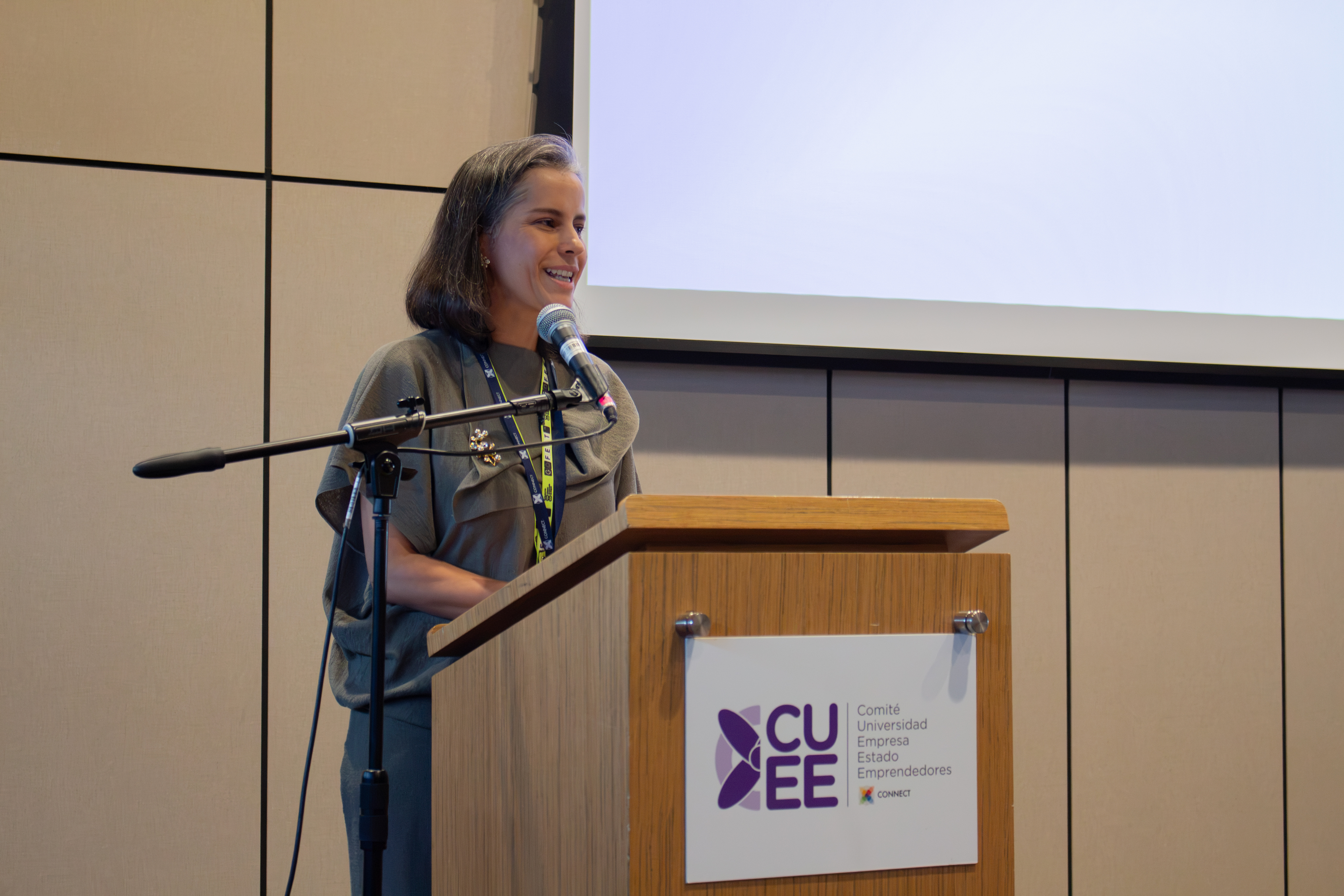
A pilot needs somewhere to go
At that August 28 gathering, the obstacle was familiar: startups move in weeks while corporations can take months. Connect’s recap also identified poorly calibrated risk requirements and the absence of an executive sponsor as barriers. The vulnerable point is the handoff from an interesting experiment to an organization willing to support it.
The discussion included venture clienting, in which a corporation first acts as a customer rather than an investor. For a founder, the distinction is substantial. A commercial relationship can test whether a product solves a real operating problem while giving both sides evidence for a deeper commitment.
The implication for readers is to give a pilot an owner, a measurable purpose and a next decision. A network can introduce the right people; it cannot supply a corporation’s willingness to adopt their work. If procurement has no path forward, or the startup cannot meet the buyer’s needs, the relationship can stall.
Connect’s current activity stretches from those conversations to public recognition. The first INNPACTA innovation award drew 537 applications in 2025, and its website now lists the 2026 call. Awards can make work visible. The more demanding test remains what happens after visibility: a research agreement negotiated, a product tested, a customer willing to continue.
For anyone approaching Connect, the useful opening is a specific request. Bring a business challenge, a technology ready for assessment or a venture with evidence of demand. The more precise the question, the easier it becomes to find a useful counterpart. That is the promise behind the name, and the work required to make it mean something.