In the California desert in 2007, Edwin Olson watched a car disappear. His MIT team had pressed the button that sent their autonomous vehicle into the DARPA Urban Challenge. It rounded a corner, and the sound of its beeper faded. There was an unusually long interval between issuing an instruction and discovering whether it had been a good idea.
Six hours later, the beeper returned. Olson remembers hearing it faintly, then more clearly as the vehicle approached home. MIT finished fourth. The sound mattered enough that, years afterward, he described his subsequent work as a pursuit of that feeling. An engineer had helped make a machine capable of leaving without him. The reward was hearing it come back.
Olson co-founded May Mobility in 2017 and leads it as CEO. His career keeps putting distance between a human operator and a machine, then asking what must fill the gap: a map, a decision, a reliable service. Eventually, the question becomes personal. If the vehicle can do the driving, what does its passenger get to do instead?
A career that refused to stay on land
Olson’s academic route ran through MIT three times: a bachelor’s degree in electrical engineering and computer science in 2000, a master’s in 2001, and a doctorate in 2008. His doctoral thesis, Robust and Efficient Robotic Mapping, addressed a foundational robotics problem. Before a robot can act usefully in a place, it needs a workable account of where it is.
His advisers were John Leonard and Seth Teller. The work crossed environments as well as disciplines. In 2002, Olson was working with the Bluefin Odyssey III autonomous submarine in the Mediterranean. Later came the road vehicle in the desert. Robotics offered a rather comprehensive way of avoiding a desk.
It took him a while to see it as a profession. He had built robots as an undergraduate, but initially failed to connect that enthusiasm with a career. Graduate school included two false starts before the field took hold. The eventual direction brought together software, physical machinery and the consequences of sending something into the world.
He joined the University of Michigan faculty in 2008 and established the APRIL Robotics Laboratory. The name spells out Autonomy, Perception, Robotics, Interfaces and Learning. In that collection of subjects, the interfaces deserve attention. Machines have to work with people as well as with their surroundings.
Fourteen robots, two people
In 2010, Olson led Team Michigan to Australia for the MAGIC international robotics competition. Its entry used fourteen robots supervised by two human operators. The assignment involved exploring and mapping a substantial indoor and outdoor environment, identifying objects and coordinating the team’s activity.
The ratio captures the difficulty. Add enough robots and a human can spend all day managing the assistance. The team’s research treated mapping, coordination and the operators’ limited attention as connected problems. Robots needed to share a sufficiently coherent picture of the place they were exploring.
Michigan won, earning a $750,000 award. Back in Ann Arbor, the university announced a presentation followed by a reception and a robot petting zoo. Even a technical victory needs a social occasion, preferably one where the guests can meet the equipment.
Another piece of Olson’s work reduced a navigation problem to something that could emerge from an ordinary printer. AprilTag, described in his 2011 research paper, uses distinctive two-dimensional markers that a camera can recognize. Software estimates a marker’s identity, position and orientation relative to the camera.
The printed square is deliberately modest. It carries a small amount of identifying information and helps a machine establish geometry. That makes it useful for robotics, augmented reality and camera calibration. Olson made the approach open and documented the algorithms. A tool could travel beyond the lab without requiring its creator to accompany it.
The passenger enters the picture
Olson worked on Ford’s autonomous vehicles and became co-director of autonomous driving at Toyota Research Institute in 2016. By then, he had experienced the field through competitions, university research and large automotive organizations. In 2017, he co-founded May Mobility with Alisyn Malek and Steve Vozar.
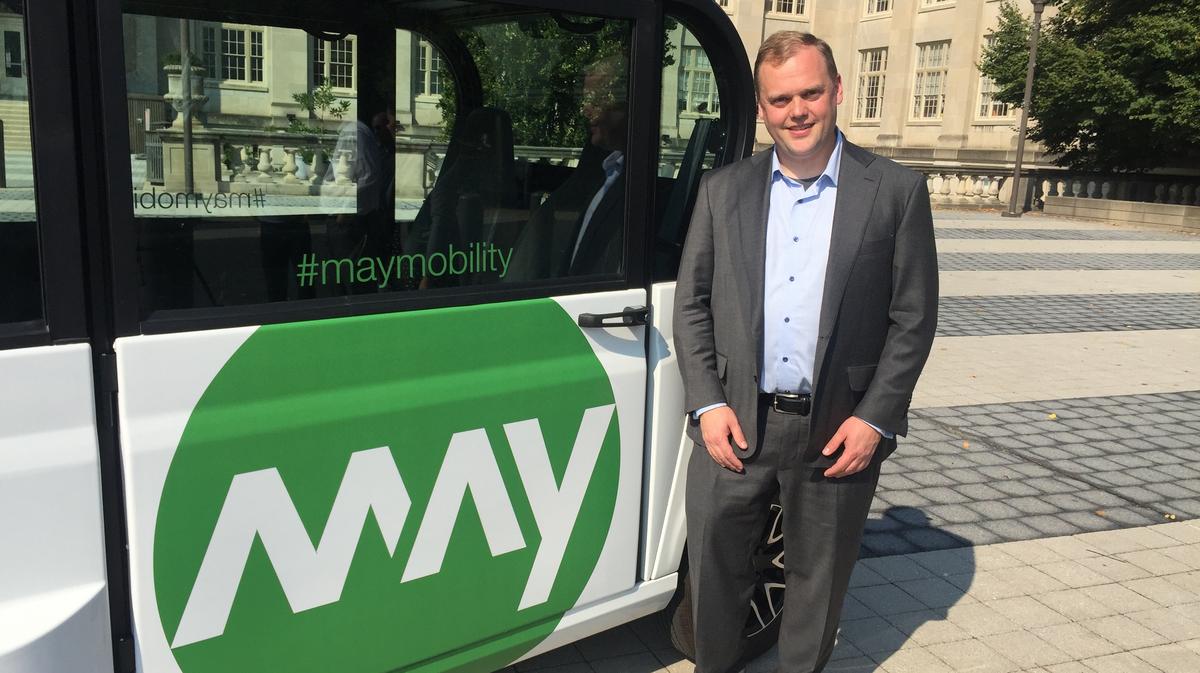
His stated ambitions went beyond a vehicle that could navigate a road. He was concerned about transportation inequity and the possibility that a city full of robotaxis would simply become a city full of additional traffic. In a 2020 interview, he argued for shared transportation that people would actively want to use, including those with other options.
May’s early proposition was concrete: deploy small autonomous shuttles in bounded operating areas, working with communities and organizations on trips they already needed to provide. A 2017 description of the business discussed six-passenger vehicles and replacing existing shuttle services. There was a customer and a route to consider alongside the software.
“Technology without impact is pointless.”
Edwin Olson
That blunt sentence expresses the founder’s chosen test. His vision included less congestion, better use of urban space and reduced dependence on private car ownership. Those are ambitions, with results that depend on how services are deployed and used. A functioning autonomous vehicle supplies one component of the answer.
Olson moved into business with academic prizes and recognition already behind him, including Popular Science’s Brilliant Ten in 2012 and a DARPA Young Faculty Award in 2013. A transportation company introduced a different audience for the work. Passengers could judge it by whether it helped them complete a trip.
A vehicle rehearses its next move
The technical thread runs through a method called Multi-Policy Decision Making. Olson and collaborators published research on multi-policy approaches before May Mobility was founded. The basic concern is familiar to anyone who has driven around a stopped vehicle: several actions may be possible, and the other road users have plans of their own.
May’s July 2026 account describes its system proposing candidate behaviors from learned models and mathematical rules, then simulating possible outcomes. It evaluates choices rather than immediately committing to the first plausible one. Waiting briefly can be preferable to passing if another vehicle’s movement makes the maneuver uncertain.
This is the company’s explanation of its design, rather than a guarantee about every encounter. Its appeal as an engineering idea is the willingness to consider alternatives. The road contains other people, and other people are generous suppliers of surprises.
The public research record also makes the company easier to place within Olson’s career. Mapping, perception, prediction and coordination were subjects he and his collaborators had worked on for years. May took those questions into a setting where an acceptable answer must arrive while a passenger is waiting.
The business takes a different turn
The business has widened since the early shuttle proposition. In September 2025, May Mobility launched an autonomous ride-hail preview with Lyft in Atlanta. Olson discussed the launch in an interview covering vehicle hardware, fleet size, availability and the passenger experience. An empty driver’s seat still leaves a considerable operations manual.
That expansion puts his earlier skepticism about robotaxis in an interesting light. The company now works with the very category of transportation platform he once worried could worsen congestion. The tension is part of the story: his larger ambitions for cities have to coexist with the markets and partners through which the technology reaches riders.
On September 16, 2026, May announced a proposed combination with ACP Holdings Acquisition Corp. The announced terms implied approximately $1.4 billion in pro forma enterprise value. Closing was expected by year-end, subject to approvals and other conditions. The proposed Nasdaq listing was a next step, rather than a completed event.
Approximate implied pro forma enterprise value. Announced combination with ACP Holdings; completion subject to closing conditions.
May also reported more than 550,000 commercial autonomous rides across the United States and Japan. Those figures describe the company’s accumulated activity; they should not be read as a count of rides with nobody in the driver’s seat. The announcement separately identified three driver-out deployments.
For Olson, the company has required a sustained departure from ordinary faculty life. In 2024, he publicly described moving to an adjunct role at Michigan after more than seven years of leave. He emphasized the importance of preserving ties to colleagues and former students. The laboratory remained part of his professional identity as the business took more of his time.
The other first chair
There is another group whose coordination occupies Olson. He began violin at age five, played with the MIT Symphony Orchestra and served as concertmaster of the Cambridge Symphony Orchestra. He joined the Ypsilanti Symphony Orchestra in 2011 and became its concertmaster in 2013. He plays an instrument by Ann Arbor maker Joseph Curtin.
In a public video, he explained how marking violin bowings helps a section play together with a common articulation and style. He then supplied deliberately terrible edits for comic effect. The joke works because the underlying task is so exacting. A roomful of capable individuals can still benefit from agreeing which way the bows should go.
Olson has explicitly connected concertmaster duties with running a company: work with a team, settle on an approach, deliver something valuable. The comparison is his, and it suits the career. Across a robot fleet, an orchestra and a transportation service, individual competence has to become coordinated action.
He has kept other interests, too. His personal website lists a cipher solver, a Wordle coach and tools for music and Morse code. In a cycling video, he described taking a long ride from Ann Arbor toward Ohio to think. For someone building machines to carry passengers, he appears quite willing to supply his own propulsion.
The returning beeper was a satisfying sound. So is a violin section playing together. Olson’s work keeps returning to the preparation that makes such moments possible, and to the people who can do something useful once the system is ready to carry its part.
Follow the next movement
Read Olson’s writing, explore the research, or hear him discuss the business.
- Personal website and side projects ↗
- Edwin Olson on LinkedIn ↗
- Edwin Olson on X ↗
- Essays on transportation and autonomy ↗
- Michigan research and publications ↗
- Watch: Inside May Mobility’s Atlanta Launch with Lyft ↗
- Meet the Ypsilanti Symphony Orchestra ↗
- The September 2026 transaction announcement ↗
- May Mobility ↗