The launch fleet at U.S. Sugar contained five tractors. Four were John Deere 8R models; the fifth was a 9R. For a farming business with 255,000 acres, that sounds almost bashful. Yet the small number is the interesting part. After an 18-month research and development phase, the company put autonomous tractors to work preparing and cultivating sugarcane land, with a central station allowing one operator to supervise multiple machines.
- Keep the equipment. ASI adds robotic control to vehicles from different manufacturers.
- Coordinate the fleet. Mobius supplies the shared command layer.
- Prove the job. U.S. Sugar’s launch followed a lengthy working pilot.
- Follow the money. SoftBank announced a $225 million ASI investment in September 2026.
Autonomous Solutions, usually shortened to ASI, builds the hardware, software and integrations that make this arrangement possible. Its current markets are civil construction, agriculture, logistics and landscaping. The work includes turning existing machinery into remotely operated or autonomous equipment and making several vehicles behave sensibly together. A machine that knows where to go is useful. A fleet that knows how to share the work is a business proposition.
01 / Five tractors, one very large ambition
U.S. Sugar’s announcement offers a helpful distinction between a launch and an ambition. Five tractors were the initial fleet. The 255,000 acres describe the company’s farmland and the intended reach of expansion over the next decade. Treat those numbers as interchangeable and you miss the operational story: a successful fall-preparation pilot persuaded the grower to expand. Experience in a working season earned the next commitment.
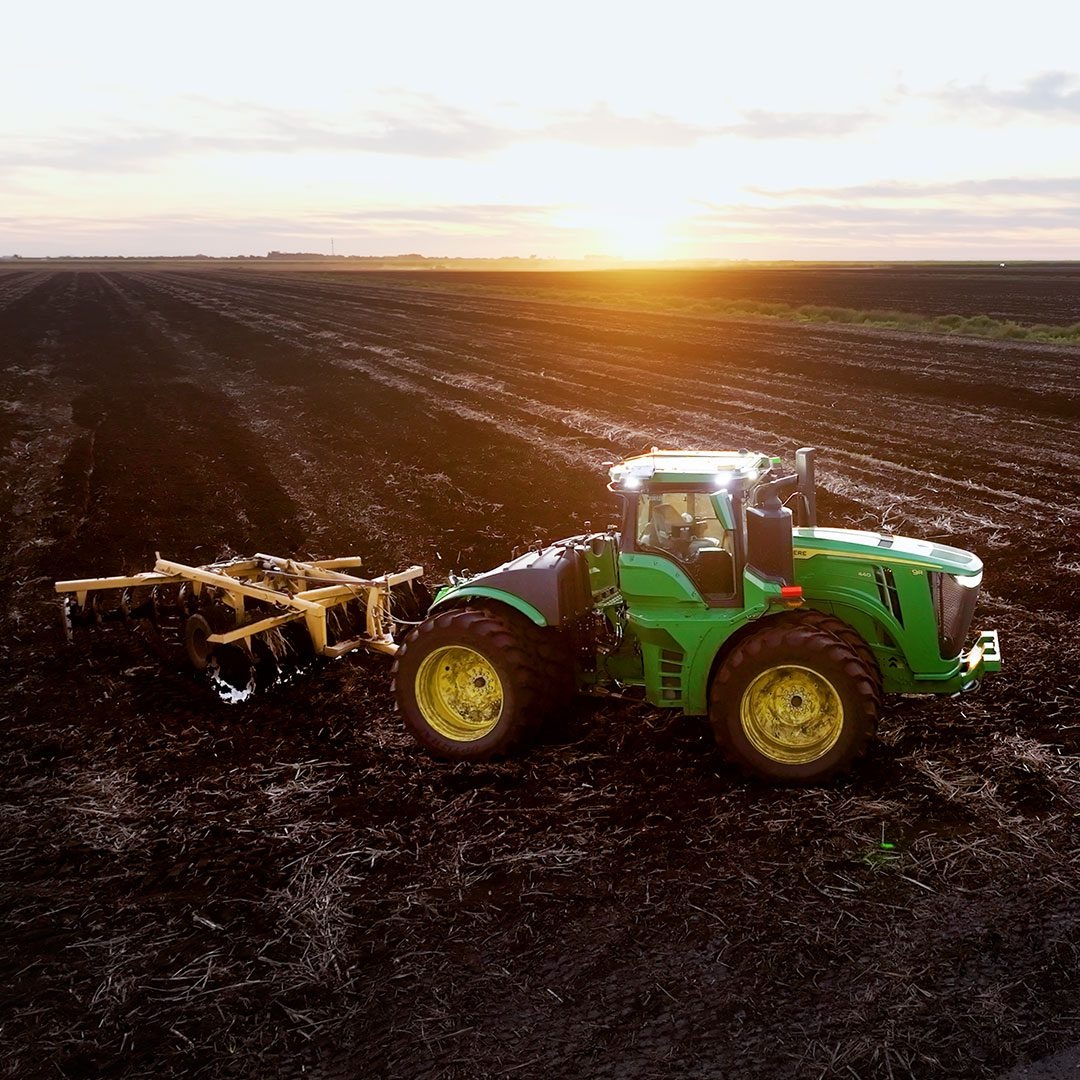
Everglades Equipment Group supplied the John Deere equipment and joined the deployment partnership. ASI integrated its system with the tractors’ existing drive-by-wire controls. U.S. Sugar also said it was working to retain every current employee through retraining as the autonomous fleet grew. That commitment puts a human question beside the engineering question. Someone still has to manage the work, understand exceptions and keep the operation running.
02 / A robot with a customer problem
ASI began in 2000, when engineers took technology from Utah State University into a commercial company. Its first contract was an autonomous orchard tractor for John Deere. Chemical spraying offered a particularly clear reason to get the operator out of the vehicle. By 2006, a Deseret News report described a company that had started in a farm shed with a gravel floor and was serving customers including Deere, the Department of Defense and Lockheed Martin.

Early invention did not guarantee an affordable product. In a 2016 Flyover Labs interview, Torrie recalled precision RTK positioning costing about $50,000 before falling to roughly $5,000. Those were historical component examples. They help explain why an autonomous system could make technical sense well before its economics became inviting.
His favorite early robot, Chaos, supplied another lesson. Customer interest never produced enough traction in a single market to justify the investment needed to bring its cost down. An ingenious machine still needed a sufficiently concentrated business. Torrie also described an early model of customer-funded development and per-unit licensing. Buyers helped pay for the engineering; ASI could reuse technology across other markets within the agreements.
03 / The badge on the bonnet is negotiable
ASI’s differentiator is its OEM-agnostic approach: it works across equipment manufacturers. The company does not need every vehicle in a yard to wear the same badge. In a 2013 interview excerpt published by ASI, co-founder Paul Lewis explained the logic in a sentence:
“The core of any vehicle is the same.”
Paul Lewis / ASI co-founder, 2013
Steering, braking and acceleration recur. The interfaces vary. Lewis described modular hardware that could adapt to different machines while keeping a common core. He and fellow founder Mitch Torrie also discussed simplifying Mobius for operators as its audience widened beyond technically adept early adopters. Getting the machinery to accept instructions was only half the job; making those instructions manageable mattered too.
Conceptual illustration of ASI’s architecture, not a specific deployed fleet.
The construction architecture makes the division concrete. An onboard vehicle control unit manages machine functions and reports status. Sensors feed obstacle information to that unit, which can react locally and report it to Mobius. The fleet platform receives dispatch information and coordinates equipment through a network such as wireless mesh or LTE. Depending on the application, positioning draws on GPS, cameras, beacons or other inputs. Compatibility is an integration task, even when the platform spans brands.
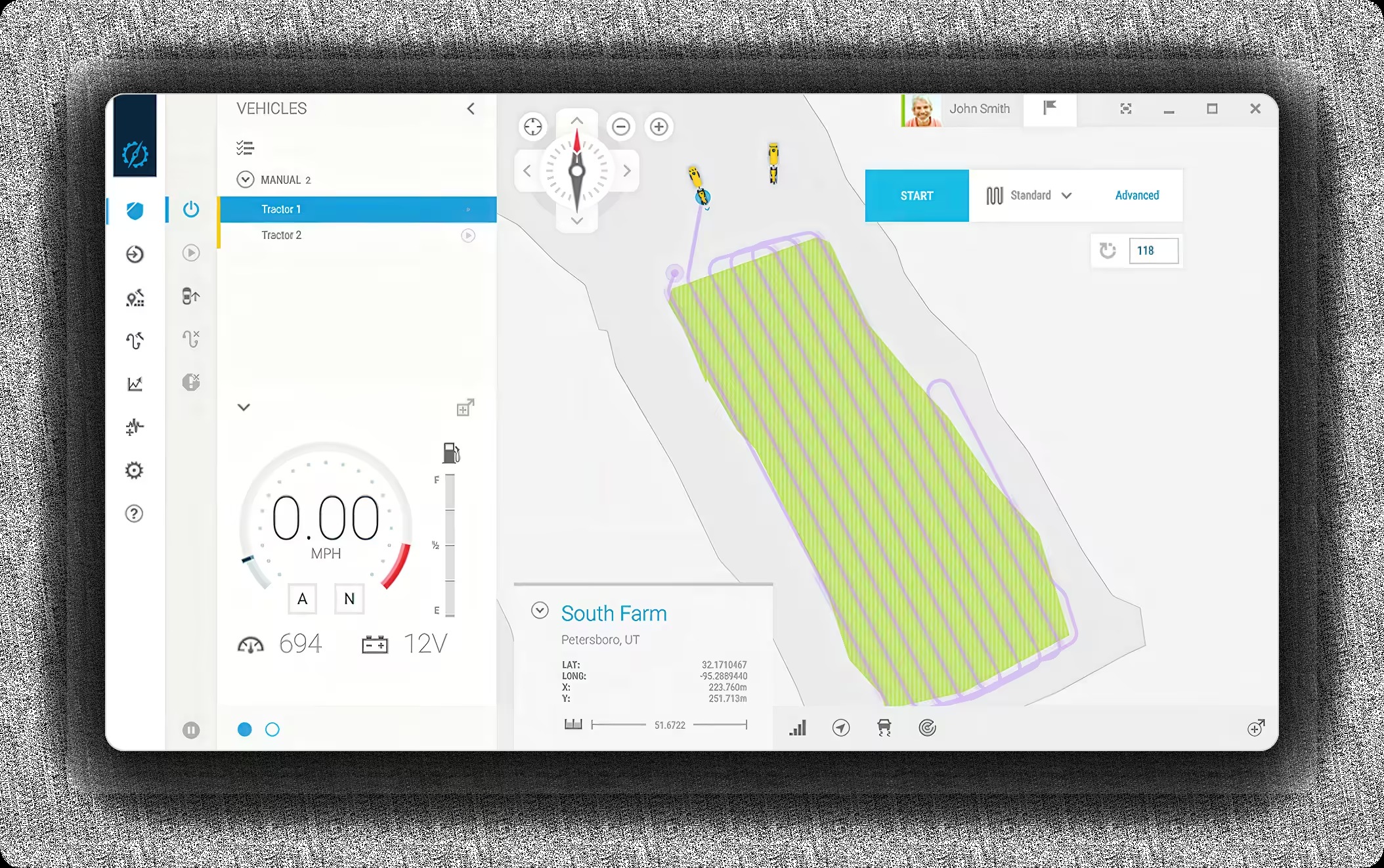
Mobius is licensed software with modular feature upgrades, including mapping and path building. Hardware integration and support surround it. This places ASI between the equipment owner and the machine maker. Alternatives include manufacturer systems such as Cat Command, which offers different levels of remote and autonomous capability, and specialists such as Built Robotics, focused on construction tasks including solar piling. The right comparison depends on the job and fleet; a brochure-wide winner would be a rather expensive fiction.
Logistics adds another variation. ASI’s yard offering combines vehicle automation with trailer visibility, defined zones and arrival or exit notifications. The problem includes knowing which trailer belongs where and how the work should flow. Driving autonomously cannot rescue a yard whose instructions are confused.
04 / The company that sold a success
Mining supplied ASI with experience in large, mixed-brand fleets. At Roy Hill in Western Australia, ASI Mining and Epiroc pursued autonomous haulage through phased validation before fleet expansion. A 2023 expansion announcement described round-the-clock operation in a dedicated autonomous operating zone since July 2021 and a two-year validation period. The sequence matters: operating evidence preceded a bigger order.
Then ASI sold the business. Epiroc completed its acquisition of the remaining 66% of ASI Mining on July 3, 2024. The buyer already held 34%. ASI Mining is therefore part of the parent company’s history, rather than a current subsidiary to tuck casually into its product list.
Epiroc completes ownership of ASI Mining.
ASI announces its exit from automotive proving-ground work.
SoftBank investment and joint venture announced.
In October 2024, ASI announced it would wind down automotive proving-ground automation and move that team into agriculture, construction, landscaping and logistics. Its simulation, test automation and tool-building skills would travel with it. Torrie described the decision as difficult and linked the expansion opportunity to capital from the mining sale. This was a choice about where to spend people and money, after years serving automotive manufacturers including Ford and Toyota.
05 / A mower joins the earthmovers
In March 2026, ASI acquired Scythe Robotics. Scythe brought its all-electric M.52 commercial mower, the Scythe Sight computer vision system and a team in Longmont, Colorado. The acquisition announcement reported nearly two billion square feet mowed in 2025 for dozens of customers across 30 states. Scythe would continue as an equipment brand inside ASI Landscaping.
The acquisition also brought experience supporting commercial customers. ASI’s announcement singled out Scythe’s account management and deployment experience, alongside its AI. For an industrial buyer, the person who answers when a machine needs help can matter as much as the algorithm inside it.
SoftBank’s investment in ASI.
A construction joint venture was capitalized separately.
September’s SoftBank announcement adds financial weight to the construction push. It describes both a joint venture for autonomous construction equipment on large infrastructure projects and a separate $225 million investment in ASI. The venture’s capitalization was not quantified. Its intended applications include civil construction and material handling, with mixed fleets across equipment brands. Capital buys room to commercialize the proposition; customers will judge it at the jobsite.
06 / What a fleet manager can borrow
The practical lesson from these cases is to choose a repeatable workflow, establish its performance requirements and earn expansion through operation. U.S. Sugar tested field preparation. Roy Hill used a dedicated zone. ASI’s own architecture keeps central coordination alongside onboard control. For a buyer, those examples suggest a sequence: define the job, scope the machines and site, validate the system, then expand.
The economics need the same patience. Retrofit work, communications, maintenance, supervision and training belong in the calculation alongside vehicle utilization. As an inference from ASI’s disclosed design, unreliable positioning or connectivity, poorly managed interaction with people, and machinery that is difficult to interface with can obstruct deployment. A machine used only occasionally may offer too little work to recover integration costs.
ASI calls itself the “People-Building Robot Company” and emphasizes safety, simplicity and growth. It reports consecutive Great Place to Work certifications in 2025 and 2026. Those are cultural signals. The operational test is more concrete: can customers change how people work while keeping the fleet productive? The five tractors in Florida offer a useful place to watch. A small launch, a long trial and a customer willing to expand make a more persuasive introduction than a robot taking its bow.