The first autonomous machine Nalin Gupta helped put into everyday service moved at campus speed. It ferried students around Santa Clara University, a compact electric shuttle navigating the mild chaos of foot traffic, crossings, and California sunlight. It was not pretending to be a robotaxi. It had a bounded world, a useful job, and people waiting to get somewhere.
A decade later, Gupta is working on another machine that must understand its surroundings and decide what to do next. This one answers the phone.
Cignara, the San Francisco company he founded in 2025, builds AI voice and chat agents for large consumer businesses. The software is designed to read customer context, apply company rules, execute a task, verify the result, and record the outcome. The route might run from a billing complaint to a refund rather than from the library to the engineering building. Yet the engineering problem has a familiar silhouette: autonomy is only useful when it knows where it may go.
S15 and P26
A robot leaves the lab
Gupta’s route into entrepreneurship began at IIT Kharagpur, where he earned B.Tech and M.Tech degrees in electronics engineering with a specialization in computer vision. He co-founded and led an autonomous-ground-vehicle research team. The group won a best engineering award from India’s Defence Research and Development Organisation for a vehicle intended for low-intensity-conflict environments. He also worked on classifying brain states from fMRI signals and completed an internship in brain-computer interfaces at the University of Tübingen.
The resume sounds like someone let a science-fiction shelf choose the electives. Gupta’s own list of interests runs from artificial muscles and quantum computing to fusion, brain-inspired chips, and interplanetary travel. He describes himself more simply: “I love startups & deep tech.”
His first startup attempt with college friends was a payment system built around India’s newly launched Aadhaar identity infrastructure. It did not take off. A co-founder later recalled the useful residue of that failure: startups contain enough low moments that the founders should choose a field they will keep working on when enthusiasm becomes unreliable.
They chose robots. Gupta, Srinivas Reddy Aellala, and Jit Ray Chowdhury started Auro Robotics around the autonomous-vehicle work they had pursued at IIT. The company focused on shuttles for contained places such as universities, resorts, retirement communities, and business parks. This was an unglamorous bit of strategic taste. In 2013 and 2014, the grand autonomous-car race was aimed at public roads. Auro selected a smaller map where the technology could become a service sooner.
A one-way ticket, then a daily route
By Gupta’s account, Auro reached the limits of its growth opportunities in India. In 2015 he took a one-way flight to the United States on a tourist visa and arrived in Silicon Valley. Auro entered Y Combinator’s Summer 2015 batch, raised venture funding, and began piloting in the world beyond the pitch deck.
At Santa Clara University, an Auro shuttle carried real students as a regular service. The distinction matters. A demonstration gets applause; a route gets weather, late passengers, maintenance, and the obligation to work again tomorrow. One former Auro engineer remembers the team building in a small Mountain View garage and pulling all-nighters before a Stanford demonstration. The glamour of autonomous vehicles, up close, looked a good deal like debugging.
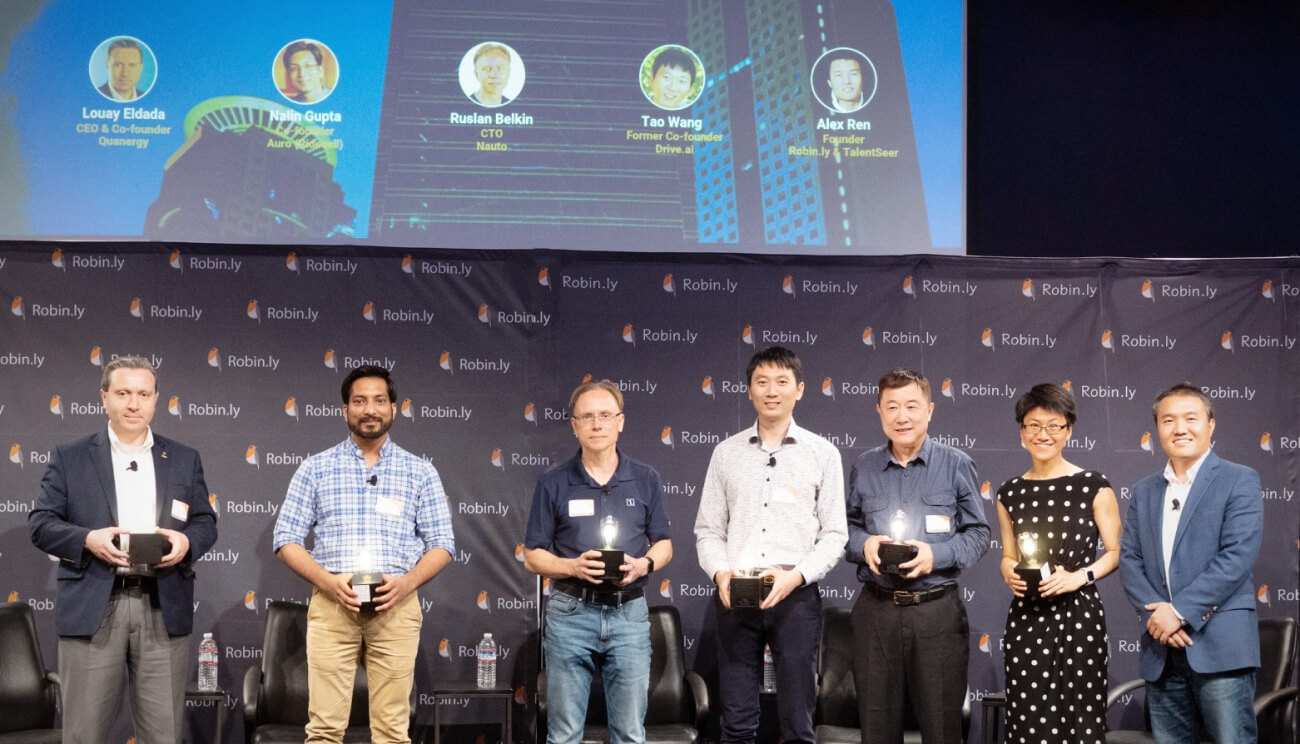
The deployment placed Auro among the early commercial autonomous-shuttle efforts in the United States. Forbes named Gupta and Reddy to its 2017 30 Under 30 Asia list in Industry, Manufacturing & Energy. In October that year, mobility-platform company Ridecell acquired Auro in an all-stock transaction.
Gupta did not treat the acquisition as a ceremonial finish line. He stayed at Ridecell, led its autonomous-driving division, and worked on expanding the product from campus golf carts toward public-road applications. He later created Nemo, a search engine for large stores of video and laser data. A user could look for a particular traffic scenario rather than inspect miles of footage by hand. Once again, context was the product.
The autonomy moves indoors
After leaving Ridecell in 2022, Gupta’s public project list became a cabinet of prototypes. Wingman was a computer-using assistant that combined natural-language instructions with computer vision. Blink proposed letting readers pay for individual articles behind publisher paywalls. He explored tokenized stocks and a decentralized stablecoin concept for Polygon. The ideas wandered across industries, but nearly all asked software to do something, not merely display something.
Cignara makes that habit commercial. The company joined Y Combinator’s Spring 2026 batch, making Gupta a YC founder for the second time, eleven years after Auro. Cignara says its agents work across voice and chat and can also assist human representatives in real time. Its product map includes conversation intelligence, policy checks, customer-profile data, business workflows, and approved actions such as booking, updating, paying, canceling, or refunding.
The familiar AI demo begins with fluent speech. Gupta’s proposition begins one layer down, with permission. Can the agent follow the membership rule? Can it recognize that a refund is allowed for this customer but not that one? Can it cite the policy, finish the workflow, and leave an audit trail? In enterprise support, charm without procedure is merely a very confident new hire on their first afternoon.
Cignara frames a support exchange as a business event. “A complaint is a retention moment, an inquiry is a sales moment, and a support call is often an upsell moment,” Gupta wrote when introducing the product. That is an operator’s sentence disguised as marketing. It converts the call center from a queue to be shortened into a set of decisions with consequences.
The company says LG uses its technology, and its website quotes an LG executive describing faster issue resolution. Its YC profile presents the ambition in larger terms: automate the revenue cycle across customer service and sales for Fortune 500-scale companies. The mechanics remain deliberately specific. Pull context. Apply logic. Take action. Verify. Respond. Document. Repeat.
The second lap
There is an appealing symmetry in Gupta returning to Y Combinator with another autonomy company. It would be too tidy, however, to call Cignara Auro without wheels. Customer conversations are not roads, company policies are not lane markings, and an irritated caller is wonderfully unlike a traffic cone.
What carries over is a disposition toward the messy last mile. Gupta has moved between research and operations, founder and acquired executive, hardware and software. His career includes patents for compact payment devices, an fMRI paper, daily shuttle service, partnerships, product strategy, and now enterprise AI. This is not a straight line. It is a collection of attempts to turn perception into controlled action.
His small archive of 2023 essays offers another view of that pattern. One article asks why robotics has advanced so dramatically in locomotion while dexterous hands remain difficult. Another proposes a richer successor to the PDF. A third imagines knowledge graphs that could represent skills more honestly than a conventional resume. They are not announcements from a settled specialist. They read like notes from someone who keeps walking around technology and tapping the walls, listening for hollow spaces.
The books he displayed on his desk make the taste plainer. Alongside technical preoccupations sat The Idea Factory, Jon Gertner’s history of Bell Labs, an institution remembered not for a single trick but for turning patient inquiry into a procession of useful inventions. Gupta’s public work has a similar appetite, if on a founder’s smaller and faster clock. The domain changes whenever a new interface between research and ordinary life looks ready to be crossed.
On his personal site, Gupta writes that he is often tinkering with product ideas or digging into research, “determined to make sci-fi a reality.” The line could invite rockets and chrome. His actual work suggests a more practical definition of science fiction: the machine understands enough of the situation to finish the job, stays inside the rules, and is ready to do it again tomorrow.
The shuttle had to arrive. The support agent has to resolve the call. Between those two obligations sits a founder’s durable interest in autonomy, and his equally durable suspicion that intelligence alone is not enough.
Follow the work
- Cignara - enterprise AI agents for voice and chat
- Nalin Gupta’s portfolio - career, projects, research, and writing
- LinkedIn and X
- Cignara at Y Combinator
- Watch Cignara’s product video
- Auro Robotics at Y Combinator