A warehouse is a hostile place for a charming answer. A truck is late, three workers have called out, aisle seven is blocked, a customer has a contractual cutoff, and an order-management system insists that a pallet exists in two places at once. The software may speak in paragraphs. The floor speaks in consequences.
Jibran Hutchins has built his young company around that difference. He is the co-founder and CEO of Haladir, a San Francisco startup that describes itself as a decision layer for logistics. Its job begins where the polished AI demo usually ends: among conflicting databases, unofficial workarounds, hard capacity limits, and expensive promises.
The wager is that language models should not be asked to carry the whole decision. They are good at reading the mess and translating it into a formal problem. Optimization software, the mathematical machinery that has spent decades learning how to route, schedule, and allocate, can then search for an answer inside the rules. One tool handles ambiguity. The other handles obedience.
The useful AI decision is the one that fits through every constraint.
01 / A short runwayFrom Fairfax to the constraint business
The public timeline is compressed enough to make a calendar look startled. Hutchins graduated from W.T. Woodson High School in Fairfax, Virginia, in 2025. He had competed in cross-country and track, and he later appeared on Carnegie Mellon University's cross-country roster. He was accepted to Carnegie Mellon's Tepper School of Business and began undergraduate study there that fall.
Software was already in the frame. His Devpost portfolio lists Gradient, an all-in-one grading platform for teachers, alongside skills in Python, JavaScript, React, and Java. At HackCMU in 2025, he joined Siddharth Radhakrishnan, Agneya Tharun, and Pius Lee on null_pointer, a track-winning project that used a phone's gyroscope as a game controller. It is a small but revealing artifact: take an ordinary device, notice the sensors hiding inside it, and give those signals a more useful job.
Before college, his public résumé also included internships in IT, financial advising, and private equity analysis. Those stops do not form the usual apprenticeship for an operations-research founder. They do suggest a recurring interest in the seam between systems and decisions: the machinery underneath a business, the numbers above it, and the people asked to make sense of both.
Haladir brought together Hutchins with Quan Huynh, Preston Schmittou, and Joseph Tso. The group left programs at Carnegie Mellon, Princeton, and the University of Virginia system to work full-time. Their early pitch centered on formal verification, reinforcement-learning environments, and making model outputs checkable. By its public Y Combinator launch in 2026, the company had sharpened the application around operationally complex industries, especially logistics.
The shift matters. Formal methods can sound like a seminar held behind a locked door. A late shipment is legible to everyone. Haladir's product, called Nomos, sits above warehouse, transport, and order-management systems. It attempts to reconcile their competing identifiers, timestamps, and event semantics into an operational graph. Only after the company can represent what is actually happening does it try to improve what happens next.
02 / Division of laborLet the model read. Let the solver decide.
Hutchins and his team make a deliberately unromantic argument about large language models: they are fast producers of educated guesses. In a chat window, an imperfect guess may cost a minute. In a distribution center, it can ripple through labor plans, pick paths, loading bays, inventory allocation, and delivery windows.
The company therefore assigns the language model a narrower, stranger job. It helps turn the operation's language into precise constraints and proposes the variables inside them. A deterministic solver does the searching. The pairing resembles a bilingual mediator working beside a stern accountant: one understands what everybody means, while the other refuses to let the numbers wander.
This is where operations research stops being an academic ornament. A warehouse manager rarely has one clean objective. The manager is balancing service levels, labor cost, equipment wear, peak preparedness, and contractual obligations. Optimize a single number too aggressively and the mathematically correct answer becomes operationally absurd. The harder task is choosing which tradeoffs the system should honor and how those preferences change throughout the day.
Haladir's view of process is equally skeptical of tidy diagrams. The official workflow may say one thing while operators have learned a dozen necessary detours. Bottlenecks acquire nicknames before they acquire documentation. A useful model has to recover the real control flow from event data and human practice, then compare it with the version framed on the conference-room wall.
03 / The benchmarkWhen feasible beats fluent
The research version of the argument arrived in February 2026. Hutchins, Tso, Schmittou, and Huynh released ConstraintBench, a benchmark designed to test whether language models can directly solve constrained optimization problems without access to a solver. It contains 200 tasks across ten operations-research domains, each with a natural-language scenario, a set of rules, and an objective. A deterministic verifier checks the proposed solution against every constraint and against a solver-proven optimum.
The finding is almost comic in its precision. Once a model manages to obey every rule, it is often reasonably close to the best answer. The trouble is getting through the door without breaking a rule. Feasibility, not optimality, was the primary bottleneck in the benchmark.
That result gives Haladir's architecture a research-shaped spine. If the model struggles to keep every constraint in view, the product should not simply flatter it with a larger prompt. Give the language model the work it does well, then pass the decision to machinery built to respect a bounded search space. The benchmark does not prove Haladir's product will work in every warehouse. It does make the alternative, trusting an unconstrained answer because it sounds composed, look rather careless.
04 / Capital and customersThe money meets the warehouse
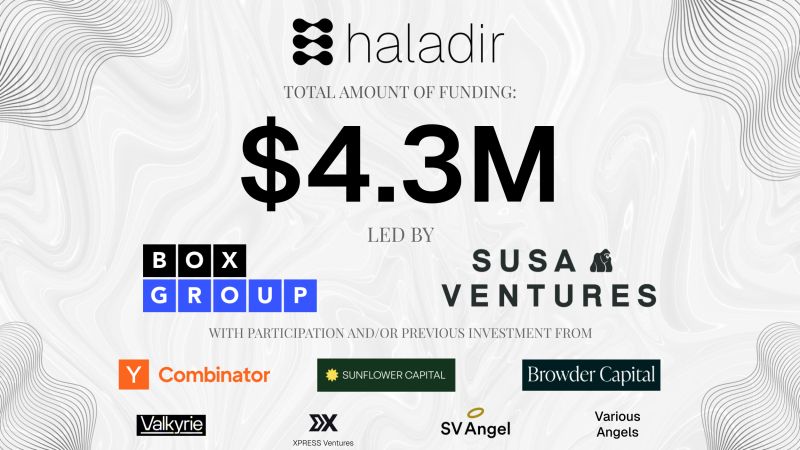
In April 2026, Haladir announced that it had raised $4.3 million in total. BoxGroup and Susa Ventures led the seed round, with Sunflower Capital, Valkyrie Ventures, XPRESS Ventures, and angel investors participating. Earlier backers included Y Combinator, SV Angel, and Joshua Browder.
Funding announcements are a peculiar genre: a number, a collage of logos, and a promise that the difficult part is about to begin. Haladir's stated use for the money is concrete enough. It is working with third-party logistics companies, distributors, and AI labs. The initial operational targets include demand forecasting, pick-path optimization, ETA prediction, inventory allocation, routing, wave release, and labor planning.
The company has also described a collaboration with FIEGE, the European logistics operator, to scope pilot uses for Nomos. In July, Haladir sponsored the INFORMS Transportation Science and Logistics Conference at MIT. Those moves place the team near the people who spend their days on the relevant equations and the operators who discover exactly where those equations meet a loading dock.
Hutchins's public posts tend toward short declarations. He celebrated the Y Combinator launch with “We're just getting started.” After the first round, he wrote that there was “still much to be done.” One especially concise update announced that the Haladir logo had finally gone up. The restraint is useful. A company selling better decisions should save its adjectives for situations in which they improve the objective function.
A company selling judgment has to earn it in the untidy gap between the model and the floor.
05 / The next decisionA founder growing at production speed
It is early in Hutchins's career, and early in Haladir's. The documented arc stretches from a 2025 graduation to a 2026 research paper, accelerator batch, funding round, and logistics pilot work. That speed is part of the story, but it is not the most useful part. The more durable idea is a discipline: know which component of a system is allowed to improvise, and know which one must prove its work.
Distance running offers an easy metaphor, perhaps too easy. The course is fixed, the clock is indifferent, and progress comes from many small corrections made before discomfort becomes catastrophe. Building operational software is less scenic. Yet both activities punish the confident start that ignores the terrain.
Hutchins has chosen terrain with almost theatrical resistance to simplification. Logistics is a world of legacy systems, narrow margins, physical bottlenecks, and customers who notice when the box is late. If Haladir can make AI useful there, it will not be because a model learned to speak more grandly. It will be because the system learned when speaking should end and accounting for reality should begin.