Arushi Gandhi's public record begins with a pleasingly unfashionable detail: she started coding in ninth grade. Before the fellowships, the customer calls and the inevitable migration to San Francisco, there was a schoolgirl at The Shri Ram School, Moulsari, learning how to tell a computer precisely what she wanted. Computers reward precision. Startups, she would discover, enjoy answering precise plans with new and more elaborate questions.
At Manipal Institute of Technology, where Gandhi studied information technology from 2020 to 2024, she turned building into a high-frequency habit. Her own tally is more than 15 hackathons across four years, with wins in roughly a third. She also debated competitively, earning breaks and podium finishes at tournaments across India. The two circuits make an oddly coherent apprenticeship: make something before the clock expires, then persuade a skeptical room that it deserves to exist.
The projects ranged widely. Indusby connected people who could reuse industrial by-products. Swayam helped self-help groups sell online. Analysa made automobile data easier to explore. Other work touched water quality, education and investing. Gandhi was not polishing one grand invention. She was collecting repetitions - user, problem, prototype, pitch - and learning that software is most interesting where it meets an organization.
The startup before the startup
Internships filled the spaces between competitions. Gandhi worked in frontend development at Fiedra, web development at Incepthink, the founder's office at BugBase and full-stack development at FreeStand. At BugBase she operated across product, research and community while the young cybersecurity company built an enterprise platform. In 2023, she interned as a software engineer on Microsoft Teams, working on backend filtering capabilities in a PowerShell module. The résumé began to look less like a ladder than a well-stocked toolbox.
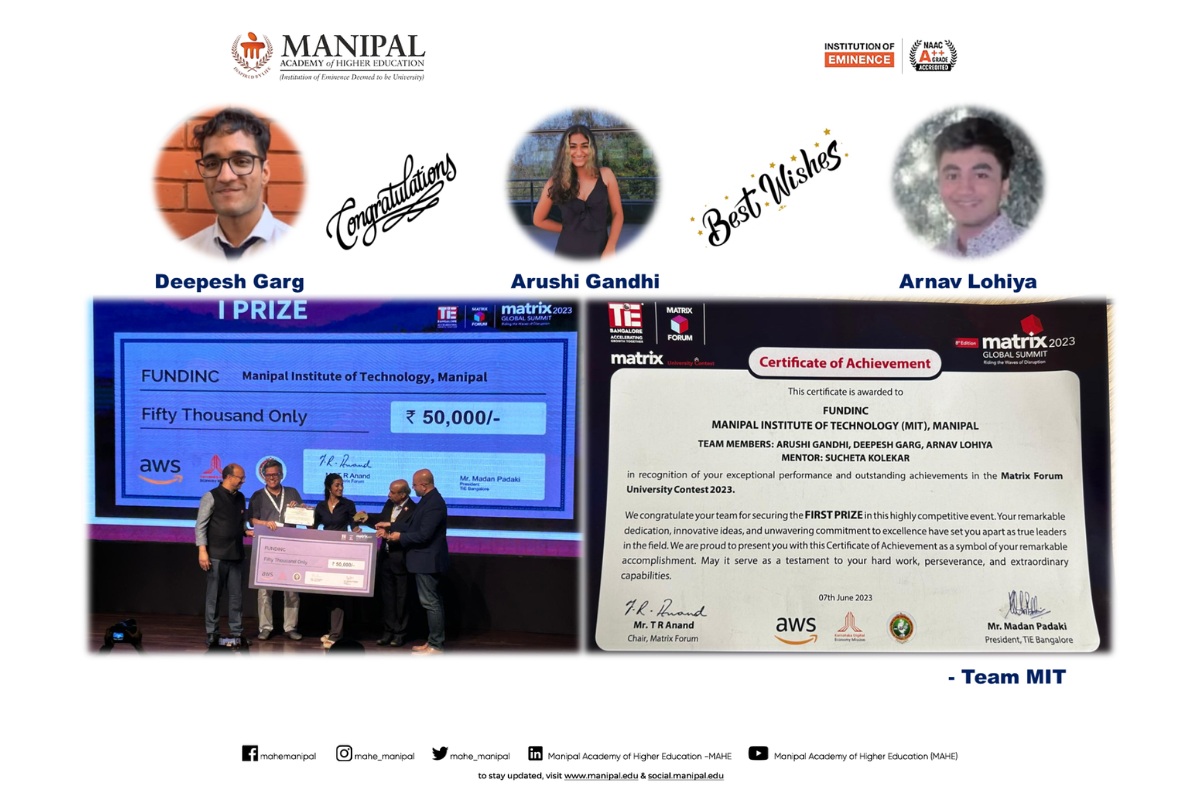
Fundinc was the first serious test of putting the tools together. Started while she was still in college, it was workflow software for venture firms and investment teams. Gandhi's résumé says the product reached $10,000 in monthly recurring revenue within two quarters. More visible was the tournament trail: Fundinc won startup competitions including TiE Bangalore's Matrix University Contest in 2023, where Gandhi and teammates Deepesh Garg and Arnav Lohiya received a ₹50,000 prize and lifetime TiE memberships.
Fundinc matters because it placed Gandhi inside the species of software that would keep occupying her: systems that businesses depend on but few employees love. Venture teams had deal flow, stages, handoffs and records. Later, Salesforce teams would have custom objects, automations, permissions and years of accumulated decisions. The glamour is limited. The consequences are not.
After graduating, Gandhi explored Antler as an entrepreneur in residence and joined Entrepreneur First in Bangalore. There she met Abhishek Eswaran, an IIT Bombay alumnus who became her co-founder. In a public announcement, she said she had joined the program to build a company that would shape the next decade of her life. The pair began Ressl AI in 2025, won backing from Entrepreneur First and Transpose Platform, and planned a move to San Francisco to get closer to customers.
Becoming “the Salesforce girl”
Ressl's opening thesis was that better coding models could productize a slice of IT services. Salesforce was the first field of attack. Its customizations mattered to front-office teams, it had mid-market customers willing to act as design partners, and its APIs made it accessible. After several months as a services firm, Ressl launched a product that could understand an organization's Salesforce setup, investigate support issues and help create configurations.
At its peak, Gandhi wrote, the platform handled about 400 tickets a week. The positioning stuck so effectively that she became “the Salesforce girl,” a title she recounts with comic dismay. Being legible is useful in a crowded market. Being reducible can become a trap.
“I was known as the Salesforce girl, to my dismay.”Arushi Gandhi, on Ressl's first product identity
Then the ground moved. Claude Opus 4.5 arrived, and an important customer churned. The customer had been growing quickly, the relationship was good and Ressl's product worked. But as general-purpose coding agents improved, the distance between a specialist product costing at least $1,000 a month and a broad coding tool costing a fraction of that began to close.
Gandhi's response is the part worth keeping. She did not turn the loss into a fable about grit. She published a detailed inventory of what had gone wrong. The long-term value after implementation could diminish. Buyers mentally capped maintenance spending. Cross-platform expansion did not magically create one buyer with authority over every system. A product could scale delivery while its go-to-market motion still resembled a services firm. And the platform owner itself could package improving coding tools.
“Product solves for scale, not GTM,” she wrote. It is a tidy sentence for an untidy lesson. Software can make the work faster without making the sale simpler.
A benchmark with consequences
Ressl's next shape grew from the operational scar tissue. The company entered Y Combinator's Winter 2026 batch and now describes itself as infrastructure to train, benchmark and deploy autonomous agents that work in real business systems. The emphasis has shifted from one agent for one platform to the environments needed to tell whether many kinds of agents can do dependable work.
That distinction sounds technical until one imagines the office. A customer-support agent must do more than draft a gracious reply. It may need to check an order, apply policy, update a record, preserve an audit trail and avoid promising something the company cannot deliver. A Salesforce agent must understand custom metadata, dependencies and dirty data, then leave the system in a correct state. Fluent prose is only the wrapping paper.
What makes an agent evaluation useful?
Ressl's public research makes the idea concrete. SalesforceBench places agents inside a simulated Salesforce organization. Another evaluation tests Sarvam models on multilingual Indian ecommerce support tasks, including tool use, backend state and policy constraints. A later essay argues that teams need high-fidelity clones of their own software for evaluations, because a superficial replica cannot reproduce the mechanics that make enterprise work difficult.
The strategic turn also preserves something from Ressl's services period: proximity to real workflows. Benchmarks designed in the abstract risk rewarding the wrong behavior. Environments derived from actual work can ask more embarrassing questions. Did the agent update the right account? Did it break a dependency? Can another operator understand what changed? Was the action permitted? Reliability is less cinematic than intelligence, but procurement departments have always preferred evidence to cinema.
The pink-theme realist
Gandhi's writing voice helps explain how she arrived here. It is blunt, specific and allergic to retrospective perfection. She admits when a positioning did not support a large outcome. She describes sitting at Dreamforce while Salesforce announced a competing direction. She jokes about being tagged whenever anyone mentioned Salesforce. Her essay titles borrow from Hindi cinema and Regency gossip. Her GitHub bio declares that she will not stop until she finds the perfect pink VS Code theme.
The humor does not soften the analysis so much as keep it breathable. Enterprise software supplies enough acronyms to suffocate a small ballroom. Gandhi prefers live observations: vendors should make each unit of AI work more efficient; companies will point scarce tokens toward their core business; specialized AI products need an advantage that survives the next model release.
Her connections have also accumulated through doing. Early startup teams gave her generalist range. Microsoft gave her a view of software at scale. Entrepreneur First introduced Eswaran. Y Combinator supplied what she called a talent-dense room and a window to rethink the company. Customers supplied the less comfortable education: where the product failed, what buyers would pay for and when a once-defensible feature became ordinary.
Ressl's aspiration is now both broader and more disciplined. Autonomous agents may eventually absorb a great deal of routine business labor. For that to happen, companies will need to know which agents can be trusted inside the peculiar software they actually use. Training environments, realistic replicas and verifiable outcomes are the unglamorous infrastructure beneath that promise.
Gandhi's path has moved from school code to college demos, from a venture workflow product to Salesforce operations, and from a specialized agent to the proving grounds around agents. Each stage makes the next question less abstract. Can it be built? Will anyone buy it? Does it keep working as the models improve? Can we prove the work was done correctly?
The office remains messy. That is precisely why it is useful.