
Most ecommerce teams do not need a customer data platform. They need to know that the person who bought running shoes is the same person who clicked yesterday’s email, asked a sizing question and is likely to order again next month. For years, the accepted answer was to install a CDP between the storefront and every tool that might touch that customer. The CDP would collect events, reconcile identities, build audiences and ship the result elsewhere.
That answer made sense when marketing platforms were mostly destinations. It is less obvious now. Klaviyo’s current platform puts a data layer underneath marketing, service, analytics and K:AI. It promises a real-time profile for each customer, fed by more than 350 integrations, then uses that profile for segmentation, messages, recommendations and service. The data no longer has to travel as far before someone acts on it.
This changes the burden of proof. An ecommerce brand already using Klaviyo should not ask whether Twilio Segment is a more expansive CDP. It is. The useful question is whether that extra surface area solves a problem the brand can name, staff and measure.
Klaviyo has eaten the basic CDP checklist
Start with what is already in the account. Klaviyo says the standard version of its Data Platform includes flexible ingestion, unified profiles, predictive analytics, real-time segmentation, integrations and native multichannel activation for Marketing and Service customers. Its Advanced KDP product adds tools such as no-code transformations, data exports, monitoring, hosted functions, webhooks, RFM analysis, recommendations, funnels and cohort analysis.
For a store whose customer journey is mostly Shopify or another commerce platform, a loyalty app, support, reviews, email, SMS and paid audiences, that is not a thin feature set. It covers the loop that matters: observe behavior, update a profile, build a segment, send or suppress a message and read the result.
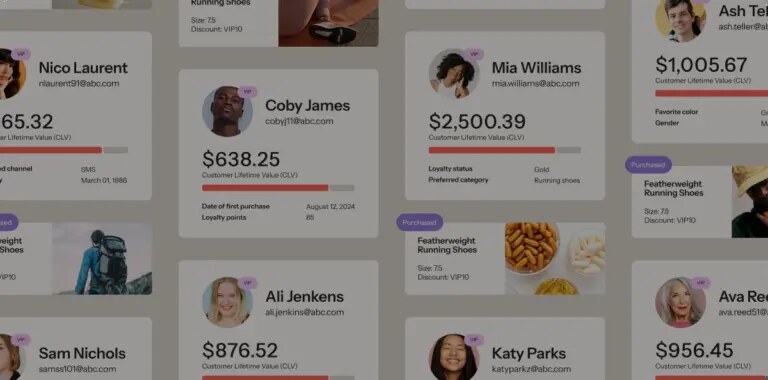
The predictive layer is particularly important. Klaviyo documents profile-level properties including predicted customer lifetime value, churn risk, expected next order date and average time between purchases. Those are familiar CDP promises, but they sit beside the campaign builder. A retention marketer can create a high-value, high-churn segment and place it in a flow without waiting for another system to calculate, sync and refresh the audience.
There are eligibility and data-quality limits to any prediction, and a score is not a strategy. Yet proximity has value. A moderately useful prediction that reaches a customer at the right moment may beat a sophisticated model waiting in a warehouse queue.
A second data layer should remove a known constraint. “More complete” is not a business case.
Where Segment earns the second contract
Segment begins from a different place. Its original job was to collect an event once and send it to many systems. The product has grown into identity resolution, audiences, journeys, warehouse activation, privacy controls and AI, but the neutral pipe remains its strategic advantage. Twilio’s documentation describes the workflow plainly: capture data from any source, enforce schema quality, unify identity and deliver it to hundreds of tools.
Klaviyo-first
- Commerce is the main source of truth
- Email, SMS and service drive activation
- Marketers own most audience work
- Fast execution matters more than neutrality
Segment earns a role
- Web, app, offline and product events must agree
- Many vendors need the same governed stream
- A warehouse anchors the customer model
- Engineering owns schemas and identity rules
Imagine a retailer becoming a subscription service with a mobile app, connected hardware and physical stores. Product managers need behavioral analytics. Data scientists need clean events in the warehouse. Support needs device history. Finance needs subscription state. Marketing still needs Klaviyo. Sending every team through a marketing-centered profile can turn convenience into constraint. Segment can sit upstream, establish a common event contract and distribute the right version of the data to each destination, including Klaviyo.
Governance is another real dividing line. Segment Protocols is designed around a shared tracking plan: define approved events and properties, validate incoming data, flag violations and block or transform data that does not conform. That matters when several engineering teams instrument several products. “Added to Cart,” “add_to_cart” and “Cart Add” may look like the same event to a person; to three dashboards, they can be three different realities.
Segment also makes vendor independence easier to defend. A team can replay historical events into a new analytics tool, route the same source to multiple destinations or build custom functions. If Klaviyo is one activation endpoint among many, the neutral layer prevents the messaging vendor from becoming the definition of the customer.
The hidden price is coordination
Software pricing is only the visible line item. A second platform introduces another identity graph, consent path, schema, set of API limits and monitoring surface. Someone must decide whether Klaviyo or Segment owns a trait. Someone must investigate when profile counts disagree. Someone must stop a deletion request from falling between systems. The brand pays with engineering hours and slower decisions before it earns a dollar from better personalization.
This is why a feature comparison can mislead. Segment can do things Klaviyo cannot, and Klaviyo can activate commerce data with less friction. Neither fact decides whether an ecommerce team needs both. Utilization decides. A powerful platform used as an expensive forwarding address is waste. A simple stack stretched beyond its identity and governance limits is also waste.
The safest architecture is reversible. Keep raw events or important history in a warehouse when the business can support it. Use clear event names. Document the handful of traits that drive money or customer experience. Klaviyo can remain the operating layer today without becoming an irreversible bet against Segment tomorrow.
Sometimes the missing product is a meeting
A surprising number of “CDP problems” are ownership problems wearing technical clothes. Marketing calls a customer active because she opened an email. Finance calls her active because she paid within the quarter. Product calls her active because she used the app this week. A new platform can store all three definitions, but it cannot choose among them. If teams have not agreed on the decision a definition will support, centralizing the disagreement only makes it easier to query.
Before procurement, put marketing, engineering, analytics and customer service around one table. Pick a single journey such as replenishment, win-back or first-order conversion. Write down the trigger, the identity required, the acceptable delay, the channel, the suppression rules and the metric. Then trace where the data fails. A missing event might need engineering. A stale trait might need a faster sync. Duplicate profiles might need identity work. An audience nobody trusts might need a definition and an owner.
This exercise also protects the team from buying a platform for a future it has not reached. If the brand has one storefront, one marketing team and a modest set of destinations, operational discipline will usually create more value than an enterprise data layer. If the exercise reveals five sources, conflicting identifiers and several teams waiting on the same governed stream, the case for Segment becomes concrete. Either result is useful because the purchase follows evidence.
The one-use-case test
- Name one decision that is currently late, unreliable or impossible.
- List the exact sources, identities and destinations it requires.
- Test whether Klaviyo can support it at the needed accuracy and latency.
- Price implementation, governance and ownership, not just licenses.
- Add Segment only if the measured gap survives the test.
A buying rule that survives the next rebrand
Vendors will keep moving into one another’s territory. Klaviyo now calls itself an autonomous B2C CRM. Segment sells collection and Connections alongside full CDP plans such as Unify and Engage. The labels are less useful than the direction of the data.
If customer data begins in a commerce platform and its main purpose is to improve messages, service and repeat purchases, keep the loop tight. Let Klaviyo prove where it fails. If the same data must become durable infrastructure for product, analytics, finance, support and multiple brands, a neutral layer starts to look less like duplication and more like plumbing.
The practical recommendation is deliberately unfashionable: wait. Run the one-use-case test. Ask the marketing team what it cannot do, ask engineering what breaks repeatedly and ask finance what the delay costs. A concrete answer may point to Advanced KDP, Segment or a cleaner implementation of what the company already owns. A vague answer points to no purchase at all.
Questions ecommerce teams ask
Does Klaviyo count as a CDP?
Klaviyo includes a built-in data platform with unified profiles, ingestion, segmentation, predictive analytics and activation. Its Advanced KDP tier adds deeper data management and analysis. Whether it replaces a standalone CDP depends on the sources, governance and destinations a brand needs.
Can Segment and Klaviyo work together?
Yes. Segment can operate upstream as the collection and governance layer, then send selected customer events and traits to Klaviyo for campaigns and flows.
What is the clearest reason to buy Segment?
A defensible reason is the need to collect and govern the same event stream across web, apps, servers and offline systems, then deliver it reliably to many independent teams and tools.
What should a small ecommerce brand do first?
Connect the commerce, support and loyalty data it already owns; clean its key events; build useful segments in Klaviyo; and measure whether those segments improve retention. Add infrastructure when a specific limitation appears.
Do predictive scores eliminate the need for analysts?
No. Built-in predictions can speed targeting, but teams still need to validate data, interpret results, design offers and measure incrementality.