At Jump Software, thirty people shared one corporate credit card. That is a small administrative detail with a surprisingly large shadow. Every purchase needed a route to the card. Every unexplained charge needed a route back to its buyer. According to BILL’s customer story, categorizing expenses consumed ten hours a month. Finance worried about overspending. Employees worried about getting reimbursed. The card had become a queue.
- Divvy connects company cards to budgets before employees spend.
- Core software has no subscription or per-user fees; card transactions support the business.
- Acquired in 2021, it became BILL Spend & Expense in 2023.
Jump’s response was to give each spender a card through Divvy, now called BILL Spend & Expense. More cards might sound like an invitation to chaos. Here, they came with something the shared card lacked: individual spending authority inside visible limits. The interesting innovation was the relationship between permission and payment.
Thirty people, one card
Expense reports have an awkward relationship with time. They explain a purchase once the money has left. A manager can object, an accountant can recategorize, and someone can request a missing receipt. None of those actions makes the original decision earlier.
Blake Murray and Alex Bean founded Divvy in 2016. Its platform reached the market in early 2018. The premise was straightforward: connect the card to the budget, then let the transaction carry information into the software. A business could distribute purchasing power without handing everyone an unlimited claim on its bank balance.
Jump’s case study describes receipts and notes being requested shortly after transactions, alongside virtual cards for departmental subscriptions. An employee quoted in the account called the resulting culture trust and accountability
. That phrase explains why the product matters beyond bookkeeping. A clear limit can make permission easier to give.
A budget with a veto
A spreadsheet budget depends on someone remembering to consult it. Divvy puts controls closer to the purchase. Administrators create budgets, assign owners and funds, and set cardholder limits. Employees can request more money. Managers see spending while decisions can still change.
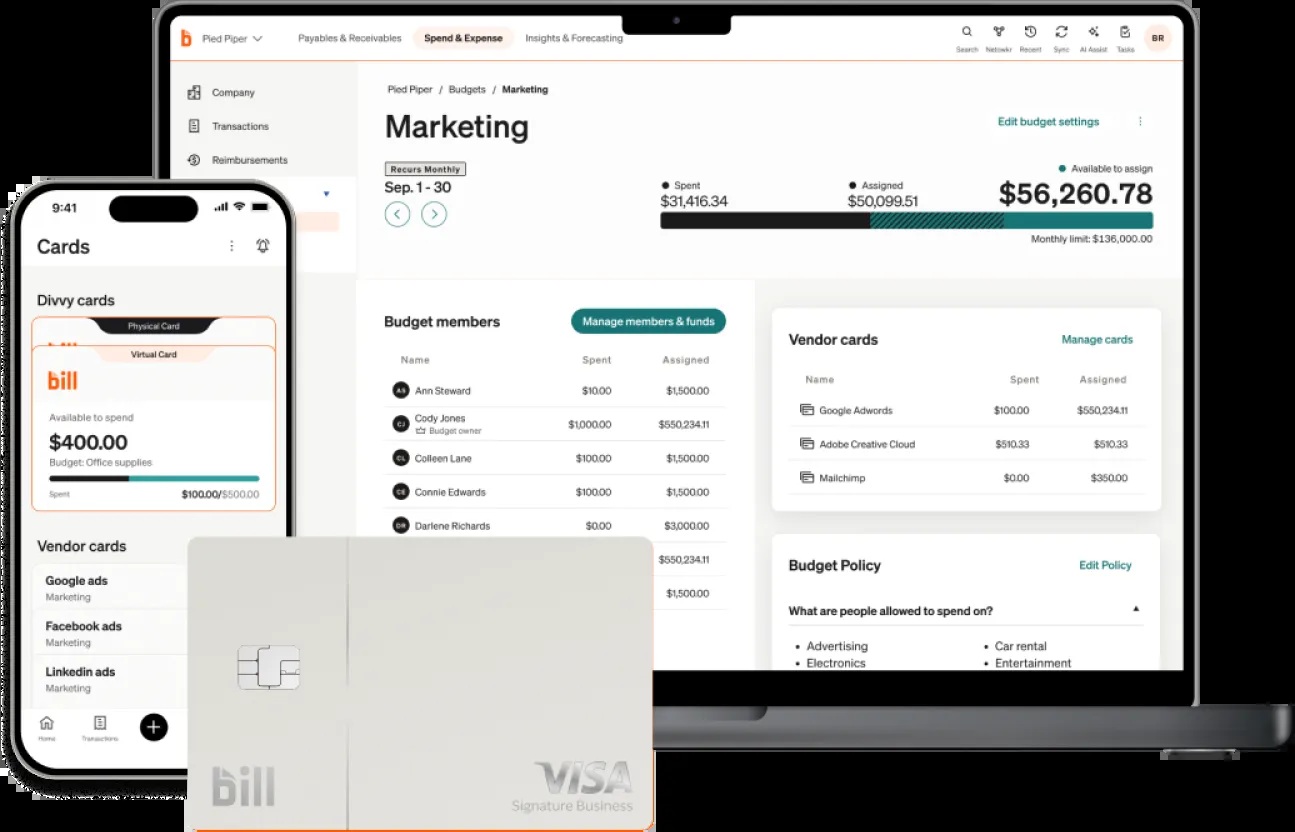
Consider the difference for a department manager. A monthly allowance can be allocated before a team buys anything, with requests for extra funds directed to the person responsible. The finance team can see the purchases without becoming the person who must physically produce a shared card. The workflow separates access from unlimited authority.
Physical cards cover everyday purchases. Virtual cards can separate vendor payments and subscriptions, giving a recurring charge its own identity. The platform also handles reimbursements when employees spend out of pocket. Receipt capture, transaction categorization, and accounting sync reduce the amount of information that has to be reconstructed later.
This is useful to a controller overseeing several departments, a startup tracking subscriptions, or a growing business trying to stop sharing card details. BILL lists Spend & Expense accounting connections including QuickBooks, Oracle NetSuite, Xero, and Sage Intacct. The software sits between the employee’s purchase and the accounting record.
The swipe pays for the software
Divvy made another consequential decision: give away the core expense software. BILL’s published pricing continues to list no subscription or per-user software fees for Spend & Expense. Adding cardholders therefore does not create the usual additional software-seat bill.
The economics run through payments. When a business uses a card, the merchant’s acceptance fee supports several participants in the card system; Divvy receives transaction revenue through that system. In BILL’s fiscal 2023 disclosures, Divvy spend-and-expense transaction fees reached $353.1 million. Free software could produce substantial revenue because the software helped organize spending that passed through the cards.
The expense report explains the past. The card can influence what happens next.
Free software does not mean every financial service is free. Card and payment charges can apply, and BILL’s accounts-payable and accounts-receivable products have separate pricing. The Divvy Card is a charge card: the full balance comes due each billing cycle. Approval and limits depend on underwriting. That matters to a company seeking long-term borrowing rather than a spending workflow.
Why BILL wanted the other half
The financing story moved quickly. Divvy announced a $200 million Series C in April 2019, followed by $165 million at a $1.6 billion valuation in January 2021. In May, BILL announced an acquisition valued at approximately $2.5 billion in stock and cash. It closed on June 1.
The acquisition announcement supplied a practical explanation. Murray said customers wanted a comprehensive payments platform. BILL already handled accounts payable and receivable; Divvy brought employee card spending and budgets. In September 2023, the software became BILL Spend & Expense, joining those workflows under a common platform.
Approximate period-end counts reported by BILL. These are spend-product businesses, not BILL’s total customer base.
BILL reported approximately 46,500 Spend & Expense spending businesses by June 2026. Its market includes the same corporate-card territory occupied by Ramp and Brex, alongside expense tools such as Concur and Expensify. Divvy’s proposition combines spending controls with a route into BILL’s broader financial operations.

The rules move into the booking screen
In April 2026, BILL announced Travel inside Spend & Expense, connecting booking with budgets, cards, and reconciliation. July’s product update described controls that warn about or block out-of-policy bookings. September added permission settings for who can book. The original idea had found another place to intervene: before the flight was purchased.
Give the limit an owner
For a buyer, the sensible comparison starts with the work. How are funds requested? Who approves them? Which accounting fields must travel with a transaction? A rewards table cannot answer those questions. A demonstration using the company’s actual purchasing routine is more revealing than a list of features.
The transferable lesson is organizational. Give each budget a responsible person. Decide limits before purchases. Make exceptions easy to request and visible to whoever approves them. Those are useful practices even without this particular product.
They also explain the conditions for success. Someone must maintain budgets and accounting mappings, review exceptions, and ensure employees use the intended payment workflow. Purchases outside it still need attention. A company unwilling to adopt the card, unable to qualify, or needing different accounting connections should weigh those constraints before comparing rewards. Divvy’s insight remains concrete: a budget becomes more useful when it participates in the purchase.